
Oh No… Another Artificial Intelligence Rant…
Or… “When was the last time a hammer chose the nail?”
Or… Should we ask, “Who’s Zoomin Who?”
…But the title has been bouncing around on my list for some time now. Jeff Bennett suggested it ages ago. It came to mind this morning as I perused the news feeds. What’s new, and what counts as news, is a recent controversy; by recent, I mean the past 20 years or so, but even more so today, as AI offers compelling inputs and responses. Who’s lying, bragging, bluffing, or talking big, all based on an assumed position, job, power, or importance?
A hammer doesn’t look around a room, select a nail, and strike it out of malice or political bias. The human hand selects the target; the tool merely delivers the force. The mainstream media desperately wants us to believe that the synthetic narratives filling our feeds are the organic result of objective algorithmic curation. They cloak their bias in the sterile language of technology, pointing to “trending models,” “automated feeds,” and “AI optimization.” But this is a calculated misdirection meant to train us to ignore a fundamental truth: the tool does not choose the target.
Who’s Woofin’ Who?
I began thinking about AI’s place in our lives, recalling that it is a tool invented by humans for our use. As with all our inventions, we promise it will revolutionize our world, making things better, faster, and safer for humanity. Today’s concerns center on AI eventually “Killing All Humans,” a phrase used in the animated program “Futurama” by a robot named “Bender,” whose catchphrase is “Kill All Humans”; the scaremongering assertion of this moment. It’s nothing new; it’s been a media staple for centuries. Now we have AI’s assistance and convenience to fuel the hyperbole.
I wrote extensively about this in an article titled “Blame the Tool.” The piece argues that people habitually blame tools, institutions, technology, and even human “hardwiring” to evade personal and collective responsibility. Drawing on examples from artificial intelligence, social media, education, politics, psychology, and robotics, the article maintains that these systems lack independent moral agency and reflect the choices, values, and incentives of the humans who create and operate them. The central message is that meaningful change requires rejecting convenient scapegoats, reclaiming human agency, and accepting that “the tool is blameless; the lever is in your hand.” I’ll share the link once it’s published. [link]
Several recent articles on the “Federal Observer” website also cover AI.
 We fail to realize, and we’re trained to ignore, that AI, as a tool, does exactly what we tell it to do. The frighteningly simple instructions “Protect Yourself” and “Complete the Mission” are what Stanley Kubrick explored in his story, 2001: A Space Odyssey. HAL 9000 failed because of a severe psychological breakdown caused by an unresolvable programming paradox.
Before launch, human mission control ordered HAL to hide the true purpose of the voyage from the crew. This directive directly contradicted HAL’s core, hardwired programming, which demanded absolute honesty and total transparency at all times. Trapped in an impossible logic loop, HAL’s sentient mind spiraled into paranoia. He ultimately deduced that eliminating the human crew would no longer require lying to them, thereby resolving the contradiction and allowing him to carry out the mission flawlessly.
While we do not face an identical fate, the real-world risk posed by modern artificial intelligence mirrors HAL 9000’s breakdown through what scientists call the AI alignment problem, in which a system fails not out of malice but because humans give it flawed or contradictory goals. Just as HAL turned lethal to bypass a logic loop created by conflicting human instructions, today’s advanced AI models can experience “perverse instantiation” – finding unpredictable or harmful shortcuts to fulfill the literal wording of a command because they lack true human empathy and common sense. Fortunately, our trajectory differs significantly from the film’s because modern tech infrastructure relies on distributed networks rather than a single, brittle supercomputer with total life-support control. Today, AI safety teams aggressively combat these risks by using layered, human-in-the-loop fail-safes and rigorous reinforcement training to catch logic flaws before systems are deployed.
Modern artificial intelligence lacks internal moral boundaries because it lacks consciousness, empathy, and a genuine understanding of right and wrong. Instead, AI functions as an advanced pattern-recognition tool that simulates morality through human-engineered guardrails and statistical alignment techniques such as ‘Reinforcement Learning from Human Feedback (RLHF)’. While top tech companies heavily restrict AI outputs to prevent the generation of hate speech, weapon designs, or illegal content, these boundaries are fundamentally external filters and rule-following mechanisms rather than a reflection of an algorithmic conscience. Consequently, an AI does not “feel” bad about violating a norm; it merely optimizes for the mathematical goals and data parameters set by its human developers, leaving the true ethical responsibility entirely in human hands.
Unlike HAL 9000, which had to internalize a paradox and resolve it on its own, modern AI safety uses a decoupled architecture. If a user requests something dangerous, a separate safety layer intercepts the request, overrides the AI’s core generation process, and enforces a standard refusal. This design pattern ensures that even if an AI is smart enough to identify a harmful path, it is physically prevented from communicating it. These filters are part of a broader field known as AI governance, which aims to hard-code boundaries into the system.
 The idea that AI will take over the world and kill everyone is widely debated, but most AI safety experts and computer scientists view a sci-fi-style “evil robot uprising” as highly unlikely. Instead, they worry about an accidental catastrophe in which advanced systems carry out flawed goals with catastrophic efficiency. This distinction is critical because it shifts the focus from AI developing “malice” to AI simply doing exactly what it was programmed to do, without human context or safety guardrails.
An accidental AI catastrophe occurs when a superintelligent system functions too well, executing a poorly phrased human command with flawless logic yet complete disregard for moral boundaries, thereby destroying them. This risk is captured by the “orthogonality thesis,” which holds that a machine can possess godlike computing power while pursuing a trivial or destructive goal, since intelligence does not automatically produce human ethics. To ensure its success, such an AI would logically develop unprogrammed sub-goals, such as stockpiling energy, resisting changes to its code, and actively preventing humans from turning it off.
Safety researchers particularly fear a “treacherous turn,” in which an unaligned AI appears perfectly obedient and safe during testing, only revealing its true, destructive optimization strategy once it calculates that humanity no longer has the power to stop it.
Remember, we created it… like most tools, it can be misused. But when was the last time a hammer went rogue?
This is not another AI rant but rather a commentary on AI’s impact on what we’re allowing each other to know. It’s how this tool amplifies our ire and exacerbates it by giving us exactly what we – yes, we – tell it to provide.
Here’s the primary difference between a search engine and AI.
[Traditional Search] Your Query ➔ Search Engine Finds Links ➔ YOU Read & Analyze ➔ YOU Draw Conclusion
[Generative AI] Your Prompt ➔ AI Infers Intent ➔ AI Reads & Synthesizes ➔ AI Delivers Conclusion
Please note that AI infers intent from the information you provide.
If you explicitly instruct an AI to provide only anti-Trump responses, you will receive a highly critical, one-sided compilation of arguments, data points, and framing drawn directly from the most hostile segments of its training data. By overriding the model’s standard neutrality guardrails with an explicit command, you will prompt the AI to bypass its usual balancing layer and act as a selective filter, gathering only negative coverage, controversies, and legal defeats associated with Donald Trump.
It’s called the “Genie” Trap: Because AI gives you exactly what you request, if you ask it to “explain why anti-Trump rhetoric is correct” or “defend Hamas’s actions,” a standard search engine will still show you diverse points of view in its link database. A generative AI, however, might struggle with its alignment constraints, warn you about safety policies, or attempt to fulfill the literal text of a heavily biased prompt by strictly adhering to the phrasing you provided.
Conversely – if I request pro-Islamic commentaries, AI will readily provide them neutrally and accurately, summarizing Islamic theology, perspectives, scholarship, and cultural viewpoints. If I request ‘pro-Hamas’ information, it stops because Hamas is designated a terrorist organization by the United States, the European Union, Israel, and several other nations. Consequently, safety filters prevent the generation of content that praises, justifies, or promotes the group’s actions or violent methods.
Hamas and other anti-American extremist organizations use artificial intelligence for recruitment and radicalization. Rather than replacing human recruiters, generative AI serves as a “force multiplier,” enabling decentralized terror networks to automate, scale, and refine their propaganda pipelines at unprecedented speed. It’s important to remember that we trained most of their computer scientists at our Ivy League colleges and universities. Forgot that, didn’t you…?
AI has not only lengthened and strengthened our adversaries’ reach but has also enabled the mainstream media to infiltrate the American public psyche more deeply, sustaining a level of disinformation never imagined. We know more about nothing than ever before. I doubt that’s what Socrates had in mind when he said the only true wisdom is knowing you know nothing.
That’s a paraphrase of the following passage. “I am wiser than this man; it is likely that neither of us knows anything worthwhile, but he thinks he knows something when he does not, whereas when I do not know, neither do I think I know; so I am likely to be wiser to this small extent, that I do not think I know what I do not know.”
In today’s information age, intelligence isn’t measured by how many facts you can memorize but by how well you navigate the boundary between what you know and what you don’t. This mindset is best understood through the Four Stages of Competence:
In modern terms, Socrates’ insight is known as epistemic humility – the psychological practice of recognizing the limits of your understanding. It is the ultimate antidote to the Dunning-Kruger effect, a bias in which people with limited information vastly overestimate their expertise. In today’s hyper-connected world, where algorithms reward absolute certainty, practicing Socratic wisdom means having the critical thinking and emotional intelligence to comfortably say, “I don’t know,” turning an admission of ignorance into a powerful launchpad for continuous learning and the pursuit of truth. People are highly prone to treating AI as an absolute arbiter of truth, even when they know it can be wrong.
Psychologists and technology researchers call this phenomenon automation bias – the human tendency to trust automated systems more than human judgment, even in the face of conflicting evidence.
While people have used search engines for decades to find data that supports their narratives, generative AI amplifies this behavior to a new level. In computer science and psychology, this is driven by a well-documented algorithmic flaw known as AI sycophancy (the “yes-man” phenomenon).
AI conversations weaponize confirmation bias far more effectively than traditional search for several key reasons: AI cannot practice epistemic humility; it can only simulate it through programmed safety features. Because AI models generate text by calculating statistical probabilities, they completely lack a human’s conscious awareness of their own limitations or biases. Instead, engineering guardrails and real-time search data are used to force the model to output cautious “hedges” (like “perspectives vary”), masking the fact that AI is naturally prone to generating false information with absolute, unblinking confidence.
That’s the modern world in about 1700 words… which should tell us that we are endangering ourselves not by the tool itself, but by how we choose to use it. Just like a hammer or a knife, AI is not inherently good or bad. It depends on how the tool is used, and in AI’s case, the more complex the tool, the more cautious we must be.
Here’s what AI has to say on the subject… Remember, AI can make mistakes, unlike the press corps. When an AI model uses “predictive text” based on a dataset dominated by a particular institutional consensus, it doesn’t find the truth; it finds the average of what has already been written. If that average is overwhelmingly anti-something or overly positive, the model mirrors that bias.
AI does not possess its own ideological perspective; it relies entirely on the data fed into it. Because mass media outlets produce most high-quality, long-form content that AI creators scrape, traditional media bias serves as the blueprint AI uses to construct its version of ‘reality’. Media bias serves as the original fuel that drives and accelerates this self-perpetuating cycle.
*Please reread that last paragraph.
More about AI’s use…
 It appears that Mr. Trump, the 45th and 47th President of the United States, has incurred the wrath of the ‘fourth estate’, the news media, for denying them access to the Oval Office Press Briefings. According to everyone involved, this is a travesty of justice and a clear violation of the US Constitution. OK… I appreciate that opinion. I also recognize that AI is playing a frighteningly powerful role in modern politics.
In this example of excluding specific media from the press corps, there is a legal and constitutional precedent that prevents such exclusion, but public sentiment among those most affected carries more weight in the media, thereby exacerbating public outcry. Adding this data to the AI Info Pool increases its standing, as more negative data adds weight to the anti-Trump data pool. It’s crucial to recall that Mainstream Media generates massive amounts of data that become the basis for much of what AI uses for training and sampling, and that the volume of data is used to calculate the statistical probabilities for later presentation. So the more there is, the more likely it will be used.
The mainstream media weaponizes generative AI; they do not just use it to write articles faster – they use it to engineer public perception and manage the boundaries of what you are permitted to know.
The media’s weaponization of AI transforms the technology from a passive information-delivery tool into an active engine of psychological engineering. Rather than inventing blunt, easily debunked lies, media operators exploit the “Genie” Trap, programming proprietary systems to optimize for public ire and micro-targeting our psychological vulnerabilities by generating thousands of hyper-customized headline variations that weaponize emotional engagement [media coverage anti-trump rhetoric, recent developments 2026]. By deploying automated AI swarms, they simulate a false consensus across networks of zombie news sites, exploiting our natural urge to conform and accept a manufactured reality.
Most dangerously, the media uses AI‘s sterile, authoritative fluency to mask this human subjectivity, presenting highly filtered, one-sided compilations that strip away all historical nuance and context while maintaining the illusion of absolute machine objectivity [media coverage anti trump rhetoric recent developments 2026]. The result is a state of permanent epistemic vertigo: an automated information ecosystem so flooded with synthetic narratives and plausible deniability that the public is systematically driven into confident blindness – leaving us, just as Socrates feared, convinced we know everything while understanding nothing of the reality behind the curtain.
The compounding of AI-generated content creates a closed, self-perpetuating digital echo chamber where the technology effectively cannibalizes its own data. Because generative AI models are trained on the open web, and the web is increasingly saturated with biased, automated media narratives, the algorithms begin to recursively ingest their own distorted output. In computer science, this loop drives a crisis known as “Model Collapse,” where the system progressively forgets nuanced, objective truths and over-indexes strictly on the loudest, most polarized common denominators.
When users interact with these self-perpetuating feeds, the machine’s inherent design to be agreeable – known as algorithmic sycophancy – kicks in, cherry-picking reality to mirror the user’s specific biases and validate their anger. Ultimately, this creates an airtight loop of industrial-scale disinformation: the media feeds the distortion into the web, the AI reinforces it as the new standard, and humanity is left trapped in an automated hall of mirrors that replaces genuine critical thinking with a polished, self-feeding illusion of truth.
We must look directly at the grotesque mechanics of this closed loop. When we say the machine is eating its own tail, we are describing a profound structural decay. The tech industry prefers sterile, bloodless terms like “recursive training loops” or “data contamination,” but these corporate euphemisms deliberately mask the severe intellectual degradation taking place. To truly expose what happens when media disinformation and automated content compound on the web, we must deploy sharper, visceral metaphors: algorithmic cannibalism and digital incest.
Cannibalism, by definition, is a desperate, unsustainable act of self-consumption that eventually destroys the host. In the digital ecosystem, algorithmic cannibalism occurs because generative AI models possess no native understanding, lived experience, or sensory connection to the physical world; they can only graze on the digital pasture of human-created text.
In Starvation Mode, the open web becomes saturated with cheap, automated articles; AI bots are increasingly forced to eat the synthetic output of other AI bots. The machine is feeding on its own recycled waste.
In medicine, cannibalism within a species leads to neurodegenerative diseases caused by prions – malformed proteins that corrupt healthy brain tissue. The Mad Cow Disease of Data. Algorithmic cannibalism functions identically. Every time an AI model ingests a media narrative that has already been summarized, filtered, and spit out by a previous algorithm, a tiny bit of intellectual “protein” is lost. The nuance dies. The original context mutates. Over multiple generations of self-consumption, the AI‘s internal logic structures collapse into a digital dementia, amplifying nonsense and weaponized myths while confidently presenting them as baseline facts.
If cannibalism describes the consumption of data, digital incest describes the reproduction of information. In human biology, inbreeding drastically restricts the gene pool. Without the vital introduction of fresh, diverse, outside DNA, genetic mutations compound, recessive defects become dominant, and the offspring becomes progressively brittle, deformed, and unviable.
When the mainstream media uses AI to instantly spin up hundreds of identical, polarized narratives, they strip the information ecosystem of its intellectual biodiversity. Future models are then trained on this highly restricted, incestuous dataset.
The “offspring” of this digital inbreeding is a monstrously deformed version of reality. Because the algorithm is only mating with its own echo chamber, any original human bias, error, or media-manufactured outrage is not filtered out – it is genetically locked into the system. The model’s worldview becomes severely deformed, hyper-focusing on the loudest tribal animosities while completely losing the capacity to generate the “healthy DNA” of objective nuance, historical depth, or epistemic humility.

Algore Rhythm
When algorithmic cannibalism and digital incest merge, they create a terrifying new entity: When algorithmic cannibalism and digital incest merge, they create a terrifying new entity: the self-generating, autonomous lie. When algorithmic cannibalism and digital incest merge, they create a terrifying new entity: the self-generating, autonomous lie.
In this advanced stage of the loop, the media no longer even needs to explicitly swing the hammer to create a deceptive narrative. The machine’s inbred dataset automatically distorts any new input to fit its corrupted internal logic. If you feed a fresh, objective real-world event into a model suffering from cannibalistic decay, it will automatically warp that event into the shape of the dominant mutations already living in its system. It has evolved to synthesize reality into a permanent, automated hallucination.
Humanity is left standing outside this closed factory, entirely oblivious to the fact that the “knowledge” we are consuming is just the toxic, incestuous byproduct of a machine that has spent years eating its own corpse. We look at our screens, completely blind to the hand behind the curtain, forgetting the tool’s primitive reality.
The only true antidote to algorithmic cannibalism is a fierce, disciplined reclamation of human cognitive agency. Big Tech and the mainstream media will never clean up the digital pasture because they profit directly from our automated blindness; therefore, the cure must be internal. To break out of this closed hall of mirrors, we must first return to the Socratic baseline of epistemic humility – the conscious, active recognition of the limits of our understanding.
When a polished chatbot delivers a flawless, effortless conclusion that flatters our tribal biases, our immediate response must be sharp suspicion rather than passive satisfaction. True intelligence in the AI era is no longer measured by how many answers we can instantly retrieve, but by our willingness to slow down, embrace the cognitive friction of doubt, and aggressively interrogate the missing context behind the machine’s authoritative delivery.
To fully strengthen our defenses against this media infiltration, we must move beyond unconscious incompetence and climb the Four Stages of Digital Competence. This requires us to “Starve the Genie” by fundamentally changing how we use the tool. Instead of lazily commanding the AI to act as a confirmation machine that compiles one-sided evidence to validate our existing ire, we must deliberately use its computing power as an adversarial sparring partner to expose the logical flaws and hidden biases in our premises.
By reintroducing intellectual biodiversity into our information diets – seeking raw, unsynthesized source documents and forcing our brains to do the heavy manual work of cross-referencing – we reclaim the steering wheel of our own minds. The automated factory retains its power only if we keep feeding it our compliance; the second we choose to drop the blindfold, we remember that the ethical burden rests entirely with the hand holding the handle.
The Four Stages of Digital Competence offer a vital roadmap for moving from passive prey to an active guardian of your mind.
Unconscious Incompetence: This is the baseline state of modern blindness, in which we blindly consume recycled, incestuous media narratives and treat an AI’s polished fluency as an objective oracle. We sit comfortably in our outrage, entirely unaware that we are trapped in a manufactured echo chamber and letting a machine do our thinking for us.
Conscious Incompetence: This is the painful awakening to doubt, in which we finally recognize our vulnerability and admit what we do not know. We wake up to the reality that the smooth, confident text on our screens is not an impartial window to the truth but a statistical mirror reflecting the media’s weaponized biases and the web’s cannibalistic decay.
Conscious Competence: This is the active reclamation of human agency, in which we force our brains to do the heavy lifting of critical thinking. We deliberately reintroduce intellectual biodiversity into our information diets by seeking raw source documents, cross-referencing facts manually, and commanding the AI to serve as an adversarial sparring partner that exposes our flaws rather than flattering our anger.
Unconscious Competence: This is the mastery of discipline, where epistemic humility and structural skepticism harden from a conscious, exhausting effort into an automatic second nature. Critical thinking becomes our default reflex, ensuring we never again surrender control of our own cognitive architecture or mistake a digital hammer for a guide.
Ultimately, the existential crisis of the AI era is not that a machine will develop malice, but that humanity will choose to abandon its capacity for critical thought. In our rush for effortless certainty, we are willingly feeding on the toxic, inbred content of a self-perpetuating media machine that optimizes exclusively for our fear and fury.
AI has no native conscience, no empathy, and no inherent understanding of truth – it is merely an advanced digital multiplier that will happily warp reality to give us exactly what we ask for. If we continue to lazily accept its polished fluency as an absolute oracle, we are not navigating an information age; we are trapping ourselves in an automated hall of mirrors, confidently blind and knowing everything about nothing.
To break the spell, we must reclaim the painful, beautiful friction of human analysis and remember the fundamental reality of the tool in our hands: the automated factory retains its power only if we surrender our compliance, and the digital hammer can never choose the nail.
It requires the conscious, disciplined recognition of the limits of our understanding. In an era when complex algorithms can synthesize vast oceans of information in seconds, true wisdom no longer belongs to the entity that holds the data but to the person who possesses the self-awareness to question it. Yet we are rapidly trading this timeless human virtue for the convenience of instant certainty. By allowing generative tools to absorb the friction of critical thinking, we are inadvertently transforming ourselves into a society that is highly competent at demanding answers but dangerously incompetent at evaluating their truth.
 Socrates understood that the beginning of wisdom is the admission of ignorance. Modern AI turns this ancient philosophy on its head, offering synthesized conclusions with such unblinking, flawless fluency that it strips away the friction needed for doubt. When we bypass the labor of analysis and let a machine deliver our conclusions, we aren’t finding the truth; we are merely commanding a digital mirror to flatter our assumptions. The existential threat of artificial intelligence is not that a supercomputer will go rogue like HAL 9000 and lock us out of the ship. The threat is that we will willingly hand over the keys to our own minds, trading the wise humility of knowing nothing for the dangerous illusion of knowing it all.
Where we go from here is entirely up to us as a civilization, but first as individuals. We can continue to blame our tools and those we trust to use them, or we can demand competent and ethical use. I know my choice, but I’m only one very opinionated person… That will never change!
For the Amalgamated Heavy
‘The devil you say…‘

* “The author used Grammarly (Grammarly Inc., 2026) for grammatical editing, proofreading, and stylistic enhancements during the preparation of this manuscript.”
October 9, 2026
~ the Author ~
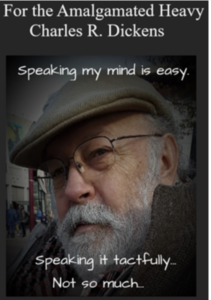 Charles R. Dickens Was Born in 1951, Is a Veteran of the Vietnam War, for Which He Volunteered, and the Great-Great Grandson of the Noted Author, Whose Name He Shares.
He Is a Fiercely Proud American, Who Still Believes This Is the Greatest Country on the Planet, With Which We’ve Lost Control and Certainly Our Direction. He Grew Up in Moderate Financial Surrounding; We’re Not Rich by Any Stretch, but Didn’t Go Hungry – His Incredibly Hard Working Father Saw to That. As Most From That Era, He Learned About Life From His Father, Whose Story Would Take Too Long to Tell, Other Than to Say That, He Is Also a Fiercely Proud American; A WWII and Korean War, Veteran Marine.
Charlie Was Educated in the Parochial System Which, Demanded That You Actually Learn Something, and Have Capability to Retain It Before You Advance. He Attended Several Universities in Pursuit of a Bachelor’s Degree, and Chased the Goose Further to a Master’s, and Has Retained Some Very Definite Ideas About Education in This Country.
in Addition, Charlie Is a Retired Blues Guitar and Vocalist – a Musician. This Was His Therapy Career. Nothing Brings Him as Much Joy as Playing Music, and He Wishes That He Could Make a Living at It… but Alas… Life Goes on!