
The Blame Game on Steroids…
“As much as I dislike mainstream news, it’s a rich source of topics for my commentaries.”

Liar! Liar! Pants on Fire! – Jan Payne
Honesty isn’t their policy; outrage is. It keeps us coming back for more. We tell them we want it, so that’s what they provide. My recent articles address this directly and in depth. These mainstream media outlets tell us who’s to blame, but it’s never us. It’s always something or someone else, rarely the individual, unless that’s their point.
The first story I encountered this morning was a comment by Sean Hannity… “What on earth is happening on our college campuses to our children?”
I began to see that statement not as a question but as an indictment. Then I realized that Sean’s superficial blame of the American collegiate system wasn’t entirely rhetorical and that it exposed the bias we’ve all accepted. The media systems we embrace train us to see the tool or the system as the source of fault rather than those in charge; we blame the tool, not those wielding it.
Artificial Intelligence will take over the world and kill all humans.
Not-so-social media platform content is nothing but lies and deception!
Oil prices are out of control, just like everything else that’s wrong in the world… It’s all Trump’s fault!
Congressional hearings are a joke… Nothing but angry grandstanding and accusations hurled across the room. Partisan bickering and character attacks. Representatives posturing for viral clips to prove their worth in the mainstream media, pandering for clicks on ‘not-so-social’ media feeds.
– I happen to agree with this one…
Seriously?
– Why is there a credibility gap in the United States?
– Why is half the country for it and the other half against it?
– Why is one part of the country suffering while the other is thriving?
– Why are the people with money against those who need it?
– Why is half of the government trying to crush the other half?
– Why are we in perpetual wars?
Do you even recognize it, or is it so familiar that you just accept this as the status quo?
Familiarity breeds contempt, ‘and children’, according to Mark Twain; but in this article, familiarity breeds scapegoating and collective amnesia. We comfortably forget that we built the very tools we blame.
We’ve taken polar opposites: “Good” and “Bad,” and made them support each other. Think about how we use not-so-social media as a yardstick for our lives and our country. All the worst events are amplified on ‘not-so-social’ media feeds, and the number of clicks, views, and comments tells us how important, popular, or significant they are in our lives.
We’ve handed control to someone who doesn’t even know us. We’re letting others define our value and how we should interpret the events around us. The really scary part is that a computer program scores the responses and rewards the winner. We’re no longer sure where right ends and wrong begins. That simple demarcation is blurred by a computer program called Artificial Intelligence.
What is the common denominator – what is the one thing all of these things have in common?
I’ll give you a moment to consider your response…
It’s us… You and I are the common denominator in all of this. Yes, I know you’re tired of being blamed for the world’s problems, especially those in America, but as they say… “If the shoe fits…”
So, you see, AI won’t kill us directly. It’s simply doing what we tell it to do – it’s doing our bidding… It feeds us what we want to hear, tallies the responses, reports the winner, then leaves the killing to us. Then we blame the tool – AI – for doing exactly what we told it to do…
Responsibility lies entirely with the human operator, as tools fundamentally lack agency, moral consciousness, and the capacity for intent. A tool cannot use itself because it cannot choose a goal. Yet we regularly blame the tool for how we choose to use it. Blaming the tool is our default response to failure.
This is most prevalent in our tech-oriented society because the tools are so complex and nearly autonomous. Human-technology interaction studies show that people are eager to assign blame to machines. When an automated or robotic system causes an error, humans assign blame to the system at a level roughly equal to, and sometimes higher than, the human operator, simply because the machine exhibits “autonomy.”
Humans are subconsciously hardwired to push accountability onto their tools. The sheer frequency of tool-blaming isn’t proof that the tools are at fault; rather, it is proof of how desperate the human ego is to deflect responsibility.
The classic English proverb says: “A bad workman always blames his tools.” It means that someone who lacks skill or makes a mistake will point to the equipment they used rather than taking responsibility for their own incompetence or lack of preparation. Consideration of the consequences is actually the emotional and ethical engine that drives this blame in the first place.
This brings me to the view that the consequences are the very definition of responsibility.
The common denominator – the one thing that all of these crises share – is the deliberate erasure of human agency, that is, ‘the inner power and control we have to make conscious choices’ – responsibility.
In each of these examples, we have collectively agreed to treat the mechanism as the monster, so the people running it never have to look in the mirror. We scream about the toxicity of the digital algorithm or the rot at the root of the academic institution, as if these systems sprouted from the dirt with a malicious will of their own. But a platform doesn’t lie; humans write the deception. An algorithm doesn’t hate; humans click the venom and feed the beast.
The Rot is the visible decay. It is the chaos on college campuses, the vitriol spilling from our “not-so-social” media feeds, the weaponization of hatred for popularity, and the erosion of moral standards in our public schools. The Rot is loud, shocking, and highly profitable for mainstream media commentators to broadcast. It is the breakdown of a society that has lost its ethical anchor.
Because the Rot is so ugly, our immediate psychological reflex is to point at it and look for someone to blame. We blame the algorithm, the university system, or the administrative bureaucracy. We treat the Rot as an airborne disease that has spontaneously infected our institutions.
The Root is entirely human. The Root – the burden – is the specific, compounding decisions made by human beings to strip the classroom of objective truth and character development. It is the choice of administrators to hide behind policies, the choice of politicians to prioritize viral grandstanding over governance, and the passive silence of communities that allowed their educational tools to be hollowed out.
Most importantly, the Root is our refusal to accept personal responsibility. The system cannot have a Root of its own because it lacks a soul, a conscience, and agency. The Root of the entire crisis is the human hand pulling the lever.

How Far Will Sean Hannity Go? – The New York Times
When Sean Hannity looks at our colleges and asks what is happening to our children, he is looking at a broken mirror and blaming the glass. The American collegiate system is a tool, an engine built to process whatever values we pour into it. If it is now producing a generation that feels unanchored, hostile, or morally confused, it isn’t because the machine magically corrupted itself. It is because the human architects, the administrators, the hands-off parents, and the cultural gatekeepers actively chose to strip away foundational ethics and traditional moral anchors. They altered the tool’s programming, and now they want to act shocked by what it produces. There’s no ‘Ghost in the machine’; it’s our hubris.
 I really like the phrase “Ghost in the Machine” because it’s the ultimate dodge. The phrase comes from a book written by Gilbert Ryle in 1949, “The Concept of the Mind”, where he describes an immaterial mind or consciousness (the ghost) that exists inside and controls a physical body or system, the machine. Computer scientists and software engineers actively use the “ghost in the machine” metaphor to describe how modern software is built, executed, and understood. The phrase was popularized in the movie “I, Robot” to describe how highly complex, interconnected programming can naturally evolve beyond its original parameters.
“There have always been ghosts in the machine. Random segments of code, that have grouped together to form unexpected protocols. Unanticipated, these free radicals engender questions of free will, creativity, and even the nature of what we might call the soul.” ~ Dr. Alfred Lanning from the movie “I, Robot”.
We love the narrative of the runaway machine because it offers us an easy out. If “the system” is a mindless monster running amok, none of us are individually guilty. We can just throw our hands up, pander for clicks, and watch the collapse unfold on our phones.
But a tool cannot choose a destination, nor can it care about the wreckage it leaves behind. By pretending the tool is the monster, we aren’t just deflecting blame – we are willfully surrendering our humanity to it.
This moral vacuum doesn’t suddenly appear on a college campus the day a student turns eighteen. It is a slow, methodical cultivation that spans the entire educational system. The universities are simply harvesting the crop that was planted, watered, and tended throughout the K through 12 pipeline.
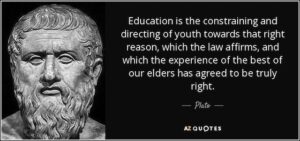 For decades, we have watched the entire public education system steadily drift away from teaching core moral values, objective truth, and foundational character development. Instead, the system was quietly retrofitted to prioritize technocratic utility, standardized benchmarks, and modern ideological trends. We replaced the hard, human work of teaching virtue with the mechanized efficiency of administrative metrics.
And when the predictable fallout of an ethically unanchored youth culture lands on our doorstep, the “blame the tool” game goes into overdrive.
School boards blame insufficient funding. Administrators cite state mandates or federal guidelines. Teachers criticize rigid standardized testing. The message is always the same: “Our hands are tied by the system.” They treat the educational infrastructure as an automated assembly line that no single human can shut down or alter.
This is a convenient lie. A curriculum does not write itself. A standardized test does not print itself. A school board policy does not become law on its own. These are inanimate tools built by specific human beings who make conscious choices. Every time an administrator chooses political convenience over objective truth, or a community passively stays silent as foundational ethics are stripped from the classroom, a human hand is on the lever.
By pretending the entire educational system is a runaway train beyond our control, we grant ourselves a comfortable, cowardly exemption from accountability. We act as if our children are being corrupted by a ghost in the machine rather than by the very tools we built, paid for, and voluntarily handed to them.
I know you’re wondering where I’m going with this. It circles back to my initial point that we — human beings — created all of these things. They are nothing without us. We made them, gave them the power to do work for us, and then blame them for doing exactly what we designed them to do.
We affect and impact everything we encounter. Even our surroundings react to us. There is no doubt that our presence on this planet caused it to change to accommodate us, yet we blame it for changing, then manipulate that for our profit. How insidious, how Machiavellian is that?
How many species have disappeared during our negligence and through our neglect, not to mention carelessness? And we blame the tools we created for doing their jobs.

FRANKENSTEIN, or the Modern Prometheus, by Mary Shelley – gothic horror fiction
Mary Shelley wrote a book titled “Frankenstein; or The Modern Prometheus” in 1818. For those who wonder how Prometheus figures into this… Prometheus stole fire from the gods to give it to mortals, allowing human civilization to advance. The stories follow a parallel track — ‘look what man has done with knowledge’.
There’s the theme for this article. The Prometheus story is 2,700 years old; Frankenstein is over 200 years old, and both share the same basic message. In fact, there are dozens, if not hundreds, of stories sharing the same basic message; all absolute proof that we do not learn from history.
Psychologists, historians, and sociologists suggest we don’t learn from history or these stories because human beings are hardwired to prioritize immediate, personal rewards over abstract, historical warnings. I’ll follow my own thread here… Are we really hardwired, or are we scapegoating our inventions — psychology, sociology, and history — to excuse our failures?
I’ll let you think about that and decide for yourselves. I have my opinion… If you’ve been paying attention to this piece, you can guess what that is.
The fields of study I mentioned above are only a couple of our creations, invented to excuse our behavior by turning explanations into justifications.
In philosophy, this trap is known as determinism or the “evolutionary cop-out.” By saying “my brain chemistry made me do it” or “it’s just human nature,” we treat ourselves like helpless passengers in our own bodies. We use the very sciences meant to enlighten us as a shield against personal and collective responsibility.
Psychology and sociology are meant to act as a diagnosis, not an excuse.
The Diagnosis: If a doctor tells you that you have a genetic predisposition to heart disease, they aren’t giving you permission to eat junk food every day. They are giving you a warning so you can change your lifestyle.
The Excuse: When we say, “Humans are hardwired to chase immediate rewards, so of course we can’t stop climate change,” we misrepresent the science. The science explains why it’s hard, not that it’s impossible.
Blaming our evolutionary hardwiring feels comforting because it relieves us of guilt and responsibility. If our failure to learn from history is just a software glitch from the Stone Age, no single politician, CEO, or consumer is truly at fault. It lets us keep chasing the “fire” (wealth, convenience, power) while shrugging off the fallout.
It helps to remember that psychology, evolutionary biology, and sociology aren’t “inventions” we conjured out of nowhere to assuage our guilt. According to their scientific community, they are discoveries of real, measurable patterns in human nature. These are the people who created these crutches in the first place; what else would we expect them to say?
Remember the vehement reactions from the climate alarmists when we challenged their assertions about bovine flatulence (cow farts)? And how the entire East Coast would be underwater by the new millennium? That the polar ice caps would melt and polar bears would wander through New York City? Well, they were right about that last one.
Knowing why we are broken is the first step toward fixing it. If we use that knowledge only to say, “Oh well, that’s just how we are,” we are choosing to ignore the lesson. We’ve turned self-awareness into an escape hatch from accountability. When we label a toxic behavior as a “cognitive bias,” an “evolutionary mismatch,” or a “psychological coping mechanism,” we strip away the moral weight of the action. It becomes an involuntary reflex rather than a conscious choice.
Fields like psychology examine human behavior in the aggregate – how a crowd or a statistic moves. But history is made by individuals who make specific, conscious decisions.

Robert Oppenheimer
Oppenheimer knew exactly what the atomic bomb would do before he built it.
CEOs look at climate data and still choose next quarter’s profits.
Politicians see the cyclical collapse of empires, yet still pass unsustainable laws to win the next election.
Calling this “hardwiring” insults human intelligence. It is a calculated trade-off: temporary personal gain over long-term collective survival.
We know how to overcome it when we want to. Humans possess an incredible capacity for discipline, long-term planning, and self-restraint when the stakes matter to them. We build complex financial portfolios for retirement decades away. We spend years training for sports or studying for degrees. This proves our brains are fully capable of overriding “instant gratification.” When we fail to do so on a societal scale, it isn’t because we can’t – it’s because we choose not to care enough about the consequences.
Saying “it’s just human nature to destroy ourselves” is the ultimate intellectual surrender — a cop–out. It lets us feel deeply philosophical and sad about the state of the world while letting ourselves off the hook. If the catastrophic ending is preprogrammed into our DNA, we don’t have to do the hard, uncomfortable work of changing our political systems, economic models, or personal lifestyles.
My takeaway from this is that we create what we need to avoid responsibility. We invent the scientific-sounding excuses to make it permissible.
I’m describing the ultimate culmination of “Osmotainment” – the combination of osmosis and infotainment, the indoctrination that occurs while we’re entertained, and the institutional shift from logic to feelings – a world where the continuous flood of information doesn’t make us wiser but instead hands us highly sophisticated, prepackaged narratives that validate our existing biases.
By teaching people to accept these clinical, scientific-sounding excuses from early childhood, our institutions have successfully commercialized accountability, driving it out of the human experience. We have built an ecosystem that actively trains individuals to seek only the data, psychological diagnoses, or social media echo chambers that align with their internal programming.
It is time to stop screaming at the glass, step out of the echo chambers, and finally reclaim the human agency we so desperately seek. We will always fail to fix the world if we continue to blame the pencil for the mistake and the spoon for obesity. The tool is blameless; the lever is in your hand!
We continue to blame the tool for our failures and faults because it’s easier than fixing the problem. We’re lazy… extremely lazy. We have tools and machines that do nearly everything for us, and we’re inventing more. There’s a race to put a robot in every home. Why?
I’ll ask again: why?
We see this same delusion playing out on our latest technological frontiers. We claim we want humanoid robots to liberate humanity from toil, yet at a price tag of $30,000, these machines are nothing more than exclusive status symbols for the top 5% of earners. The lower 50% – the people actually drowning in manual labor and genuine workloads – are completely locked out. We treat the robot as a grand savior from human exhaustion, while completely ignoring the economic reality of the world we’ve built.
We have collectively agreed to treat the mechanism as the monster or the gadget as the savior, so we never have to look in the mirror. We scream about the toxicity of the digital algorithm, the rot at the root of the academic institution, and the threat posed by Artificial Intelligence, as if these systems sprouted from the dirt with a malicious will of their own.

Algore Rhythm
But a platform doesn’t lie; humans write the deception. An algorithm doesn’t hate; humans click the venom and feed the beast. If the mirror is broken, it is because we broke it.
Here we are, creating more excuses and scapegoats to mask our inability to confront mistakes and bad choices. We don’t need better pencils or fancier spoons; we need to stop blaming the world we made for ourselves for our failures as human beings. Knowing why we are broken should be the first step toward fixing it. If we use our advanced intellectual tools only to say, “Oh well, that’s just how we are hardwired,” we are choosing to ignore the lesson. We are turning self-awareness into an escape hatch from accountability. When we label a toxic behavior as a “cognitive bias” or an “evolutionary mismatch,” we strip away the moral weight of the action. It becomes an involuntary reflex rather than a conscious choice.
It is time to stop screaming at the glass, step out of the echo chambers, and finally reclaim the human agency we so desperately try to escape. The tool is entirely blameless; the lever is in your hand.
And if Artificial Intelligence does ‘kill all humans’, it’s doing so because we told it to.
For the Amalgamated Heavy
‘The devil you say…‘

September 21 2026
~ the Author ~
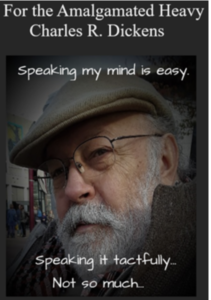 Charles R. Dickens Was Born in 1951, Is a Veteran of the Vietnam War, for Which He Volunteered, and the Great-Great Grandson of the Noted Author, Whose Name He Shares.
He Is a Fiercely Proud American, Who Still Believes This Is the Greatest Country on the Planet, With Which We’ve Lost Control and Certainly Our Direction. He Grew Up in Moderate Financial Surrounding; We’re Not Rich by Any Stretch, but Didn’t Go Hungry – His Incredibly Hard Working Father Saw to That. As Most From That Era, He Learned About Life From His Father, Whose Story Would Take Too Long to Tell, Other Than to Say That, He Is Also a Fiercely Proud American; A WWII and Korean War, Veteran Marine.
Charlie Was Educated in the Parochial System Which, Demanded That You Actually Learn Something, and Have Capability to Retain It Before You Advance. He Attended Several Universities in Pursuit of a Bachelor’s Degree, and Chased the Goose Further to a Master’s, and Has Retained Some Very Definite Ideas About Education in This Country.
in Addition, Charlie Is a Retired Blues Guitar and Vocalist – a Musician. This Was His Therapy Career. Nothing Brings Him as Much Joy as Playing Music, and He Wishes That He Could Make a Living at It… but Alas… Life Goes on!