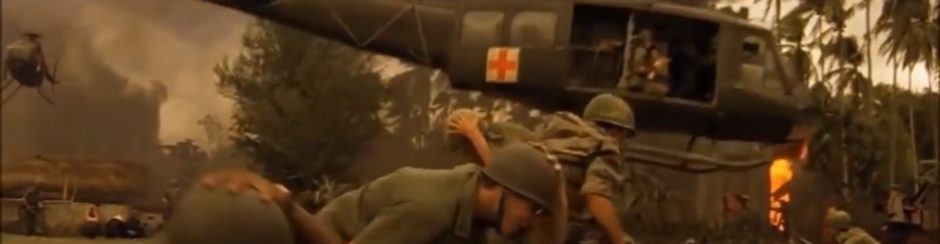
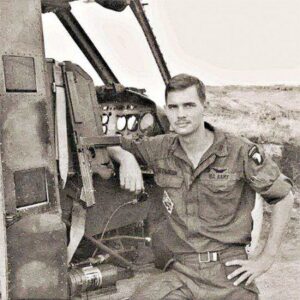
 “You always take care of your men before you take care of yourself.” Fred Behrens lived this truth on every mission he flew until his luck ran out on April 23, 1971.
“When I was serving in Viet Nam, helicopter pilots were our lifeline. They brought food, supplies, and came to pick us up to take us to the rear, where we could get a break. Normally, we were 21 days out (in the bush) and then three days at a firebase to get a shower and a little rest. When we got into a conflict, they also came to help. So these guys, the copter pilots, were our heroes.
“On April 15, 1971, I saw what a hero really was … Fred Behrens. Fred’s main goal was to save lives, and that was what he did. When he risked his own life to save Jim Zwit and others that night, under intense enemy fire and the worst flying conditions, he proved himself a hero. Fred has touched people all over this nation by doing what he did, being a Dustoff pilot. Fred will be rewarded in Heaven for the lives he saved. I love him like a brother. Thank you, Fred.” — John Payne, Infantryman E-4, second platoon, Delta Co., 2nd Btn., 501st Infantry Regiment of the 101st Airborne Division.
DUSTOFF: A military term for the emergency evacuation of casualties from a combat zone. — Wikipedia
Fred Behrens was born into a military family in 1947. His father was a career serviceman, first in the Army, then in the Air Force, so they moved often during Fred’s childhood, all over the United States and to bases overseas. Fred finished high school in Newark, N.J., in 1966, then attended community college for a couple of years. Not being satisfied with the student life, he left college in 1968 and in April 1969 he entered service with the U.S. Army.
His basic training as an infantryman was at Ft. Polk, Louisiana. After basic, he transferred to Fort Wolters, Texas, where he trained at the Army Aviation Flight School. From there he was sent to Ft. Rucker for advanced flight training, graduating in May of 1970. At Ft. Rucker he learned to fly helicopters — the famous Bell UH-1 (Huey), the workhorse aircraft of the Viet Nam conflict, as well as the Hughes OH-6 Scout helicopter, a much smaller and more versatile aircraft than the Huey.
This schooling earned Behrens the rank of Warrant Officer — “neither fish nor fowl,” as he described that title, Warrant Officers being neither enlisted men nor commissioned officers. After a year of service, they were eligible to become Chief Warrant Officers (CWO). They typically had one specific job: WO Fred Behren’s job was flying helicopters.
According to the Viet Nam Helicopter Pilots Association, nearly 12,000 helicopters of different types were deployed during the course of that conflict. Of those, 5,086 were destroyed, resulting in the deaths of approximately 5,000 pilots and crewmembers. The life expectancy of a helicopter pilot in Viet Nam was between 13 and 30 days.
And so WO Fred Behrens went to war. He arrived in Viet Nam on June 6, 1970 and was sent to the 101st Airborne Division stationed in the Demilitarized Zone (DMZ). There he was assigned to Company B of the 101st Assault Helicopter Battallion. He spent the next five months flying mostly Hueys, ferrying troops to remote landing zones (LZs), flying resupply missions, picking up troops when their missions were completed, “taking care of the troops,” as he put it. He flew every day — and often at night — whatever was required.
In September of 1970, he transferred to a Scout helicopter unit, flying the smaller UH-6, commonly called the “Loach,” on “hunter-killer” team missions, in which the Loach flew “low and slow” and a Cobra gunship flew at a much higher altitude, following the Loach. The Cobras were basically flying weapons platforms, carrying multiple rockets as well as mini-guns, machine guns capable of firing six to nine thousand rounds per minute. They were scouting for signs of enemy ambushes, movements or encampments. When contact was made, the Loach would pull up fast and the Cobra would dive down and wreak havoc on the enemy. This was dangerous work, especially for the Loach pilot and his crew — which typically consisted of one man armed with an M-60 machine gun.
 In November of 1970, WO Behrens transferred to the Eagle Dustoff medivac unit of the 101st, part of the 85th Evac., located at Phu Bai. A hospital had been set up there, where the wounded were brought after being taken off the battlefield. Flying Dustoff was a daily job, even though the pilots were supposed to be limited to 120 hours of flight time per 30 days. The thinking was that after 120 hours, the stress became overwhelming, creating the possibility of making mistakes — mistakes that could cost lives.
CWO Behrens stated that he often exceeded the limit — there just weren’t enough pilots to keep up with the calls for Dustoff.
On his first Dustoff mission, he picked up two infantrymen wounded by a land mine and flew them back to Phu Bai. When he later asked the surgeon how they were, he learned that one of them had died. This sent him into a state of depression — he had not imagined at that point that anyone he medivaced would die. He threw it off, however, and never again asked about the wounded, realizing that to know their fate would only make his job more difficult. “After that I simply chose to believe they all survived,” he said.
From Nov. 1970 until April 23, 1971, CWO Behrens flew countless Dustoff missions. “The mission we did, picking up all those gruesomely wounded guys was horrible,” he said. “But we were saving American lives, and we had a really dedicated feeling about it. I had gone through a big transition…I had matured a lot.”
On April 15, 1971 he was sent to pick up wounded at LZ Liz, located in the Song Ve valley southwest of Chu Lai. Three platoons of D Co., 2nd. Btn. of the 501st had been sent to LZ Liz to retrieve the bodies of two American soldiers who had been killed there on April 11. The bodies were lying out in the open. E-4 John Payne expressed concern to his lieutenant that they were surely walking into an ambush, but the lieutenant dismissed that concern and insisted they retrieve the bodies. Starting at Firebase Bastogne, they worked their way through three kilometers of thick jungle until they reached LZ Liz about six in the evening.
E4 John Payne says he knew they were being watched. Second platoon was sent in to get the bodies, with the first and third platoons holding back. When most of the second platoon reached the bodies, the Viet Cong opened up, killing or wounding all but six of the 25 men in the platoon. The remaining six retreated to the treeline and found cover, dug fox holes and fought as best they could from there. At that point, E4 John Payne and the others risked their lives numerous times to retrieve the wounded from the open, dragging them back to cover.
E4 Jim Zwit, who was in the third platoon, ran forward to help. As he was carrying a wounded man to safety, a mortar round landed next to him, killing the man he was carrying and severely wounding Zwit in the chest. In the midst of this chaos, someone dragged Zwit to cover.
By this time, it was completely dark. Several hours later, at about 11 pm., Chief Warrant Officer Behrens flew to the site to pick up Zwit and another severely wounded man. He could not land because of the triple canopy jungle, so he lowered a “jungle penetrator” — a skeletal seat attached to a metal cable. E4 Zwit was put on the penetrator and was being hoisted up when enemy fire on Behrens’ copter became very intense. Small arms fire was striking the copter … “those green tracers looked like basketballs coming at us,” he recalled later. When a rocket-propelled grenade bounced off the copter’s skid and exploded, he had no choice but to fly away with Zwit still dangling by the cable.
Zwit was dragged for a hundred yards or so through the trees, pushing against them as best he could with his feet to avoid being further injured. The Dustoff crew finally managed to get him onboard, and he was taken to the 85th medivac. No one expected him to live, but he survived and spent ten months recovering from his injuries.
The remaining men of the second platoon later recommended that CWO Behrens receive a Silver Star for his actions that night, but he was denied that award because he had not followed the proper protocol for taking the helicopter from the base. He had heard a call for help and put together a crew and just did it on his own. His dedication to his job and to his fellow soldiers was overlooked because of a technicality in the rules. He is not bitter about being denied the medal, however, “I was just doing my job,” he said. Saving the wounded was his focus — medals were not important.
The following day all of D Co. left E4 Payne and the other five survivors of second platoon, to finally get the two bodies off the LZ. They walked the three kilometers back to Firebase Bastogne carrying the bodies.
On April 23, CWO Behrens was sent to Hill 809, a remote LZ at the edge of the A Shau valley, where an intense firefight was taking place. A detachment of Rangers had been ambushed by entrenched troops of he regular North Vietnamese army. One helicopter had already been shot down and when Behrens made an approach to the LZ.
He came under heavy fire from two anti-aircraft guns, but was able to get a wounded Ranger aboard. He returned to the 85th evac. and, after refueling, flew back to pick up more wounded. While taking off from the LZ Behrens was shot through his left ankle. The impact of the bullet forced his knee up with such force that it broke his nose. The copter went into a spin, but he was able to recover and began his ascent when the copter was hit by a rocket-propelled grenade and disabled.
Behrens managed a hard landing. His crew chief was shot and killed. He sent a “Mayday” signal on his radio, but the reply he got was to “E and E” — escape and evade, if possible. He managed to shut down the copter’s engine and got to the edge of the LZ, where he set up a makeshift defensive perimeter. He sent another message with his survival radio, but was told by the Btn. commander, “You’re back in the infantry now, do the best you can.”
With him were a crew chief trainee and a medic who had been on the copter. Snipers zeroed in on them. The next day the trainee was mortally wounded by a Cobra gunship strafing the LZ with its mini-guns, unaware that Americans were hiding there. Behrens was shot three more times during that strafing. He now had five bullet wounds and only 13 cartridges left for his Thompson submachine gun. Later, a sniper killed the medic and wounded Behrens again through his left arm. He managed to locate the sniper and kill him. A group of Rangers tried to come to his aid but were all shot down. Behrens spent that night sitting awake, severely injured, waiting for the NVA to move on him. The next day he managed to move to a bomb crater in the middle of the LZ and hid among three huge logs.
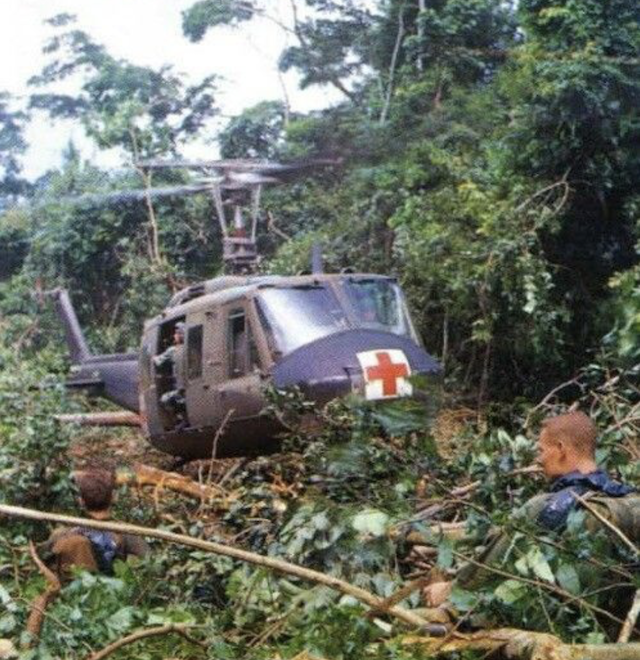 Later that day an American Phantom jet dropped two 250 lb. bombs on the LZ, throwing Behrens into the air and peppering him with shrapnel. They still had no idea he was there. He was miraculously able to signal to a Cobra gunship by waiving his shirt in the air. They saw that he was not the enemy and sent more Rangers in to help him. They gave him water and one of them stayed with him until a Dustoff copter could get there. They shared a can of apricots. There was still intense fighting going on all around them.
Behrens had not bled to death because he was so dehydrated. He said he had accepted by that time that he would probably not live. A Dustoff copter finally arrived and got him on board. They took Behrens to the 85th evac. where he was immediately taken to surgery.
The following day, he woke up in traction. He spent several days in the intensive care unit. Behrens believed that in a couple of weeks, he would be fine and back flying Dustoff. He was instead taken to Da Nang and then on May 1, was flown to an Army hospital on Okinawa, where he stayed until May 20th. During that time he realized, “that last mission, when I got shot down, was the only mission where we talked about premonition … my mother had written me that she had a nightmare that she was never going to see me again … that had never happened before. It was something else.”
After his stay at Okinawa, he was flown to Japan, where he was put on board a C-141 transport that had been reconfigured to carry wounded to hospitals in the U.S. He ended up at St. Albans Navy hospital in New York, where he underwent several more surgeries. He stayed there until Jan. 30, 1972. He was not completely healed, but “they needed the bed.”
After leaving service with 100 percent disability status, he spent nine months with his parents in Edison, N.J., gradually getting well enough to begin attending classes at the local community college. After a couple of years, he moved to Powhatan, Va., near where his roommate from flight school lived. Fred Behrens has lived in Powhatan since then, doing volunteer work with the American Legion, The Veterans of Foreign Wars, and the Disabled American Veterans organization, helping veterans in any way he can. He also volunteers with the Innsbrook After Hours Concerts, a non-profit organization in Richmond that supports many charities.
For his service, Fred received three Distinguished Flying Crosses, one for his actions during a fight at Firebase Ripcord, one for his heroism at the fight at LZ Liz and one for his actions at the fight where he was shot down on April 23rd. This year marks the 50th anniversary of that fateful day. He also received a Purple Heart and was later awarded an honorary Combat Infantryman’s Badge from the Army Rangers, a coveted award signifying active combat engagement with an enemy force. He still has the boots he was wearing when he was shot down.
Fred Behrens is a true hero to anyone who knew him in Viet Nam, especially to the men whose lives he saved. He says he has no regrets. He would do it all over again if he were called to do so.
He said, “We [the Dustoff pilots and crews] tried to do a good job … I believe we did. Life is good.”
This is one man’s story of his time at war. My hope is that readers will learn a little from this about what happened in Viet Nam, not just for Fred Behrens, but for everyone who served there — they all have a story to tell.
Thank you, Fred Behrens, for your service and for your continued efforts to help others. Thanks also to all the brave men and women who were willing to serve our country during the Viet Nam conflict.
Addendum: Jim Zwit passed away March 14, 2021, one month short of the 50th anniversary of his wounding. He is in a better place now.
Written and published on SovaNow ~ May 27, 2021/p>