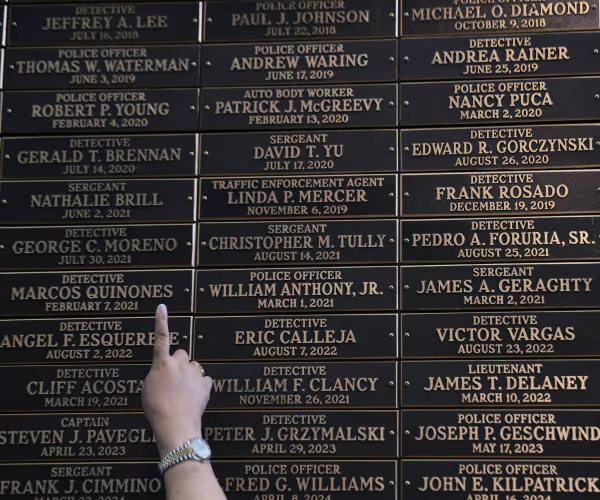
Families of first responders view the new 9/11 Memorial Wall at One Police Plaza on Sept. 9, 2026 in New York City. Family members of first responders, and other NYPD officers was a new wall display was unveiled honoring first responders who lost their lives during the Sept. 11, 2001 World Trade Center terror attacks and since. (Michael M. Santiago/Getty Images)
Twenty-five years later, the central question is not if we remember 9-11.
How could we possibly forget?
The central question is what that memory requires of us.
And if, over the years, do those requirements change.
Sept. 11, 2001 was – and still is – a muti-dimensional tragedy.
The tentacles of this tremendous loss, terrifying disaster, treacherous act of terror, reach across personal, communal, and national lines.
We are required to memorialize 9/11 in all three ways.
And 25 years later, we need to impart that memory to an entire generation, a generation not present to bear witness, to experience the fear and then to grieve.
Never forgetting is not just an expression, it is an imperative.
Memorializing memory requires more than thought and recollection.
In order for it to be consequential, to ensure that the events remain forever fresh, to paint the mental pictures that will allow future generations realize just how inexplicably horrific that day was and the following days and weeks were, we need, first of all, to make it personal.
From there the communal and national will flow.
Our children and grandchildren need to be transported back to that Tuesday.
While they cannot actually experience the horror and the dread, and God willing they never will experience anything at all similar, they need to internalize just how horrified we were.
The lessons of Jewish memory and Jewish remembrance can act as our springboard, helping us pave our way.
In Judaism, national trauma becomes part of interpretive tradition.
Public mourning becomes part of a national ethos allowing for the mourning and memorializing of events that may have taken place thousands of years ago, as if they were happening here and now.
The First Temple was destroyed by the Babylonians in 586 BCE.
The Second Temple was destroyed by Romans in 70 CE.
In Jewish tradition, and even ensconced in Jewish law, those tragic, life altering events are approached as if they occurred only yesterday.
The Israelites departed from Egypt so very, very many generations ago and to this day, every Passover that event is commemorated as if it happened to every single living Jewish person alive today.
It is as if they, not merely their ancient forebears, experienced first slavery and then the transition to freedom.
Memory is not History. We must be careful not to muddle both. History is distant.
Memory isn’t History. We must be careful not to muddle the two. History is distant. Memory is about caring, has passion and urgency. Memory isn’t what happened, it’s what the community believes is important to convey as a result of events. 2977 people were murdered on 9/11.
2977 people were murdered on 9/11.
Each one had a name, a family, a personal story to tell.
Six others were murdered in the same place by the same people, in 1993.
Meaningful rituals like reciting every single name of those who perished is a powerful way of remembering.
Having the names scroll through our tv screens, phones, tablets, and computer screens – for as many hours as it takes, gives a glimpse into the enormity of the tragedy.
It enforces the realization that each name is equivalent to a whole world that was baselessly, viciously, and randomly destroyed.
A name is simultaneously the smallest monument and the greatest rebuke to abstraction.
Cities, towns, schools, and media outlets should all have public memorials. Not just New York City, Washington, and Pennsylvania.
Lighting long-lasting candles, candles that burn and are not blown out for 24, 48, or 36 hours, lit in a ritualized manner accompanied by a moment of silence or a silent prayer is a very powerful act of remembrance.
One of the most significant aspects of Jewish memorializing is that it stringently distinguishes between mourning and vengeance.
Ritualizing memory will ensure that over the years the meaning and significance of 9-11 will continue to resonate in future generations.
Vengeance begets hate and more tragedy.
The fundamental importance of memory and memorializing is the responsibility these simple acts take for the future.
Responsibility means that while, yes, each year there is a day called 9-11, the lessons of that day continue daily and at every moment.
We honor and recognize those who died, remembering why the United States of America was the chosen target.
We remember.
We memorialize.
We preserve the past.
In these ways, we pave the way for the future.
Written by Micah Halpern for NEWSMAX ~ September 9, 2026