
The Faustian Bargain of Modern Attention
The title sounds dramatic, but the invasion was anything but. It came through convenience, safety, and the ordinary little arguments that no sensible person wanted to oppose.
The Bargain Looked Harmless
 At first, the bargain seemed harmless. Who would object to carrying a phone in a pocket? It promised convenience, safety, speed, and connection. We could reach our loved ones anywhere. We’d never miss an important call. In an emergency, help would be only a tap away. It sounded less like technology and more like protection. That was the sales pitch, and most of it was true.
And to be fair, much of the promise was real. A child could call from the roadside. A parent could be reached from the hospital. A traveler could find a route through an unfamiliar city. No reasonable person wants to return to helplessness just for nostalgia’s sake. The problem is that the device did not stay in its lane. It moved from an emergency tool to an everyday companion, from the glove compartment to the kitchen table, from the nightstand to the hand, until the servant began claiming every idle moment.
It slipped into our lives under the most reasonable arguments imaginable. Parents wanted reassurance. Workers wanted efficiency. Friends wanted easier contact. Families wanted to find one another at any hour. None of that sounded sinister. Refusing the device soon began to seem irresponsible, almost antisocial, as if opting out meant making life harder for everyone else. That is how the bargain became so powerful: it did not arrive as a threat. It arrived as common sense, and common sense is much harder to refuse.
But did any of us ask what the real cost would be? Not the monthly bill. Not the price of the device. The real cost was privacy, solitude, peace of mind, attention, and, finally, our presence with one another. The contract was written in tiny print, and by the time we noticed the terms, the bargain had already become commonplace.
That is why the smartphone belongs in the old Faustian category. It offers instant gratification in exchange for something harder to measure and easier to lose. I still think of it as the Portable Altar of Enlightenment, but too often it acts like a vending machine: feed it attention, and it spits out distraction.
Progress Has Never Been a Bargain
Every age believes its inventions are the exception. This time, we say the benefits are obvious, the costs manageable, and the bargain sensible. But progress always brings a bill, and the bill rarely arrives with the first thrill. It comes later, after the wonder has become ordinary and the habit has become hard to break.

…and WE Monkey’s are still on Trial!
Henry Drummond states it plainly in Inherit the Wind: “Progress has never been a bargain. You have to pay for it. Sometimes I think there’s a man who sits behind a counter and says, ‘All right, you can have a telephone, but you lose privacy and the charm of distance. Madam, you may vote, but at a price: you lose the right to retreat behind the powder puff or your petticoat. Mister, you may conquer the air, but the birds will lose their wonder and the clouds will smell of gasoline.’”
Drummond’s examples matter because they do not let progress off the hook. The telephone gives us reach but takes away privacy. Flight gives us mastery of the air but costs us some wonder. Every advance enlarges one part of life while quietly shrinking another. The smartphone belongs in that tradition. It has given us access, speed, reassurance, and information. It has also turned attention into the cheapest currency we spend.
That is what makes this kind of progress hard to judge. Its blessings arrive loudly; its losses arrive quietly. We notice the saved time, the quicker answer, the easier errand, the instant reassurance. We do not notice the habits being rewired. We become less patient with delay, less tolerant of uncertainty, less practiced in waiting, and less willing to let even a small question go unanswered. The machine solves problems, but it also teaches us which discomforts we no longer know how to endure.
The Invasion of the Attention Snatchers
 That line about the telephone feels almost prophetic now, because the old telephone still knew its place. It hung on the wall or sat on a desk, waiting for us. It belonged to a room, a household, a particular interruption. It had limits. Today’s attention snatchers have no such modesty. They follow us. They buzz in our pockets, glow beside our beds, intrude at dinner tables, and interrupt us at stoplights. They don’t merely connect us; they invade us.
The invasion is quiet because it looks like a choice. No army crosses a border. No siren announces the occupation. Instead, the snatchers arrive one notification at a time, slipping into the pauses that once belonged to thought. They wait in the pocket during dinner, glow at the edge of the bed, ride along in the car, and sit faceup on the table like a guest who refuses to leave. Before long, no ordinary moment is left unclaimed. Waiting becomes checking. Rest becomes scrolling. Silence becomes a problem to be solved.
We see them at the red light, where a driver glances down for a second and drifts forward without realizing it. We see them at the dinner table, where a family conversation pauses as someone checks a message that could have waited. We see them in church pews, classrooms, waiting rooms, and checkout lines, glowing in laps like tiny idols. Even children learn the posture early: head bent, thumb moving, face lit from below. The invasion does not always look dramatic. Sometimes it looks like everyone in a room quietly surrendering at once.
They appear in the restaurant booth, where four friends sit together, then disappear into their screens. They appear on the walking trail, where a sunset spreads across the sky as someone photographs it, posts it, checks the reaction, and somehow misses the thing itself. They appear in bedrooms at midnight, turning rest into one last scroll, and in the first gray minutes of morning, when the day has not even begun before the world rushes in. The snatchers do not need to steal whole days at once. They take them by the glance, by the thumb-flick, by the surrendered minute.
But the invasion does not stop with stolen glances and surrendered minutes. Once the device has claimed our private attention, it begins to claim the shared air as well. What began as a quiet theft of the mind becomes, in its next stage, a public performance.
The Public Sermon of the Speakerphone
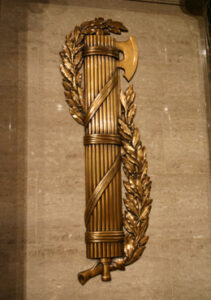
This is one of a pair of bronze fasces appear in the U.S. House of Representatives, flanking the Speaker’s Rostrum. (Office of the Clerk, U.S. House of Representatives)
And then there is the portable speakerphone, that beloved civic punishment masquerading as convenience. Once, if people wanted a private conversation, they had the decency to step aside and lower their voices. Now the conversation is blasted into grocery aisles, doctor’s offices, airport gates, restaurants, and sidewalks as if the rest of us had bought tickets to the performance. I once stood behind a man in a checkout line while his phone, held flat in his palm like an offering plate, announced the results of a family dispute to everyone between the magazines and the chewing gum. No one had asked to attend the meeting, but there we were, unwilling shareholders in the drama. We are conscripted into someone else’s errands, arguments, gossip, and dental appointments, trapped in the acoustic spillover of a stranger’s life. The attention snatcher no longer needs to sit silently in the hand. It has found its loudspeaker, and everyone nearby is expected to endure the sermon.
What makes the speakerphone especially galling is its assumption that public space has no claims of its own. The user treats volume as a personal liberty rather than a social trespass. The rest of us are expected to adapt: to stop reading, stop thinking, stop enjoying our meal, and stop occupying our own small patch of quiet, all because someone has confused hands-free with manners-free. It is no longer conversation. It is noise with an audience.
We have all encountered the traveling evangelist of the loud call: the commuter conducting business from the back of the bus, the shopper comparing prescriptions in aisle seven, the diner narrating dinner plans over a cooling plate, the gym philosopher lecturing between sets, and the airport prophet pacing the gate, broadcasting every delay as if appointed by the airline itself. Each scene is small, almost ordinary, and that is precisely the problem. The rudeness has become so common that we are expected to treat it as weather.
The Price of Constant Interruption
Watching the Monster
The speakerphone is only the loudest symptom of a larger problem. Even when the device falls silent, it keeps tugging at the mind. Drummond warns that when we conquer the air, “the birds will lose their wonder.” We have conquered distance with texts, alerts, and notifications, but in doing so, we have injured wonder itself. Every chime is a tiny claw at the mind. Every red dot demands attention. Every vibration turns an ordinary moment into a command. Deep thought, once protected by silence, is now constantly pecked apart.
The genius of the attention snatcher — the old Text Monster grown more ambitious — is that it makes interruption feel like an obligation. A message arrives, and suddenly we feel summoned. If we don’t answer quickly, guilt begins to build. The device has trained us to confuse availability with love, speed with courtesy, and constant contact with genuine connection. Dr. Pavlov might admire this pack of well-trained creatures, all obediently answering to the ping of these Altars of Enlightenment.
The danger is not merely that we are interrupted, but that we come to expect interruptions. The mind learns to live in fragments. We skim instead of reading, glance instead of observing, and react instead of considering. A quiet morning becomes a series of minor emergencies, each announced by a sound the device has taught us to obey. Over time, concentration begins to feel unnatural, almost suspiciously slow, as if any thought that requires patience must be less important than the next thing flashing on the screen.
The Hidden Fine Print

A fine print depicting the Tree of Cracow, in the gardens of the Palais Royal, circa 1742
This is the hidden fine print of the bargain. We thought we were gaining power: instant reach, instant response, instant knowledge, instant reassurance. But the price was the charm of distance. Distance once gave relationships room to breathe, allowing longing, patience, imagination, anticipation, and privacy. Now, distance has been declared a technical inconvenience, and the solution has become a leash.
Then come the unsolicited texts: campaigns, sellers, scammers, fundraisers, reminders, confirmations, and strangers who somehow got the number we never gave them. They arrive at an alarming rate, making it brutally clear: privacy is no longer the default. Defense is. We did not invite the intrusion, but the work is ours now. Block it. Report it. Opt out. Unsubscribe. Silence unknown senders. Then do it again tomorrow, because the next one will get through.
The Leash We Mistake for Control
 That is how the leash tightens: not with one forceful tug, not through one dramatic surrender, but through thousands of tiny permissions we barely notice granting.
The Text Monster also fosters a false sense of control. We believe we command the device, but more often it commands us. We reach for it in lines, in waiting rooms, in elevators, even in the middle of conversations. It’s a reflex, not a choice. What began as a tool has become a habit.
The result is not merely distraction. It is behavioral conditioning. The chime, the buzz, the badge, the little glowing signal on the screen—each delivers a small jolt of anticipation. Like Pavlov’s bell, it teaches us to respond before we think. The attention snatcher doesn’t have to shout. It only needs to whisper, and we obey.
The Loss of Solitude
 What suffers most is solitude. Creativity, prayer, reflection, and peace all require some measure of silence. Even boredom has its uses. It gives the mind room to wander. But the attention snatcher hates boredom. It rushes in to fill every unoccupied second, keeping us from spending five uninterrupted minutes with our own thoughts.
Solitude is not loneliness. Loneliness is disconnection; solitude is a chosen quiet. It is where memory settles, conscience speaks, and scattered thoughts finally line up. But the Portable Altar offers an escape hatch from every quiet room. The moment silence opens, the hand reaches down, the screen lights up, and we are back on the surface.
Inheriting the Wind
 A house without silence may still look intact from the street, but inside, something is off. A house divided against itself – between the need for quiet and the appetite for interruption – cannot hold together forever. One part of us wants to think, pray, listen, remember, and be left alone for five minutes. The other part keeps answering every ping from the glowing little boss in the hand. That is the real split. Not a scheduling problem. Not a productivity problem. A divided household of attention, where silence is treated as neglect and interruption gets the master bedroom.
That is where Inherit the Wind stops being merely a literary reference and begins to sound like a diagnosis. Lawrence and Lee drew the title from Proverbs 11:29: “He that troubleth his own house shall inherit the wind: and the fool shall be servant to the wise of heart.” We have troubled our own house by inviting restless little masters into every room and then pretending they are servants. The question is no longer whether the phone serves us. It is how often we serve it.
The Loneliness of Connection
And once the house of attention is divided, connection starts to look much cheaper than advertised.
That may be the ugliest trick of all: the Attention Snatchers promise connection while training us for loneliness. A string of emojis cannot replace looking another person in the eye. A flood of messages cannot replace an unhurried conversation. The screen gives us contact, but contact is not communion.
There is real poverty in being always reachable and rarely known. We can keep dozens of conversations alive without ever going deep. We can answer quickly, forward headlines, trade jokes, and acknowledge birthdays with a tap, while still avoiding the harder work of being present. Real connection is not efficient. It demands attention, patience, listening, and the willingness to stay in the room when there is nothing clever to say.
We see it in families texting from separate rooms instead of crossing the hall, in friends keeping streaks alive while the friendship itself goes unattended, in group chats that generate constant noise but little conversation, and in quick “check-ins” that demand no real answer. We collect more little facts about one another and somehow know less. The device keeps the thread moving, but a thread is not a bond.
So the question is unavoidable: after all this contact, speed, and access, what remains when the screen goes dark?
That is why accounting matters. When we finally look up after an hour of scrolling, replying, checking, tapping, refreshing, and answering summons that felt urgent only because they arrived, what have we gained? A few fragments of news. A handful of half-thoughts. A record of interruptions. The stale satisfaction of having kept up with everything and having entered into almost nothing. And what have we lost? The quiet hour. The patient conversation. The private self. The charm of distance. The wonder of the birds. The simple human act of being fully where we are, with the people actually before us.
The Bargain Comes Due
 That is the Devil’s old bargain in a new form, and Faust understood the danger long before a phone ever glowed in a human hand. In Goethe’s Faust, the temptation is not merely pleasure. It is the promise of power, experience, knowledge, and satisfaction without limit. That is what makes the bargain so seductive. We’re offered convenience, and we pay with attention. We’re offered connection, and we pay with presence. We’re offered the world in our hands, and too often the world in front of us disappears. Faust speaks of the divided self when he says, “Two souls live in me, alas / Irreconcilable with one another…” That division is ours as well: one part wants silence, depth, and real communion; the other keeps reaching for the glowing little master that calls us back.
The terrible thing about such bargains is that they rarely feel terrible at first. They feel efficient, modern, and like keeping up. No one announces the moment when a convenience becomes a dependency or a servant becomes a master. The cost arrives quietly, in the hours we no longer notice, the conversations we half-hear, the silence we can no longer bear, and the people beside us who receive only the remainder of our attention.
That is how the bargain comes due: not in a single dramatic bill laid on the table, but in the slow realization that something essential has been spent. We pay in shortened attention spans, diminished patience, and conversations offered only in fragments. We pay when silence begins to feel like deprivation, when waiting feels like punishment, when the people nearest us must compete with a device designed never to stop asking. The debt is not measured in dollars. It is measured in the parts of ourselves we no longer know how to keep.
If we’re not careful, we will faithfully serve the snatchers, feed them our days, obey every summons, and still end up with nothing solid in our hands. We will have traded the real for the instant, the human for the convenient, and the soul for the signal. After all the buzzing, glowing, and texting, we may find that what we have inherited is only the wind.
Perhaps the question is no longer whether we own the device. It is whether we still own ourselves.
And in the End…
 This is the trade: distance for access, silence for signal, patience for speed, presence for the cheap comfort of being reachable. We did not simply lose privacy. We surrendered the room where thought forms, relationships deepen, and a person can be unavailable without being treated as missing.
What comes next is not a collapse. It is corrosion: thinner conversations, shorter attention spans, weaker memory, and people who are easier to contact but harder to reach. Every pause gets filled. Every silence is treated as a defect. Every spare minute gets harvested by a device built to keep asking.
The Attention Snatchers will not leave on their own. They will keep buzzing, glowing, ringing, and insisting that this interruption is the important one. They will keep promising that one more glance costs nothing. That is the lie the entire system depends on.
Stop pretending neutrality is possible. Choose one act of refusal and make it ordinary. Eat one meal without a screen on the table. Take one walk without reporting it to the machine. Let one silence endure without apology. Give one conversation your full attention instead of the leftovers. Put the phone face down. Turn off the summons. Make the device wait. Reclaim one room of the house before the tenant changes the locks.
The old Devil’s bargain did not require smoke, fire, or a signature in blood. It only needed someone willing to believe the price was small: a little convenience, a little speed, a little entertainment, a little glowing world in the hand. That is how the sale works now — one interruption at a time — until the screen owns the minutes, the minutes own the day, and the day is gone.
For the Amalgamated Heavy
‘The devil you say…‘

September 9, 2026
~ the Author ~
 Charles R. Dickens Was Born in 1951, Is a Veteran of the Vietnam War, for Which He Volunteered, and the Great-Great Grandson of the Noted Author, Whose Name He Shares.
He Is a Fiercely Proud American, Who Still Believes This Is the Greatest Country on the Planet, With Which We’ve Lost Control and Certainly Our Direction. He Grew Up in Moderate Financial Surrounding; We’re Not Rich by Any Stretch, but Didn’t Go Hungry – His Incredibly Hard Working Father Saw to That. As Most From That Era, He Learned About Life From His Father, Whose Story Would Take Too Long to Tell, Other Than to Say That, He Is Also a Fiercely Proud American; A WWII and Korean War, Veteran Marine.
Charlie Was Educated in the Parochial System Which, Demanded That You Actually Learn Something, and Have Capability to Retain It Before You Advance. He Attended Several Universities in Pursuit of a Bachelor’s Degree, and Chased the Goose Further to a Master’s, and Has Retained Some Very Definite Ideas About Education in This Country.
in Addition, Charlie Is a Retired Blues Guitar and Vocalist – a Musician. This Was His Therapy Career. Nothing Brings Him as Much Joy as Playing Music, and He Wishes That He Could Make a Living at It… but Alas… Life Goes on!