Those who minimize or dismiss the adverse side effects of America’s “transformation” reveal a failure to regard social and political progress with the seriousness it demands.
 My father worked on the docks of New York City when America’s economy was booming before 1929. As with many Europeans of economically depressed countries at the end of World War I, he left his native country to seek a new life in America, which was calling for the extra muscle needed to build a brand new, modern infrastructure . . . from subways and skyscrapers in New York to infinitely more from coast to coast.
Then came the Great Crash of ’29, stopping the great momentum, dramatically illustrated in 1931 when New York’s fantastic new Empire State Building opened its doors in the middle of the Great Depression.
Pop stopped working at the docks and started shining shoes on the streets, while mom was tested to the top of her capacity raising three kids in their dingy Brooklyn tenement. (I was the latest to arrive in the family.) It was a rough ride that made life all the more valuable for overcoming each obstacle, day-to-day and hand-to-hand.
America was in a storm of productivity, early in the 20th Century, with creative advances in every field. Breathless innovations in technology, industry, transportation, communications, and the arts were remaking the landscape and changing American homes almost overnight from primitive to modern.
The daring, the drive, the originality that delivered a vigorous and vibrant America to the world were still in force following the devastation of World War II. Excellence was still taken for granted in industry, education, sports, in the performing arts. In my Brooklyn high school, over 90% of students graduated regularly, having dealt successfully with far tougher standards than today.
Exceptions kept aside, as with any frank discussion, the following observations are intended to depict typical American life before the middle of the 20th century.
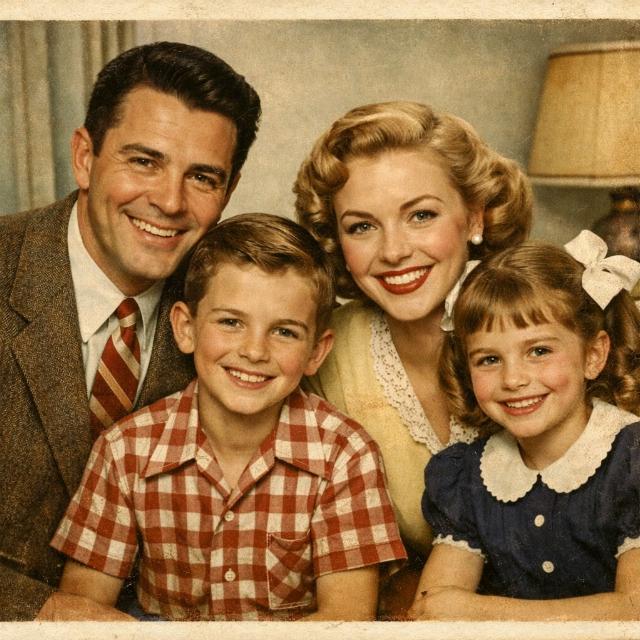
Up until about 1960, children that were not orphans had fathers and mothers living together, secure in bonds of love, and rules inspired by the Word of God. That life is sacred was taken as a fact, not an opinion. Women were respected and cherished by men. No high IQ was needed to understand that a man could not be identical to a woman, and no woman could be identical to a man. Respect was common for each other’s actual differences. Men and women would laugh at the notion that male and female are interchangeable, whether in function or psyche. Such an absurd idea, as held by post-Friedan feminists and today’s gender-confused, reveals a mind tangled in abstractions and lost in wish lists — frequent with liberals.
Reality, not science, informed the actions of the typical pre-1960s American, whether living in Manhattan or the boondocks. He and she knew in the bones that scientific knowledge is not wisdom, that opinion and fact are not equal. The alert of every generation knew — and still know — that emotions do not substitute for thinking. Solutions to real problems, not artificial ones from pressure groups, need clear heads anchored in reality.
It was generally understood that freedom comes with a responsibility to use it wisely and accept the results, good or bad, from their source: me. Any needed guidance in difficult matters came from pastors and rabbis, not (as today) from celebrities, think tanks, and professionals that serve sponsors instead of truth and justice.
The foregoing take on life generated a beneficial social atmosphere — friendlier, warmer, more open than today. Schools were free of drugs and violence, and none of them required armed security guards. In spite of the presence of every form of corruption and deceit known to man, life in America was nevertheless upbeat. People generally succeeded in living their lives as they saw fit, not as agenda peddlers thought they should.
In short, before 1960, America was — it’s been said often — “another planet.” Having lived in that freer, far more open and natural environment, I can report from personal experience as a resident of New York City that after 1960 the level of social wellbeing in that great urban center dropped fast.
The atmosphere all over America soured, as a slew of prescriptions for speech, behavior, even thought — so-called “political correctness” — began to stifle initiative and creativity, while a culture of “victim class” versus “oppressor class” was descending on Americans that did not reflect the American character. That it followed Marxist dogma was not “news fit to print,” and the mainstream media remained dutifully silent.
So, as with the “invasion of the body-snatchers,” Americans found themselves living in a different, rather fretful and contentious country.
The closing of an open mind and the collapse of morals accelerating after mid-twentieth century were not “evolutionary” or inevitable, as imagined or reported. The truth is that America’s decline was in fact anticipated by well-funded change agents infiltrating publication and entertainment media, schools, colleges, churches and seminaries, spreading Marxist tenets through American culture — an amalgam of anti-American beliefs stemming from the Left, which is an appropriate title considering its relation to Marxism, communism, and socialism, none of them democratic. To put it bluntly, leftists are not American.
What possible improvement can a leftist change to America be? Were we no longer American? Did the Constitution cease to be America’s Law of the Land? Were issues of social and political justice to be henceforth decided by vote, judicial decree, or executive signature — as in dictatorships?
Was anything-goes to replace judgment based on moral principle? Was life no longer sacred? Was the family obsolete? When did right become wrong? When did up become down?
When I came home from the war in Korea (1950–53) I found that the cultural atmosphere in America was deteriorating. Americans would soon find themselves facing the deadly rioting of 1960s young rebels obsessed with Marxist doctrine, on a mission to destroy the country we had fought for to protect from communism.
Had Americans forgotten not only about the war in Korea but about the threat to their homeland from domestic enemies as well as foreign enemies?
In mid-century a majority of Americans — especially among the young — had no clue about what happened to their country and to their minds, thanks to the “progressive” dumbing in the public schools after World War II and to well-funded operatives infiltrating media, college administrations, political and public service venues in focused efforts to advance a new world order modeled on collectivism. A “conspiracy theory” smear against those who noticed was effective until the fact was no longer secret but even a feature of President George H. W. Bush’s New World Order Speech of September 11, 1990.
Those who minimize or dismiss the adverse side effects of America’s “transformation” reveal a failure to regard social and political progress with the seriousness it demands. For starters, when it becomes “legal” to kill a baby on the day of its birth, or mutilate one’s body to “change it to the opposite sex,” or it becomes valid to harm a human being for whatever reason — when it becomes “justice” to lose one’s job, reputation, liberty, even one’s life for speaking the truth — then the line of sanity has been crossed.
Stepping away from that dangerous line affirms the inherent smarts of real Americans. It is always appropriate for real Americans to exercise their smarts by loudly denouncing and vigorously opposing activity that threatens human life or attacks motherhood, fatherhood and family, or mocks God and the Creation.
Written by Anthony J. DeBlasi for the American Thinker ~ April 23, 2026
~ the Author ~
Anthony J. DeBlasi is a veteran and lifelong defender of Western culture.
The Frankfurt School Long March. Thankful that I got to see America 1.0 as a Gen Xer.
How freedom minded it was before the 24-7 news cycle.