
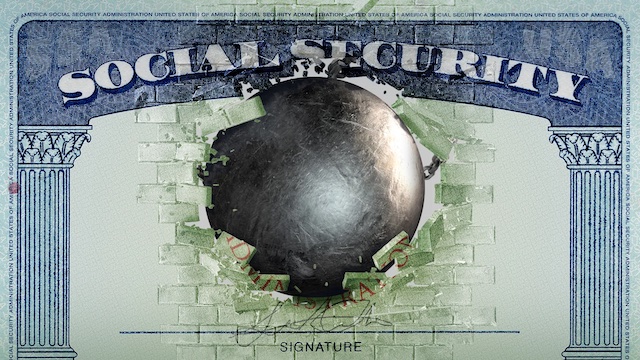
Illustration: Sarah Grillo/Axios
Federal officials are scrambling to contain the fallout from a massive Social Security data exposure that has thrust millions of Americans into the crosshairs of identity thieves. A whistleblower has alleged that more than 300 m Social Security records were placed at risk, potentially affecting virtually every working-age and retired person who depends on federal benefits. The breach is not just a technical failure, it is a direct threat to people’s credit, bank accounts, and long term financial security.
At the center of the storm is the Department of Government Efficiency, or DOGE, which is accused of mishandling sensitive information and quietly moving it to an unsecured environment. As investigators dig into how this happened and who knew what, ordinary Americans are left wondering whether their Social Security Number is already circulating in criminal markets and what, if anything, they can do to protect themselves.
How a government efficiency push became a security nightmare
The core allegation is stark: a federal effort to streamline services appears to have opened the door to one of the largest potential privacy disasters in U.S. history. A Whistleblower complaint describes Social Security data for roughly 300 m people being copied to a cloud server, raising the risk of identity theft and even loss of benefits if records are altered or misused. The complaint ties this exposure directly to the Department of Government Efficiency, which was supposed to modernize systems, not weaken them.
In WASHINGTON, further reporting has detailed how More than 300 m Americans had their Social Security information put at risk when Department of Government Efficiency officials allegedly moved data in ways that bypassed normal safeguards. One account describes how More than 300 m Americans’ Social Security data was swept into this effort, dramatically expanding the blast radius if that information was accessed or copied by unauthorized parties. For a program that underpins retirement, disability, and survivor benefits, the idea that its core identity records were treated so casually is staggering.
What investigators now admit about DOGE’s access
As the controversy has grown, federal agencies have been forced to acknowledge details they initially played down. In WASHINGTON, a Department of Government Efficiency employee is now accused in a Justice Department filing of sharing Social Security data to an unauthorized server without the knowledge of agency leaders, a move that allegedly occurred about a year before it came to light. That filing describes how the Department of Government employee moved personal data outside official systems, raising questions about internal controls and auditing.
Officials have also now conceded that DOGE accessed private data inside Social Security systems, after earlier denials that any sensitive information had been touched. In Jan, federal representatives finally acknowledged that DOGE had in fact reached into Social Security databases, while the public was urged, Please, to wait for a full accounting of what information was raided and how far it spread. That admission, reflected in detailed coverage of the Jan reversal, has only deepened public mistrust, because it suggests that the initial narrative significantly understated the scope of DOGE’s access.
The staggering scale: 300 m Social Security records in play
What sets this incident apart is not just that Social Security data was mishandled, but the sheer number of people whose information may now be vulnerable. In Aug, one televised report warned that 300 m Americans could face a new and very real threat of identity theft because their Social Security records were placed at risk. The segment described how 300 m Americans might now have to assume that their names, numbers, and benefit histories are exposed, a scale that would rival or exceed the largest private sector breaches on record.
Another Aug broadcast focused specifically on American Social Security information, again citing a figure of 300 m records that may have been swept into DOGE’s orbit. That coverage highlighted a whistleblower claim that the Department of Gove had access to this trove, potentially without adequate encryption or monitoring, and warned that criminals could use it to open fraudulent credit lines, redirect benefits, or impersonate retirees. The repeated 300 m estimate in that American Social Security report underscores how systemic the risk is: this is not a niche subset of users, it is essentially the entire Social Security universe.
What I would do now if I feared my SSN was exposed
Faced with a breach of this magnitude, I would start from the assumption that my Social Security Number is no longer secret and act accordingly. The federal government maintains a dedicated portal where victims can report identity theft, generate recovery plans, and get pre filled letters for creditors and police; I would go straight to IdentityTheft.gov to document any suspicious activity and lock in a paper trail. From there, I would immediately place fraud alerts or credit freezes with the major credit bureaus so that new accounts cannot be opened in my name without extra verification.
Next, I would follow detailed guidance on what to do if a Social Security Number is exposed, which emphasizes practical steps like contacting local law enforcement, notifying my bank, and monitoring statements for unauthorized charges. One widely used resource on this topic, focused specifically on a compromised SSN, stresses that it is Important to treat any breach as a serious, ongoing risk rather than a one time scare, and to coordinate with all of the appropriate authorities. That advice, laid out in a step by step guide on What to do when your Social Security Number, or SSN, is exposed, aligns with what security professionals have urged for years.
How and where to report fraud tied to Social Security
If I saw signs that someone was already misusing my identity, I would move quickly to get law enforcement and regulators involved. The Social Security Administration itself instructs people to Report a stolen Social Security number to the Federal Trade Commission if they think they are a victim of identity theft, and to work with SSA on any benefit issues that arise. That official guidance, available through the agency’s own Report page, makes clear that Social Security and the Federal Trade Commission share responsibility for helping victims recover.
The FTC, for its part, encourages people to report anything they think may be a fraud, scam, or bad business practice, even if they are not sure it rises to the level of a crime. Its online system explains that You can file a Report about suspected fraud and then go to IdentityTheft.gov to start a personalized recovery plan, combining documentation and practical next steps in one place. Those instructions are spelled out in the agency’s About section, which walks through what you can report and how the information is used to track patterns of abuse.
Written Nathaniel Cross for the Daily Overview ~ January 25, 2026