
My subtitle is an homage to the movie “A Christmas Story” based on a story by Jean Shepherd to set the tone for my commentary.
We watched this movie last night as part of our ritual viewings of our favorite seasonal movies. It’s based on the humorous writings of author Jean Shepherd; this beloved holiday movie follows the wintry exploits of youngster Ralphie Parker. It opens with a downtown scene about an Indiana town in the 1940s.
– “Downtown Hohman was prepared for its yearly bacchanalia of peace on Earth and goodwill to men.”
“Higbee’s corner window was traditionally a high-water mark of the pre-Christmas season. (The kids crowd around the window, and we soon see inside.) First-nighters, packed earmuff to earmuff, jostled in wonderment before a golden, tinkling display of mechanized, electronic joy.”
Christmas’ meaning has changed drastically over my 74 years, altering my appreciation for this particular holiday as I read and learned to appreciate classic literature and film messages that try to interpret its true meaning. The culmination was my realization of its importance to mankind.
Now, it marks the final push to boost fourth-quarter profits by encouraging more spending. Statistics from 2024 show that we spent $976 billion, with expectations for 2025 to exceed $1 trillion.
I frequently cite statistics for clarity, especially financial numbers because it seems to be our measure of success and failure. The more money one has, the more important and influential they are, and the more they lose – the bigger the failure. This carries over into every facit of life in America. We’re so wealth-aware that it is our yard-stick for everything.
You can make what you will of these numbers. Personally, I see a dramatic uptick in advertising in all media sources starting in November with pre-Christmas merchandizing and continuing through January of the following year with clearance and year-end close-out sales.
The almighty internet is replete with suggestions to contain and limit spending, but most of it will go unattended. The average US personal credit card debt is $5,595, with a total debt of $1.32 trillion. Gen X has the highest per person average of $9,600 and the lowest per person is the ‘silent generation’ (born 1928 to 1945). Baby Boomers – my group (1945-1964) are edged out by the Millennials then by Gen Z. [link] This data indicates a complete lack of financial comprehension, and as it is in law, ignorance is no excuse. We are subject to the law regardless of our understanding or knowledge. Think of this like gravity. You may not understand it, but you never, ever fall up.
I recall the phrase Peace on Earth, Good Will to Men… which comes from Lukes’ account of Jesus’ birth. It begins His saga on Earth, and fulfills God’s promise to send a savior, The Christ.
How many of you remember why we celebrate this particular day?
An Ipsos poll found that 75% of Americans agree that people have forgotten the meaning of Christmas – that includes Christians and non-Christians alike, and according to a 2024 Gallup poll, 235 million of the 340 million, roughly 69%, of Americans claim to be Christian.
Is it a religious or secular holiday?
Can it be both?
The Roman Empire receives credit for the first celebration in 336 AD, during the reign of Constantine, although there is no record of a particular person having done so. The controversy about the Christmas’ inventor continues to two notable authors, Washington Irving, and Charles Dickens. Irving wrote about the typical English Christmas in ‘The Sketchbook of Geoffrey Crayon’, in 1820. Dickens was only eight-years old at the time, yet our recollections of this holiday are based on Dickens novella, ‘Being A Ghost Story of Christmas’ that we know as ‘A Christmas Carol’ 1843.
There is much controversy about the actual day of Jesus’ birth, but that’s not my point. We’ve lost sight of why we celebrate and venerate the day, like every other holiday in our calendar. So, after this excursion through the weeds, I’ll get to my point.
Christmas is a festival season beginning in late October, running through the start of the next calendar year during which we celebrate seasonal changes from autumn to spring; the end of growth – the harvest, through to the renewal of things, spring. Why someone chose December 25th is a contentious topic; and we’re stuck with it. But what we’ve managed to do to it is typically human – American, and like everything we touch, it is corrupted.
Rather than celebrating the transition in the equinox, the changing of the seasons, we turn it into another opportunity to profit from an invented holiday like St Valentine’s Day. Chaucer gets the credit for this one in 1375 with his poem “Parliament of Fowls.” “For this was sent on Saint Valentyn’s day, When every foul cometh there to choose his mate.”
OK… My point is that humans have an amazing propensity for capitalizing and profiting on and from everything and anything.
There’s an old saying that someday they’ll figure out how to tax the air… Well, it’s been proposed many times but fails to pass through Congress, the opposite of progress… Thank God… but it’s still out there.
So, Christmas is a festival of capitalism where your love is judged by the value of the gifts given and received. I want to modify this statement to include all celebrations in America, Christmas is the most blatant, and the next to occur.
Let’s start with ‘Black Friday’ – the day after Thanksgiving Day in America. It is a very popular shopping event that takes place on the Friday following the “Gobble ‘till you Wobble”, marking the official beginning of the Xmas holiday shopping season. Adobe reported that shoppers spent $12.5 million per minute for a record single day total of $14.25 billion online.
Forecasts predict that the US retailers will spend $466.34 billion on advertising for 2025; the global advertising estimate is $843 billion, with an expected sales volume to exceed $1.3 trillion. Not a bad Return on Investment (RoI).
148 million emails were sent for Black Friday, and Cyber Monday this year.
And you thought no one was watching…
Of course, they were watching – this is the most lucrative holiday of the entire retail year. It’s the Festival of Fourth Quarter Earnings…
Just to be sure I’ve covered all aspects of this festival, I asked AI’s opinion.
AI tells me that there are four possibilities based on specific criteria.
1st The Religious Meaning:
For Christians, the core meaning of Christmas is the celebration of the Incarnation – the belief that God became human in the person of Jesus Christ.
– A Gift of Love: It is seen as God’s ultimate act of love for humanity, providing a Savior to reconcile people to Himself.
– Fulfillment of Prophecy: Christians celebrate it as the fulfillment of ancient Old Testament prophecies, such as Isaiah 9:6, which foretold a child who would be called “Mighty God” and “Prince of Peace”.
– Emmanuel: A central theme is the name Emmanuel, meaning “God with us,” signifying that God is present in human struggles.
2nd Cultural & Universal Meaning:
Beyond religious doctrine, the “true meaning” often refers to a shared set of values that promote peace and goodwill.
– Selfless Giving: Influenced by stories like Charles Dickens’ A Christmas Carol, it emphasizes thinking of others and bringing happiness to those around you.
– Generosity to the Poor: It is traditionally a time to be “especially conscious of the poor and less fortunate”.
– Unity and Family: For many, it is a time to pause the busyness of life to appreciate loved ones and celebrate common humanity.
3rd Historical & Etymological Meaning:
– Etymology: The word comes from the Old English Cristes mæsse, meaning “Christ’s Mass”—a liturgical service celebrating the birth of Jesus.
– Origins: While now centered on Christ, the mid-winter date (December 25) was likely chosen in the 4th century to coincide with and replace ancient pagan festivals like Saturnalia (Roman) and Yule (Germanic/Norse), which celebrated the winter solstice and the return of light.
4th Symbolic Meanings of Tradition:
Many modern symbols have been given “true” meanings to align with the holiday’s spiritual roots:
– Christmas Tree: The evergreen symbolizes eternal life in Christ.
– Red Decorations: Often interpreted as representing the blood of Christ shed for humanity.
– Gifts: Remind believers of the gifts from the Magi (Wise Men) and God’s “indescribable gift” to the world.
Charles Dickens’ 1843 novella A Christmas Carol is widely credited with reshaping Christmas into the holiday celebrated today, transforming it from a waning religious observance into a vibrant cultural festival. Often called the “architect of the Christmas spirit,” Dickens popularized several core traditions and shifted the holiday’s social focus. It revived old customs, popularized the imagery, and added Merry Christmas to our lexicon.
The story also emphasized home as a sanctuary, and focused on children.
It institutionalized Charity and Goodwill, and probably the most profound impact was redefining Christmas as a time of humanitarian responsibility. It became the season of giving because it pricked Scrooges’ public conscience, increasing charitable giving shortly after the book’s publication. It promoted the idea that Christmas should be a kind, forgiving, charitable, pleasant time when people see each other as “fellow passengers to the grave” instead of competitors. It also spoke directly to the Social Injustices of child labor and the horror of poverty, framing benevolence toward workers and the poor as core holiday duties.
The rise of consumerism in the 19th and 20th centuries contributed to the monetization of the Christmas holiday when deliberate shift to link gift-giving with the emotional connection and the rise of mass advertising in the 20th century. It has recently evolved purely material accumulation toward digital efficiency, ethical shopping, and “experiential” gifting.
Macy’s created “seasonal shopping” to move stockpiles of merchandise, introduced festive window displays, and the Store Santa to attract families.
Merchandisers rebranded Santa from a stern figure who might punish children to a jolly, benevolent gift-giver and by the 1930’s, Coca-Cola further cemented this commercialized version of Santa in the public’s mind. Giving was framed as proof and a sign of love – emotional marketing – a way of demonstrating affection during the holiday seasons.
This year, over 52% of shoppers used AI assistance to curate gift ideas, compare prices, and manage budgets… This should concern us all, above all of the other invasions of AI. Please recall that AI uses all of the information stored on the internet to make decisions and to present solutions.
That means… that ALL of your financial data is available to AI.
Stop for a moment and let that percolate.
Do you understand the implications and ramifications of this?
Do You???
Here are some AI trends:
– Experiences over objects, is especially prevalent with Millennials and Gen Z who lean toward gifts like travel and wellness retreats instead of physical goods.
– Ethical Consumerism, over 68% of shoppers prefer brands with sustainable guarantees, prioritize carbon-neutral shipping and ethical sourcing over simple price points.
– Social Commerce, impacts Holiday shopping and now involves not-so-social media with Tik-Tok and Instagram as the primary channels of discovery and propaganda.
– Vibe Shoppers are individuals who forego strict lists in favor of buying whatever and whenever inspiration strikes. These are the target market for the hyper-marketers and advertisers and begins as early as August for that particular season.
While I was at it, I asked AI for some alternatives to object oriented excessive Christmas consumerism. AI did not disappoint… There were pages of ideas and alternatives available. Maybe AI’s not such a bad tool after all, but why wouldn’t we think of these alternatives ourselves? Here’s a good place to pause and consider why we lean toward that which we’re told and programmed to consider, instead of personal creativity and insight of friends and family?
I’d like to add one of my all-time favorite gifts; to donate money to charity, in someone else’s name – and send them the receipt.
I see this tendency and trend to look elsewhere for inspiration as proof of our indoctrination to be lazy followers and not active leaders, but that’s another article for another time. It shows is how dependent we’ve become on the tools that were created to ease our burdens, not to take control of our lives. AI is a perfect example of my statement. As soon as it was available, we put it to work replacing all the tasks that helped create it, and as it approaches sentience and improving itself, we realize that we may be too late to stop it. The smart people in the room worry, while all the sheeple fall in line.
I much prefer to view Christmas in the Dickensian sense, possibly because of my heritage and name, but more probably because I believe there is too much evil in the world and all the of the available evidence points directly to the steady decline of American morals and ethics. Everything we see, hear, or read points an accusing finger at someone else to blame them for our decisions and subsequent failures.
I also believe that this decline is self-perpetuating. The more often we shift blame and avoid accepting our own failures and errors, the worse it becomes, and the more responsibility we shirk, the more places and people we find to blame. One of the most popular right now is our president, but that’s nothing new. Leaders have always been targets and the higher up the food chain, the bigger target they become. Even God frequently get’s the blame for catastrophes and our errors in judgement; and He had nothing to do with them.
A simple scan of the mainstream media malarkey that passes for news should serve as a perfect example, yet we pass it off as “someone else’s problem,” never once considering that all we need to do is look in the mirror and see the real culprit. The person looking back is the one at fault. Always… This is a philosophical discussion I’m not going to touch, but when you analyze any issue or failure, you will find personal culpability and responsibility in the equation.
America’s immediate situation stems from our complicit silence and failure to right that which we know to be wrong. A simple smile and a gentle Merry Christmas melts the ice and opens an opportunity for a very pleasant conversation. And if your greeting is met with an icy cold shoulder, you’ve lost nothing and maybe, just maybe, gave the other person something to think about for the future. You have nothing to lose, and everything to gain.
In Dickens novella, the idea was not to create a new holiday, but to expose the issues facing Victorian England.
Where are we today in America?
Aren’t we facing the same situations?
What would you do to change them?
Not everyone can write like Dickens, but the message in this particular story speak to the things needing change and the steps to move it closer to a solution. Maybe they won’t change them permanently, but it’s a start.
What do we have to lose?
Reading literature can open your eyes, and maybe even change the world.
So… what’s it all about Ralphie?
– Is it the festival of fourth quarter earnings?
– A holiday of our love of family and friends?
– Are we thanking God for keeping His promise to send a savior?
– Or maybe it could be, should be a bit of all of them…
Merry Christmas and a Happy New Year
For the Amalgamated Heavy

December 24, 2025
~ the Author ~
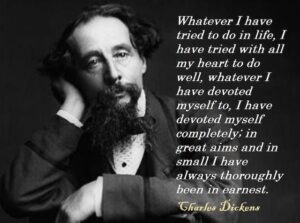 Charles R. Dickens Was Born in 1951, Is a Veteran of the Vietnam War, for Which He Volunteered, and the Great-Great Grandson of the Noted Author, Whose Name He Shares.
He Is a Fiercely Proud American, Who Still Believes This Is the Greatest Country on the Planet, With Which We’ve Lost Control and Certainly Our Direction. He Grew Up in Moderate Financial Surrounding; We’re Not Rich by Any Stretch, but Didn’t Go Hungry – His Incredibly Hard Working Father Saw to That. As Most From That Era, He Learned About Life From His Father, Whose Story Would Take Too Long to Tell, Other Than to Say That, He Is Also a Fiercely Proud American; A WWII and Korean War, Veteran Marine.
Charlie Was Educated in the Parochial System Which, Demanded That You Actually Learn Something, and Have Capability to Retain It Before You Advance. He Attended Several Universities in Pursuit of a Bachelor’s Degree, and Chased the Goose Further to a Master’s, and Has Retained Some Very Definite Ideas About Education in This Country.
in Addition, Charlie Is a Retired Blues Guitar and Vocalist – a Musician. This Was His Therapy Career. Nothing Brings Him as Much Joy as Playing Music, and He Wishes That He Could Make a Living at It… but Alas… Life Goes on!