
We’ve been warned…
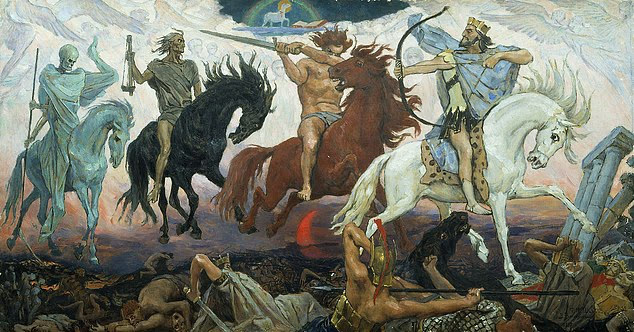
The white horse symbolizes Conquest, the red horse stands for War, the black horse denotes Famine, and the fourth, described in ancient Greek as ‘ashen’ or ‘chloros,’ often interpreted as pale green, represents Death
I’m currently finalizing my book, American Apocalypse: A compilation and synopsis of My Past Observations, and it’s been far more work than I imagined, especially the citations and attributions for the information I used. This part is a monumental pain in the ass, but it’s necessary for accuracy and legal compliance. Lord knows, I have enough problems without goose-stepping into that legal minefield.
I needed a break to refocus on something other than my project. My diversion is a cup of coffee and a foray into the fantastic realm of the Mainstream Media’s Outrage Machine: the Internet News Feeds. It’s difficult to choose from the thousands of infotainment feeds, so I use my favorite aggregator because it offers a variety of options – and I can sort them by topic, genre, and even political bent.
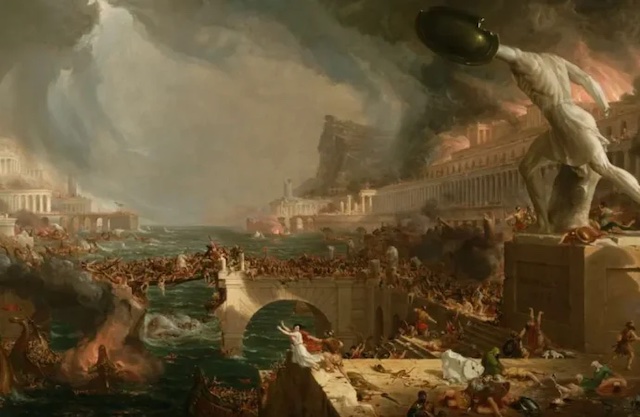
We’re like Nero, fiddling as America burns. A mind-numbing revelation…
I’ll clarify the title — I’m using the word Apocalypse — apokalypsis — in its original Greek sense, not the modern-day fire-from-the-sky catastrophe sense popularized by organized religions and the film industry; the intent is Revelation.

‘‘So I looked, and behold, a pale horse. And the name of him who sat on it was Death . . .’’
The Book of Revelation, also known as the Apocalypse of John, has succumbed to Hollywood and our tendency to sensationalize everything to heighten impact. The Greek word apokalypsis literally means “revelation.” Both titles mean the same thing, just viewed through different linguistic lenses. The biblical book’s purpose is to ‘warn,’ ‘reveal,’ and ‘proclaim’ the ultimate triumph of God and good over evil through Jesus Christ. John the Apostle wrote it between 90 and 95 AD while in exile on the Greek island of Patmos amid intense Roman persecution.
Make of this whatever you will, but the message is a clear warning against neglecting the business at hand. This is the thesis of my book and, incidentally, the theme of this article. I believe America is moving from warnings to results. The relevance to today is simple. As we move through America’s history, we’re presented with two simple choices: heed or ignore. We’re already seeing these results in the mainstream media feeds, and as we choose to ignore them, we will pay the price for our apathy.
We are in the unique position of having near-instantaneous access to the world’s history at our fingertips. We can find almost anything in milliseconds. The only limitation is paywalled, personal, private, unindexed, or non-digital data.
The total amount of digital data in the global datasphere is estimated to reach about 221 zettabytes as the global internet and connected storage systems expand rapidly. To put that scale into perspective: a single zettabyte is 1 billion terabytes (or 1 followed by 21 zeros). Human society now generates more than 400 million terabytes of data every day through video streaming, email, social media, enterprise transactions, Internet of Things (IoT) sensors, and generative AI outputs. That’s roughly 55 trillion HD movies, which would take a human 125 billion years of nonstop watching to get through them all.
Imagine slogging through all of this data just to find a quotation or a date. Thank the inventors of Artificial Intelligence (AI), soon to be called Synthetic Intelligence (SI). The main difference between Artificial Intelligence (AI) and Synthetic Intelligence (SI) is whether a system mimics human behavior or genuinely creates an independent form of cognition. And coming to a Supercomputer Data Center in a neighborhood near you: Artificial Super Intelligence (ASI).
ASI is a ‘hypothetical’ future stage of artificial intelligence in which computer systems vastly surpass the cognitive capabilities, creativity, and problem-solving skills of the best human minds across every domain. Unlike current technologies that handle specific tasks or mimic human speech, an ASI system would possess an independent, superior intellect capable of out-thinking humanity, both collectively and individually. But don’t worry, ASI won’t be here tomorrow; estimates place it in the mid-2030s.
Americans rely on another agent to interpret and present its relevance in carefully crafted, choreographed, captioned compilations for consumption. I’m talking about ‘The American Outrage Industrial Complex and Culture,’ which grooms the data and then delivers it via the mainstream media network, not-so-social media, political campaigns, and algorithms that profit from the anger they cultivate. It has its factions screaming insults and anti-American epithets at every meeting imaginable. This is just one of the obvious signs of our impending demise.
Manufactured outrage is the artificial creation, exaggeration, or engineering of public anger and indignation over an issue – often through emotionally charged language, distorted facts, or media framing – to advance political, social, or financial goals.
Action is replaced by noise: People exhaust their energy reacting to online triggers, mistaking indignation for real civic engagement, leaving structural problems unaddressed.
And this is how we use this incredibly powerful tool. Not for research or edification, but for indoctrination – ‘osmotainment’! See my article [link] on the Federal Observer.
Harry S. Truman said: “There is not really anything new, if you know what has gone before. What is new to people is what they do not know about their history or the history of the world.” (Often shortened to “The only thing new in the world is the history you do not know.”)
George Santayana said, “Those who cannot remember the past are condemned to repeat it.”
This is a personal favorite...
“And he who was seated on the throne said, ‘Behold, I am making all things new. He also said, write this down, for these words are trustworthy and true. He said to me, ‘ It is done! I am the Alpha and the Omega, the beginning and the end. To the thirsty, I will give from the spring of the water of life without payment. The one who conquers will have this heritage, and I will be his God, and he will be my son.” ~ Revelation 21:5–7
Here’s the takeaway and the relevance to today’s America.
Part 1: We’ve been warned throughout history, especially during our brief stint as a republic. America’s 250 years is a long time for a nation. History records that the Roman civilization endured for 2,200 years, but the actual kingdom lasted about 244 years; the Republic about 482 years; and the Empire about 1,480 years. The fall of Rome was not a single event but a multi-century process of institutional decay, economic crises, external pressures, and systemic fractures.
 Even Benjamin Franklin warned that we would have trouble maintaining this republic.
According to the diaries of Maryland delegate James McHenry, as Franklin walked out of the convention, he was approached by Elizabeth Willing Powel, a highly influential Philadelphia socialite, salon host, and political thinker.
Benjamin Franklin’s famous warning, “A republic, if you can keep it…” It captures the profound truth that a democratic republic is not a permanent guarantee; it is a fragile structure that depends entirely on the civic virtue, shared values, and moral responsibility of its citizens.
This echoes James Madison’s warnings in Federalist No. 10, where he cautioned that unchecked factionalism and the prioritization of self-interest over the common good could destroy a republic from within. Ultimately, both Founders emphasized that self-governance is an ongoing, active responsibility rather than a passive inheritance, offering a timeless reminder that when a populace loses its civic trust, the institutions designed to protect liberty will naturally decay.
Part 2: The results are a staggering debt and our inability to decide on an appropriate course of action to repair the damage caused by our negligence. We’re torn between doubt and a desire to make decisions fair for everyone. We’ve spent too much time dividing, categorizing, and cataloging people to accommodate their feelings, losing sight of this country’s actual goal: to establish a self-governing constitutional republic dedicated to protecting inherent, unalienable rights – specifically life, liberty, and the pursuit of happiness – by ensuring that government power derives solely from the consent of the governed. We’ve parsed the consent of the governed into so many constituent parts that consensus is improbable, if not impossible.

‘Modern Politigencia’
We created Congress, the opposite of progress, to manage the process, but it’s no more than a spectacle of bitterness and buffoonery. The 535 voting members are more interested in viral video clips than in the country’s business, spending more time keeping their jobs than doing them. They fiddle while America burns.
I’ve spent considerable time and effort writing about this topic of governance over the past years, with a similar message and warning. This is the revelation – the apocalypse I wanted to share with anyone who’d listen. America faces a crucial decision: not the midterm elections, although they play an important part, but our identity as a nation, a republic, and a country.
One of my epiphanies this morning was the staggering amount of money purloined from our government. A recent Senate hearing cited $1 trillion per year, roughly $115 million per hour.
The specific math ($1 trillion a year / 8,760 hours in a year = ~ $114.15 million per hour) was presented by Haywood Talcove, CEO of LexisNexis Risk Solutions Government. Testifying before the Senate Homeland Security and Governmental Affairs Committee, Talcove asserted that outdated federal security systems allow transnational criminal syndicates to pillage public funds on an industrial scale.
Holy Sheep Shit!
The issue with this number centers on who counts and how the fraud numbers are counted. The conundrum is… what does it matter if this is America’s – OUR – money? Why does it matter who holds the ledger or the calculator? This is the same lame game played throughout our government.
The game is about assigning blame, not fixing the problem. (See my article “Blame the Tool” [link]
According to the testimony and subsequent fraud risk models, the money is not being siphoned by individual “one-off” scammers, but rather by highly organized networks using automated tools.
Instead of fixing the problem, Congress — the opposite of progress — spends its time arguing over which party is responsible. It’s an endemic problem in our government, and the watchdogs slept through the attacks. While individual consumers lose roughly $16 billion directly to scammers, the taxpayer system as a whole is estimated to lose closer to $1 trillion annually, including losses from international fraud rings targeting government infrastructure.
“A fool blames others, a novice blames himself, and a wise man blames no one, but instead fixes the problem.” ~ Epictetus
 I wish Congress, the opposite of progress, would memorize that quote; however, the missing component to effect the necessary change is the humility required to admit their mistakes. How can we justify embracing our enemies in the name of Diversity, Inclusion, and Equity (DIE) and in the pursuit of peace? We even allow them to infiltrate our country, politics, and our neighborhoods. We allow them to impose Sharia Law to contravene our Constitution and our laws. They run for elected office by espousing anti-American ethics and principles. They’ve captured young, impressionable minds through our system of higher learning and now infect the very fabric of American life in the body politic.
Our laissez-faire approach to governance put us in this position. It’s all our fault!
The foundational architects of modern liberalism emerged from the ‘Age of Enlightenment’ (1680 – 1798): Locke and Mill, who revolutionized political thought by arguing that legitimacy derives from the consent of the governed and that individuals possess natural rights. Centuries later, Mill’s ‘On Liberty’ popularized the “harm principle” – the idea that society has no right to interfere with an individual’s actions unless those actions cause direct harm to others. This shifted the cultural default from duty to the community to the autonomy of the self.

John Rawls
John Rawls provided the modern framework for pluralism. He argued for a society designed so that everyone could agree on basic fairness without surrendering their personal convictions about “the good life,” thereby making state and cultural neutrality a core civic virtue.
John Rawls’s high-minded theory of pluralism clashed with the existing traits of the American cultural character; it provided an intellectual shield for a highly destructive shift: it gave citizens philosophical permission to prioritize self-interest and ignore the republic’s collective good.
The failure stems from Rawls’s fundamental miscalculation about human nature and the specific design of the American system: by allowing our physical and social geography to mirror our worst, most selfish impulses, we have broken the mechanism that makes democracy possible: the ability to see a political opponent as a fellow citizen.
The collapse of the procedural republic stems from three fatal miscalculations about human nature and the architecture of American governance.
First, social trust cannot be mandated by law; it is a cultural asset built exclusively through real-world proximity, shared goals, and sacrifice. When citizens were given philosophical permission to opt out of local civic spaces, that foundational trust evaporated.
Second, when individuals, corporations, and wealthy enclaves optimize exclusively for private comfort and treat the republic as a resource to exploit rather than a commonwealth to sustain, they inevitably hollow out public schools, local news, and other shared institutions that hold the nation together.
Finally, because a system built on neutral rules is emotionally sterile – offering no shared story, grand purpose, or deep sense of belonging – citizens starved of genuine community refuse to remain isolated, rational actors and instead surrender to toxic, hyper-partisan tribalism manufactured by demagogues and national media networks.
Americans took this to mean: If I am obeying the letter of the law and paying my taxes, I have fully fulfilled my duty to the nation. It turned citizenship into a transaction. It gave people philosophical permission to ignore their neighbors, withdraw from public life, and do whatever they pleased, as long as it wasn’t technically illegal.
When individuals focus primarily on themselves, a republic’s stability begins to weaken. Citizens who choose emotional detachment through consumerism rather than engaging in local self-governance are neither neutral nor independent. Rather, they become vulnerable to the tribal hostility and manufactured antagonism propagated by national media and political figures. We must remember that a republic relies not only on procedural rules but also on the continuous, deliberate cultivation of civic virtue to uphold its fundamental principles.
Does any of this sound familiar?
The Information Era (1990s–Present) marked the birth of the commercial internet, and the subsequent rise of hyper-personalized mass media dismantled the local “mediating structures” that once filtered information. By placing personal choice at the center of the human experience, modern digital connectivity accelerated cultural deregulation, completing the shift to the hyper-individualized reality of today.
The Counterculture Explosion (1960s–1970s) marked the moment when “liberality” shifted from a political or economic concept to an all-encompassing social lifestyle. Traditional authority figures (the church, the nuclear family, institutional governments) were widely questioned. Movements for civil rights, women’s liberation, and anti-war protests cemented personal expression and autonomy over one’s lifestyle as ultimate values.
The Baby Boomer Generation dropped the ball, enabling all of this to happen. Our idea of peace and love was fine for the free-for-all flock-fest of the 60s, but the consequences of that are what we reap today. The real problem is the liberal emphasis on individual autonomy, cultural pluralism, and the loosening of traditional social and moral constraints – a trend that cannot be attributed to a single person or event. Instead, it is the product of an interlocking web of historical philosophy, economic shifts, and technological advancements that systematically dismantled older, hierarchical social structures.
The boundary line is where individual autonomy crosses into institutional deregulation. What appears to be “doing as we please” often reflects a culture that has systematically reordered its highest moral value, placing personal autonomy above institutional compliance. Sociologists and legal scholars who study this breakdown in rule-following generally categorize this modern phenomenon as three distinct shifts:
The Death of Institutional Deference: Historically, people followed rules not only because of the law but also out of deference to the institutions that made them (churches, governments, universities, professional bodies). Today, that deference has largely evaporated.
Decades of institutional failures, political polarization, and widely publicized corruption scandals have led to a cynical public view we call the Trust Deficit. When people lose faith in an institution’s integrity, they no longer regard its rules as legitimate moral guardrails. Instead, they see rules as arbitrary hurdles to be bypassed whenever they conflict with personal convenience or individual desires.

Charles Taylor
The philosopher Charles Taylor coined the term ‘expressive individualism’ to describe the dominant moral framework of modern life. Under this view, the highest human duty is no longer to fulfill a specific role in a community or to submit to a shared tradition. Instead, the ultimate goal of life is to discover your inner identity and express it authentically to the world. Within this framework, pre-existing social expectations, traditional codes of conduct, and bureaucratic rules are often seen not as protective structures but as oppressive forces that stifle individual freedom and personal happiness.
What I’m describing is the widening gap between what the law says on paper (de jure) and how society actually behaves (de facto). Because modern culture places a high premium on personal liberty, Selective Enforcement mechanisms have largely retreated from regulating private morality, speech, and lifestyle choices. In many modern settings — from corporate environments to public spaces — the culture has shifted toward a risk-management framework rather than one grounded in moral obligation. People weigh the cost of breaking a rule against the benefit of personal independence, treating the rule as a suggestion or a fee rather than a boundary.
This leaves modern society in a fragile paradox: we demand total individual freedom to “do as we please,” yet we still require a baseline set of predictable rules to keep a highly complex, interconnected world from fracturing.
Rebuilding social order when individual independence gives way to institutional disregard requires shifting our focus from enforcing a single moral code to fortifying transparent, predictable procedural fairness across our systems. Because modern pluralistic societies can no longer rely on a unified definition of personal morality, institutions must earn voluntary compliance by demonstrating radical transparency, substantive competency, and equal enforcement of the law, regardless of an individual’s status or political affiliation.
This systemic approach must be supported by a cultural pivot away from hyper-individualism and back toward covenantal responsibility, grounding our daily behavior in local, physical communities rather than in fractured digital landscapes. Ultimately, when citizens recognize that their institutions are competent and fair and actively participate in the tangible civic spaces at their doorstep, they willingly accept the baseline rules necessary to keep a complex republic from fracturing.
This is precisely where we are today. Empirical global research, including the Edelman Trust Barometer, an industry-standard annual global study measuring public trust in four core societal institutions — Government, Business, Media, and Non-Governmental Organizations (NGOs) — confirms that we are in the acute, hyper-mature phase of this social crisis. The transition from a society that values shared communal institutions to one defined by individual isolation and institutional defiance is no longer merely a philosophical theory – it is a measurable reality.
Sociological assessments of the current cultural moment highlight several undeniable indicators:
– The Mass Erosion of Trust: Traditional “truth-keeping” and governing institutions—specifically national governments, mainstream media, and multinational corporations—face chronic public distrust. Public cynicism is not a fringe position; it has become the default structural condition of modern life.
– The Rise of “Insularity”: As institutional trust collapses, people do not stop seeking belonging—they simply narrow their definitions of community. Global data show that a vast majority of the public now hesitate or refuse to trust individuals who do not share their exact values, background, or political leanings.
– Workplace & Civic Dysfunction: This cultural deregulation is directly affecting physical spaces. Professionals are increasingly hostile to collaborating with peers who cross political lines, and many explicitly refuse to follow directives from leaders whose personal ethics conflict with their own.
– The “Me” over “We” Mandate: In commercial marketing, tech algorithms, and social interactions, the paradigm has shifted from building societal consensus to prioritizing personal relevance.
We have reached the logical endpoint of the hyper-individualistic path. Having systematically dismantled the objective, central authorities that once upheld a shared moral code, society now stands deeply fragmented. We live in a landscape of hyper-insulated circles, where rules are treated as optional speed bumps to be avoided rather than as a unifying social fabric.
Revelations like these are the reason I started writing.
What about the industrial-level corruption in America?
We should all recognize that the mainstream media is a real force, since nearly everything we know comes through them. They control the content, context, and cadence. Truth is not part of this calculus; it’s about impact and how it supports the narrative.
I heard California gubernatorial candidate Steve Hilton call it the Corruption Industrial Complex.
Steve Hilton said:
“They get their own people there, you know, their own people, and they put them into the different agencies, what we might think of as the bureaucracy, the administrative state, the deep, all these different terms we’ve got to learn in terms of national politics and Trump and Washington, right? So, it’s the same here. There’s an administrative state, 200-plus agencies, the California Air Resources Board, the Coastal Commission, the State Water Resources Control Board, the Pest Board, the pesticide regulator, endless different groups, the state board of education, etc. Hundreds of these groups. What the environmental groups do is they put their own people inside those agencies. They get them hired, then they sue. They use litigation as a tactic. They sue the agency for being insufficiently environmental, and then their people inside settle in order to advance the goal. That’s a real dynamic that’s going on.”
* Transcript from the Jillian Michaels Podcast 10/02/26
Mr. Hilton’s comments were specific to California, but if it exists in one state, it most certainly exists in others. This is the game used to redistribute our tax money through unnecessary agencies to promote partisan change and industrial-level fraud.
Is it any wonder that we don’t trust anyone?
In the United States, public trust in the federal government is near historic lows, with fewer than 30% of Americans expressing confidence in Washington. However, this distrust is heavily concentrated at the federal level, as Americans maintain significantly higher levels of trust in their local and state governments. People tend to congregate or live in areas that suit their politics. That would explain why people stay in Blue or Red states and migrate between them.
This is fine for the financially mobile; what about those who lack the wherewithal to leave?
Ultimately, when a society stops moving, it stops mixing. The physical isolation of lower-income Americans within their current zip codes accelerates the division of the country into locked-in political fiefdoms. Those with wealth can buy their way into a community that perfectly mirrors their values; those without are left to navigate the escalating polarization of the place they happen to be in.
This entire crisis of fiscal segregation, hyperpartisanship, and institutional collapse represents the direct manifestation of specific historical warnings that America explicitly received—and systematically ignored. By prioritizing short-term financial incentives and partisan optimization over structural stability, the nation allowed abstract warnings to harden into concrete geographic reality.
The Kerner Commission Report (1968) — The Warning of Two Societies:
Commissioned to study civil unrest, the report famously warned that America was moving toward “two societies, one black, one white – separate and unequal.” Although originally focused on race, this structural split has since expanded into a severe system of fiscal segregation, dividing the country into wealthy, urban/coastal professional hubs and economically locked-in rural/rust-belt communities — 61 years ago.
Dwight D. Eisenhower’s Farewell Address (1961) — The Capture of Public Policy:
Eisenhower warned of the “military-industrial complex” and the danger that public policy could become captive to a scientific-technological elite or concentrated financial power. Today, this capture is evident in the sweeping influence of private equity firms and special interest groups over essential civic infrastructure, such as healthcare, local economies, and housing, fueling the widespread public belief that the government serves capital rather than citizens – 65 years ago.
George Washington’s Farewell Address (1796) — The Danger of Factional Overreach:
Washington warned that the rise of political parties would inevitably lead to a “frightful despotism,” in which political figures would prioritize party power over the common good and deliberately divide the public to maintain control. Today, this manifests as manufactured malice and an architecture of animosity, in which media institutions and politicians use affective polarization as a business model to secure viewership and donors — a pattern that began 230 years ago.
There doesn’t seem to be an easy fix; I suppose that’s intentional. Why would the people who benefit from corruption allow it to be erased or eradicated? All of the possible solutions I can find require Constitutional-level interaction or conventions. Since Congress — ‘the opposite of progress’— is the culprit and in charge of any action referencing the Constitution, we’re screwed. There are too few representatives working for the republic, and too many working for themselves; they will never right the wrongs that make them millions and keep them in office.
I submit that the system is irreparably broken, yet we watch from our Barcaloungers and Lazy Boy recliners as the cavalcade plays on in high definition on our 70” flat-screen TVs and smartphones – the portable altars of enlightenment. We revel in the outrage and absorb the ads that promise an extra-large free helping of diversion from the drudgery of daily life.
We believe every last word, and when the chime sounds, we salivate like Pavlov’s dogs at the next feeding.
The indoctrination is complete.
Our only hope is a quiet revolution by citizens to insist on change. But that will never happen. Will it?
Still…
It’s OUR country – OUR Republic – and Congress, ‘the opposite of progress,’ works for us…
At least, that’s how it was originally designed, meant to be.
Seneca wrote in his Moral Letters to Lucilius: “Very often the things that cost nothing cost us the most heavily“.
For the Amalgamated Heavy
‘The devil you say…‘

October 19, 2026
~ the Author ~
 Charles R. Dickens Was Born in 1951, Is a Veteran of the Vietnam War, for Which He Volunteered, and the Great-Great Grandson of the Noted Author, Whose Name He Shares.
He Is a Fiercely Proud American, Who Still Believes This Is the Greatest Country on the Planet, With Which We’ve Lost Control and Certainly Our Direction. He Grew Up in Moderate Financial Surrounding; We’re Not Rich by Any Stretch, but Didn’t Go Hungry – His Incredibly Hard Working Father Saw to That. As Most From That Era, He Learned About Life From His Father, Whose Story Would Take Too Long to Tell, Other Than to Say That, He Is Also a Fiercely Proud American; A WWII and Korean War, Veteran Marine.
Charlie Was Educated in the Parochial System Which, Demanded That You Actually Learn Something, and Have Capability to Retain It Before You Advance. He Attended Several Universities in Pursuit of a Bachelor’s Degree, and Chased the Goose Further to a Master’s, and Has Retained Some Very Definite Ideas About Education in This Country.
in Addition, Charlie Is a Retired Blues Guitar and Vocalist – a Musician. This Was His Therapy Career. Nothing Brings Him as Much Joy as Playing Music, and He Wishes That He Could Make a Living at It… but Alas… Life Goes on!