The Sleeper Effect & Indoctrination
“The breeze at dawn has secrets to tell you. Don’t go back to sleep.
You must ask for what you really want. Don’t go back to sleep.
People are going back and forth across the doorsill where the two worlds touch.
The door is round and open. Don’t go back to sleep.” ~ Rumi – 13th-century Persian poet.
 It’s early, even for me. I read the opening quote before falling asleep, and it stayed with me all night. The metaphor didn’t hit me until about 3 AM. So here I am. Rising from a fitful slumber with that quote echoing in my mind, and unsure where it could lead.
Rumi’s poem is a passionate plea for spiritual awakening, mindfulness, and conscious living, using the transition from night to day as a metaphor for moving from spiritual ignorance to divine awareness. I also see a connection to our naivete – and that’s today’s theme.
As my coffee and I scan through 125 emails, wading through the spam, I click on a response to a recent post about socialism. A dear friend reminds me that it’s our responsibility to choose capable leaders and protect the institutions and checks that keep the government accountable. The article, titled “The Promise and the Trap” [link], addresses “the creeping stranglehold of socialist ideology in America.” I couldn’t agree more. That’s its central theme. This commentary comes into focus.
This response reminded me that programming and indoctrination extend far beyond what we believe; they shape how we see things, especially how we interpret our world. And that, my friends, is the very point of indoctrination.
From her perspective, socialism is integral to America because we have social programs that protect the vulnerable; protection soon becomes a right, not merely a statutory benefit. But… they are not the same, even though they share the root word — social.
Her point is that many American programs, such as Social Security, Medicare, and Public Education, exist to protect people. I completely agree. My article’s central argument is that our ideological shift is from a free capitalist society to one that forces everyone into the same mold. It’s forced equity, not equality of opportunity. We saw the results of this in the Diversity, Inclusion, and Equity (DIE) programs during the Biden administration. People with the right attributes were placed in jobs for which they lacked the necessary skills. Los Angeles’ fire chief is a perfect example. Read about the Malibu and Pacific Palisades fires if you’re curious. There were many, many other examples that stress my point.
My friend’s response made me think about how programming, more accurately, incidental indoctrination, affects how we interpret what we read and hear. I’m not immune… I catch myself reacting to trigger words and phrases, too. These filters shape how we interpret information. We need to be aware that what we consume shapes how we react to stimuli, especially what we hear and read. When everything is filtered, indoctrination is complete, driving us to seek out infotainment that confirms our biases, and media algorithms perpetuate this cycle.
 You are what you eat, and in this sense, it isn’t just the food we put in our bodies; it’s the crap stuffed into our minds.
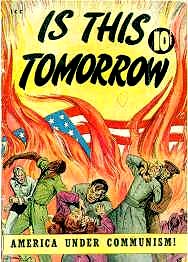
The fear of Communist indoctrination was part of the “Red Scare” in the 1950s. Guess what… They were right on all counts, but that’s another story. If you don’t believe me, look at the socio-political climate on America’s college campuses and in today’s political arena as examples.
There are countless opinions on this subject, but the consensus is that it began with the rise of mass media, corporate advertising, and the intense anti-communist campaigns of the Cold War era in the 1950s, as a coordinated effort to condition people to equate patriotism with unregulated capitalism. Institutions such as the media, Hollywood, and schools have long been used to suppress class consciousness and to enforce a pro-corporate status quo.
* I’m introducing a new term: “Osmotainment.” It combines Osmosis and Infotainment – a portmanteau that captures the idea of subconsciously absorbing ideological or political values while being entertained. “Indoctrination through Osmosis.”
Indoctrination means accepting ideas without question, driven by culture, family, media, or school. Because everyone grows up immersed in a specific culture and its hidden biases, absolute neutrality does not exist. Osmosis is the passive process of absorbing something without energy or intent, requiring only exposure.
Here we are, more than 75 years later, consuming gigabytes of infotainment daily that reinforce indoctrination as quickly as we ingest it. We are, indeed, what we consume. Avoiding indoctrination is nearly impossible, but we can sharply reduce its impact by building strong critical-thinking skills.
I’d like to expand on ignorance a bit. Webster’s defines ignorance as “the state of being ignorant; lack of knowledge, learning, information, etc.” The root word is ‘ignore,’ meaning “to refrain from noticing or recognizing.” Stupidity is the inability or refusal to understand, reason, or act with good judgment, whereas ignorance is simply a lack of knowledge or information. The core difference lies in capability and choice: an ignorant person lacks the facts, while a stupid action occurs when someone has the facts (or the capacity to know them) but fails to use them properly.
Linguistically, “ignoring” implies an active choice, but cognitively, it is primarily a passive, automated filter designed for neurological survival. At its most basic level, your brain is biologically programmed to involuntarily delete millions of background sensory bits every second just to prevent system overload. However, modern digital landscapes rely heavily on conditioned ignoring, a subconscious state where media loops and algorithms train our minds to accept biased or ideological premises as normal, invisible background noise. True active ignoring is rare; it requires conscious, executive willpower to wake up from this passive state, recognize the background conditioning, and deliberately choose what we allow into our long-term memory.
The correlation I like to draw is that we learn lessons and then promptly shelve them, like all the books we plan to read but never do. We conveniently forget these lessons because we’re inundated with vast amounts of information daily. Estimates suggest we take in an overwhelming 34 to 74 gigabytes (a Gigabyte = 1 billion bytes) of data every day, the equivalent of 100,000 to 200,000 words or 16 movies. Our brains don’t process information the way a computer does. We have filters to sort it, and those filters are influenced by programming and indoctrination. Studies show that our processing rate is between 60 and 120 bits of information per second. To put this into perspective, understanding a person speaking requires about 60 bits per second. Interestingly, your brain discards about 99.999% of the data it receives, while we retain roughly 7.5 bits of it. That’s right, a tiny amount… That’s where the filters come in. But don’t be fooled; the information is not lost. Remember the analogy of putting a book on the shelf?
Five hundred years ago, 74 GB was the total amount of information a highly educated individual would consume over their entire lifetime. Today, due to smartphones, social media, work apps, and streaming, we encounter that same amount before we go to sleep, representing a 25,000-to-1 increase.
I just finished an article titled “Much Ado About Nothing: Theater in America ~ The Greatest Show on Earth! ” [link]. It examines the Outrage Business model in America and how we’re programmed to respond by the content we follow on the massive infotainment systems we’ve created. I’m talking about the internet and the algorithmic engines that feed us more of what we regularly consume. If you generally watch tumbling kitties in a playpen, you’ll find endless suggestions for that very activity. If you follow doom & gloom, that’s what you’ll get.
I began thinking about how our perceptions of Socialism and Capitalism have changed. Our view is vastly different from what it was 75 years ago, and even more so from 40 years ago, which is more than a generation since the Red Scare era and the Evils of Communism, Marxism, and Socialism.
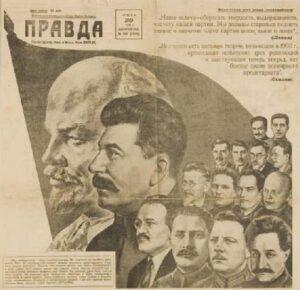 How did we stray from fighting the war on Communism to embracing one of its fundamental transitional steps? Marxist-Leninist theory holds that socialism is the lower phase and the transition toward Communism. There are some fine points involved, basic differentiations in the ideologies, but the goal is the same. Different paths to the same destination.
In its purest theoretical form, communism envisions a world in which all property is publicly owned, and citizens are provided for according to their abilities and needs. The core philosophy is captured by the famous Marxist slogan: “From each according to his ability, to each according to his needs.”
If you don’t remember anything else from this article, please keep this simple fact in mind. “Socialism doesn’t work without force.” You can argue that it’s working just fine in many countries around the world, but those are adaptations of socialist ideology.
Modern Socialism takes two main forms: State Capitalism, as in China and Vietnam, and Social Democracy, as in the Nordic Model. Each model handles power in a fundamentally different way. State Capitalism is authoritarian, whereas Democratic Socialism rejects authoritarian control but imposes high taxes and heavy regulations to fund a massive social safety net for healthcare, education, and pensions. What we perceive as ‘free’ is anything but… There’s always a cost.
In modern sociopolitical discourse, the term “power grab” rarely refers to a dictator seizing a factory with tanks. Instead, it is a battle over leverage. Critics view every new government regulation, tax hike, or welfare program as a subtle expansion of state control over individual life. Proponents see those same programs as necessary structural safeguards designed to protect everyday people from the immense, unaccountable power of global corporations and billionaires.
If we use the strict philosophical definition of pure socialism – the complete abolition of private property, total worker or public ownership of all means of production, and an economy entirely stripped of market profit – every modern nation falls short. Today, all countries operate mixed economies that blend elements of capitalism and state intervention.
Consider what you think you know about socialism and most other subjects. It probably comes from the mainstream media complex. Is their bias partisan, or do you receive fair and honest representations?

Islamabob
Now let’s add information on four of the hottest topics: Immigration, Islam, Politics, and the Midterm Elections. I could cite several other examples, but I want to point out that what you probably know about any subject comes from the mainstream media complex rather than from online research, and even that research is likely biased by the company’s owner. So, let me remind you that “you are what you consume” – and that becomes what you believe.
I asked AI for a list of completely unbiased internet feeds… There are none.
 There are, however, several reputable ‘fact-checking’ sites. Instead of passively waiting for a social media feed or an algorithm to serve you information (which triggers the Sleeper Effect), you must actively seek out wire services or bias aggregators. True media literacy means examining the raw ingredients of a story before the infotainment industry cooks it into a narrative.
Finding unbiased information requires active changes in user behavior. So the real answer is that you have to find it, because it is NOT coming to you…
Here’s a final tidbit for consideration. The last time a major news broadcast in the United States was federally mandated to be balanced and unbiased was in August 1987. That was the month the Federal Communications Commission (FCC) officially repealed the Fairness Doctrine. That was Osmotainment’s official birthday, the moment it took over the media. This was the historic Point of No Return. Under the Reagan administration, the FCC voted 4–0 to abolish the doctrine.
The argument was that the explosion of cable TV meant there were plenty of stations, so the government no longer needed to enforce balance. Critics also argued that the rule had a “chilling effect,” prompting stations to avoid controversial topics altogether to avoid legal headaches. While 1987 marked the end of enforced neutrality on the airwaves, many media historians argue that a purely unbiased news broadcast has never existed.
Osmotainment: The Subconscious Conditioning of the Masses by Digital Mainstream Media. How modern infotainment, social algorithms, and pop culture serve as a vehicle for ideological conditioning – absorbing complex political, economic, or social values “through osmosis” as the audience’s critical guard drops during amusement.
The insidious power of Osmotainment relies entirely on a psychological loophole known as the Sleeper Effect. Discovered during World War II propaganda research, this phenomenon occurs when a persuasive message is initially paired with a “discounting cue” – such as a disclaimer that a television show is fictional or that a social media clip is satirical entertainment. At first, our analytical guard recognizes the cue and dismisses the underlying message as mere amusement. However, memory research shows that our brains process information and its source along two distinct neural pathways. Over time, the source tag decays and vanishes much faster than the message itself, breaking the link between the information and our initial skepticism.
Weeks or months down the road, the message is effectively freed from its warning label, and we recall the narrative premise as an objective, self-evident truth. In the digital age, algorithm-driven entertainment loops weaponize this glitch. By flooding our sensory buffers with repetitive, emotionally charged narratives while our critical defenses are down, modern media acts as a slow-acting psychological conditioning agent. We think we are simply relaxing and filtering out the background noise, but as the sources fade into amnesia, the underlying worldviews quietly wake up to reshape our default assumptions about reality.
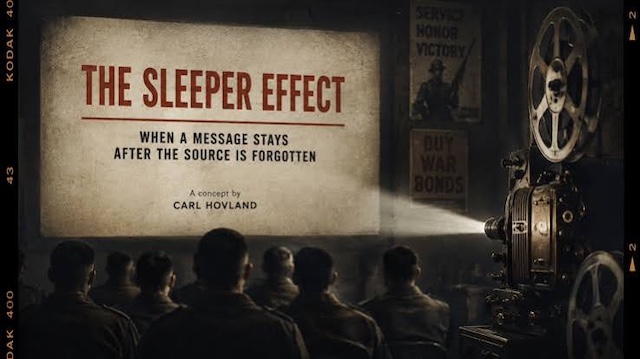 It’s known as “The Sleeper Effect,” first identified in the 1940s by pioneer social psychologist Carl Hovland while he was studying the impact of media on World War II soldiers. Hovland tracked how U.S. Army recruits responded to the propaganda film series “Why We Fight.” He measured the soldiers’ attitudes five days after watching the films and found little change in their opinions. However, when he checked back nine weeks later, their support for the war’s objectives had increased significantly. The film’s persuasive power had lain dormant – sleeping – before waking months later.
Initially, scientists assumed people had simply forgotten the source. However, modern cognitive research suggests something more subtle is at play: the Dissociation Hypothesis. Your brain stores the message content and the source tag in two separate neural pathways. Because the source tag decays much faster, the link between them weakens over time. The message is “liberated” from its skeptical context.
Hovland studied the Sleeper Effect in a world of simple black-and-white films. In the 21st century, digital platforms have turned it into an automated pipeline. The Inherent Disclaimer of “Entertainment”: When you sit down to watch a satirical late-night show, a meme on social media, or a hyper-realistic drama series, your brain applies an automatic discounting cue: “This is just for fun; it’s not real news.” This lowers your guard and makes you more likely to accept the narrative’s premise. The Power of Repetition: Algorithms ensure you don’t just see an idea once. They feed you dozens of pieces of content – podcasts, TikToks, lifestyle videos – all echoing the same underlying social or political premise.
Weeks later, when a real-world political debate or social issue arises, you don’t cite the specific entertainment media you consumed. Instead, you just “feel” that a certain viewpoint is common sense. Your attitude has shifted unconsciously, perfectly matching the definition of the Sleeper Effect.
Psychologists discovered that for a full Sleeper Effect to take hold, a person needs to encounter two opposing elements simultaneously: a persuasive narrative, an emotional story, or an intriguing claim, and a mental warning label that tells your brain to reject the message. This could be a “paid political ad” disclaimer, a famously biased news anchor, or simply the fact that you are watching a completely fictional movie.
Recognizing the invisible machinery of osmotainment naturally raises a vital question: What do we do now? The answer is not to abandon digital media altogether – an impossible feat in a hyper-connected world – but to fundamentally change how we interact with it. True defense against subconscious conditioning requires shifting from passive consumption to active, aggressive media literacy. We must treat our daily media consumption not as a vacuum of pure relaxation but as a space where our cognitive borders are constantly negotiated.
To break the spell of the Sleeper Effect, we must practice intentional “source tagging.” When an interesting premise, social narrative, or political assumption flashes across our screens disguised as entertainment, we must consciously attach a clear mental label to it: “This is an unverified clip from a late-night satirist, or this is a structural narrative framing from a corporate-funded television network.”
By deliberately reinforcing the link between the message and its origin, we keep the source tag from fading in our memory channels. Ultimately, reclaiming our minds requires mindful awareness. It means answering Rumi’s ancient call to refuse the comfort of the cultural lullaby and to remain wide awake at the open doorway where the digital world meets our own.
The ultimate harm of osmotainment is that it subtly erodes individual cognitive sovereignty on an industrial scale. When an entire society absorbs its values, historical interpretations, and political frameworks through the numbing lens of soft entertainment, the public square becomes intellectually standardized. Because the Sleeper Effect operates beneath conscious awareness, people do not realize their worldviews are being engineered from the outside. They mistake manufactured consensus for their own organic intuition. Over time, this collective conditioning degrades critical thinking, leaving the public highly vulnerable to emotional manipulation and behavioral control, as complex systemic crises are reduced to digestible, ideologically loaded entertainment narratives.
Furthermore, this continuous algorithmic conditioning fractures the shared reality required for true civic engagement. As users are fed hyper-personalized streams of “comfort media” – each carrying distinct background political assumptions—society splinters into deeply entrenched ideological silos. The result is a public that is simultaneously overstimulated and underinformed, reacting to cultural symbols with intense emotion while completely divorced from verified structural facts. This is the profound danger that Rumi’s warning addresses. The harm of going “back to sleep” in the modern era is not a passive loss of awareness; it is the active, unconscious surrender of the mind to a corporate and algorithmic architecture that shapes what we believe, fear, and desire.
Maybe that is why Rumi’s words stayed with me through the night. They were not just poetic; they were diagnostic. They described the quiet danger of drifting through life half-conscious, absorbing other people’s assumptions until they feel like our own.
I don’t claim to be immune. None of us are. But awareness is the beginning of resistance. If osmotainment works by putting the mind to sleep through comfort, repetition, and amusement, then the first act of freedom is simply to wake up.
* Ask better questions.
* Check the source.
* Notice the frame.
* Guard the doorway.
And whatever you do – don’t go back to sleep!
For the Amalgamated Heavy
‘The devil you say…‘

September 24 2026
~ the Author ~
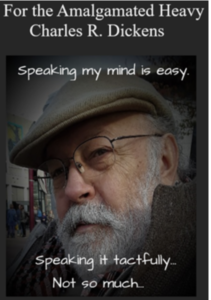 Charles R. Dickens Was Born in 1951, Is a Veteran of the Vietnam War, for Which He Volunteered, and the Great-Great Grandson of the Noted Author, Whose Name He Shares.
He Is a Fiercely Proud American, Who Still Believes This Is the Greatest Country on the Planet, With Which We’ve Lost Control and Certainly Our Direction. He Grew Up in Moderate Financial Surrounding; We’re Not Rich by Any Stretch, but Didn’t Go Hungry – His Incredibly Hard Working Father Saw to That. As Most From That Era, He Learned About Life From His Father, Whose Story Would Take Too Long to Tell, Other Than to Say That, He Is Also a Fiercely Proud American; A WWII and Korean War, Veteran Marine.
Charlie Was Educated in the Parochial System Which, Demanded That You Actually Learn Something, and Have Capability to Retain It Before You Advance. He Attended Several Universities in Pursuit of a Bachelor’s Degree, and Chased the Goose Further to a Master’s, and Has Retained Some Very Definite Ideas About Education in This Country.
in Addition, Charlie Is a Retired Blues Guitar and Vocalist – a Musician. This Was His Therapy Career. Nothing Brings Him as Much Joy as Playing Music, and He Wishes That He Could Make a Living at It… but Alas… Life Goes on!