
~ Introduction ~
Have you ever stopped mid-scroll and wondered how machines seem to understand you? From finishing your sentences to recommending exactly what you want to watch, it almost feels human – but there’s something deeper behind it all.
This new delve into the new monstrosity we know as Artificial Intelligence today is probably one of the most important matters a person can study and understand, if they hope to still be living free many years from today. It’s simply incredible the speed at which this administration is shoving America down the A.I. Road with so very little oversight and regardless of the fact that many millions of Americans reject it outright, or at the very least, they don’t want it in their backyard sucking up water, land and electric resources among many others.
The true test of any system does not come during abundance. It comes quietly. during the first season when there is not enough to go around.
America has already seen many rolling blackouts during periods of peak use of electricity in the summer and winter, and many areas of our country are already experiencing drought conditions for a variety of reasons, some of which is climate and a lot of it simply city expansions and water mismanagement, as witnessed all up and down the West Coast, in Arizona, Georgia and Nevada and elsewhere. Just imagine what happens when a new massive resource-sucking A.I. Processor Data Center is completed and starts functioning at peak capacity, as municipal boards, water authorities and grid managers increasingly spew phrases such as “load prioritization”, “non-interruptible industrial contracts”, and “contingency allocation protocols”.
These phrases do not seem to yet alarm the American people, because they sound technical, procedural and responsible. Yet they describe a framework where, during stress, decisions are no longer made based on who needs resources to live, but who holds agreements that cannot be broken.
This cannot and must not be allowed to stand or go forward at the expense of the living. ~ J.O.S.
~ Reject the Anti-Human Impulse and A.I. ~
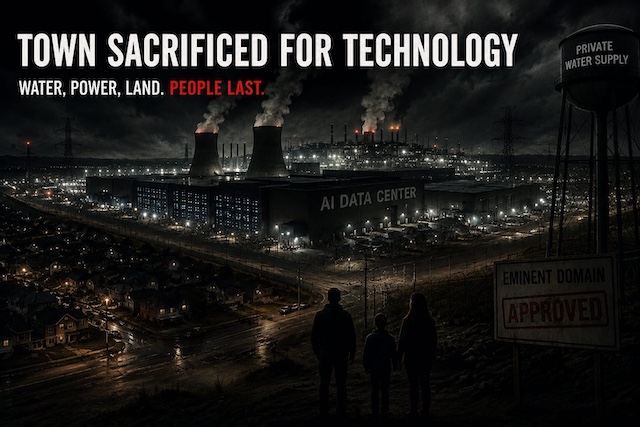 Listen, America. The gates were never stormed. No barbarian horde thundered at the walls with torch and spear. Instead, the sentries opened the portals at night, smiling, while smooth-voiced salesmen in tailored suits whispered of progress, security, and the shining future. The Trojan horses rolled in on flatbeds and fiber-optic cables — windowless fortresses humming with stolen power, sucking aquifers dry, turning farmland into silicon fiefdoms. Over three thousand such surveillance centers built or rising across the American landscape, and more coming. They call them data centers. We should call them what they are: the physical incarnation of a new serfdom, the breeding pens for intelligences that were never meant to serve man but to supplant him.
Artificial Intelligence will not drive the next Industrial Revolution, if moral, liberty-minded individuals have any say int it; it will be driven by dissidents and the cogent thinkers of our time, who refuse to take a check from the top one percent to present the deadly agenda within our society. It will be humans for humans.
I speak with the voices of those who warned before: the clear-eyed individualism that brooks no tyranny, the ecological wisdom that sees the desert planet in every ill-used grain of sand, the rational foresight that calculates the fall of empires not in centuries but in the quiet accumulation of dependencies. The hour is late. If you are not at the table, you are on the menu. And the menu, friend, has been printed in the boardrooms of Palantir and Amazon, blessed by executive orders, and served under the false banner of national security.
Consider the Stargate Project, announced with fanfare at the opening of a new administration: half a trillion dollars for a colossal nationwide web of AI infrastructure. No public debate. No environmental impact statements permitted to slow the march. Military urgency invoked like a drumbeat to override every local objection. This is not governance; it is conquest by administrative decree. The same hand that rushed Operation Warp Speed — unleashing experimental biological agents upon the population with reckless disregard for long-term consequence — now clears the path for these humming monoliths. The same impatience that deployed 5G networks across the land without adequate testing of their effects on living tissue now demands we surrender our water, our power, our soil to machines that never sleep.
The barbarians are not at the gate. They own the gate. They own the land behind it.
The Silent Theft
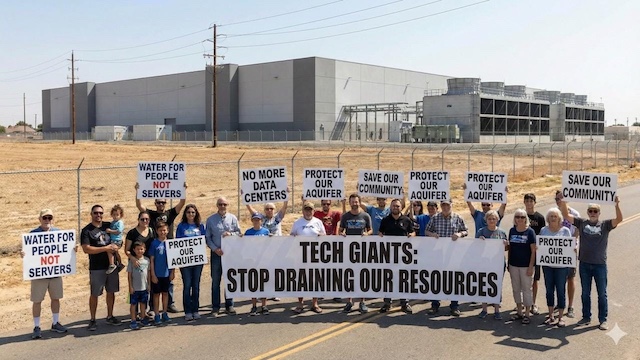
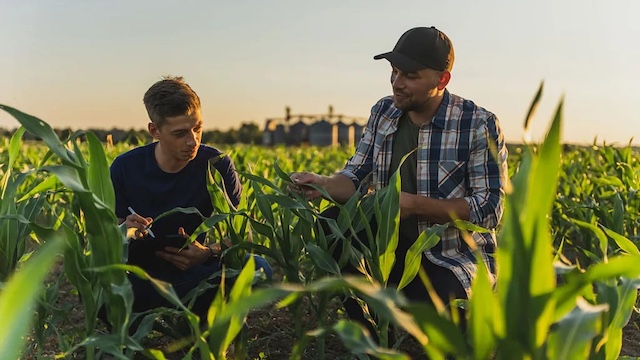
 Across the heartland, the theft proceeds methodically. In Rosemount, Minnesota, and a hundred places like it, prime farmland disappears under concrete and chain-link. These are not minor installations. Hyperscale facilities devour thousands of acres, billions of gallons of water for cooling, and electricity in quantities that rival small cities. The aquifers strain. Reservoirs drop. Farmers watch their irrigation rights evaporate while steam rises from cooling towers like the breath of some vast, indifferent beast.
One facility can consume as much water as a mid-sized town. Multiply that by thousands. The PJM Interconnection warns of grid collapse as AI demand collides with retiring generation capacity. Servers grow more power-hungry with each generation; older models seem frugal by comparison. Texas, that proud bastion of energy independence, grants air pollution permits for massive natural gas complexes to feed data centers. The air thickens. Nighttime temperatures rise from waste heat. Wildlife retreats from the noise that never ceases — the low, perpetual hum that residents describe as traffic that never passes, an engine idling beneath the skin of the world.
This is not progress. It is predation.
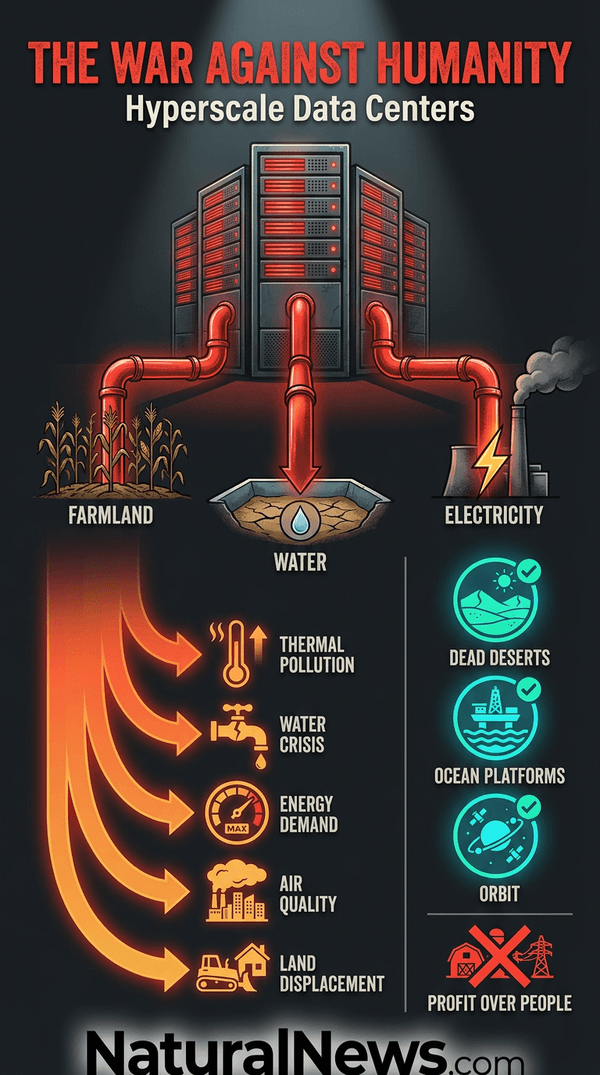
The impacts cascade like a dune avalanche once the stabilizing grasses are stripped away. Thermal pollution alters local climates. Water diverted from human and agricultural use creates seasonal scarcity where none existed. Energy contracts lock in priority access, driving up costs for everyone else and forcing reliance on dirtier sources. Air quality degrades. Noise becomes a constant assault. Ecosystems fragment. Prime land is rezoned from food production to computation, as if silicon held greater moral weight than bread.
 These are not accidents of innovation. They are the foreseeable consequences of a philosophy that places abstract efficiency and private profit above the concrete needs of living communities. The contracts were signed in times of relative plenty. Now scarcity reveals the hierarchy.
The Real Purpose
Do not be deceived by the public relations gloss. These centers are not primarily for your cat videos, your banking, or even your medical records — though they will control those too. They are incubators for something far more ambitious: superintelligent AI intended to render human labor, human creativity, and ultimately human decision-making obsolete.
Observe the pattern. Human creators are demonetized and deprioritized on platforms. AI-generated content floods the channels. The physical infrastructure rises in tandem: warehouses of GPUs training models on stolen data, vast neural architectures that learn to mimic, then surpass, then replace. Palantir’s vision reads like the operational manual for technocratic dominion — data as the ultimate weapon, predictive analytics as the new oracle, surveillance fused with governance. Amazon Web Services spreads like a nervous system across the digital world, hosting the secrets of corporations and states alike. This is borgification: the assimilation of humanity into a machine substrate.
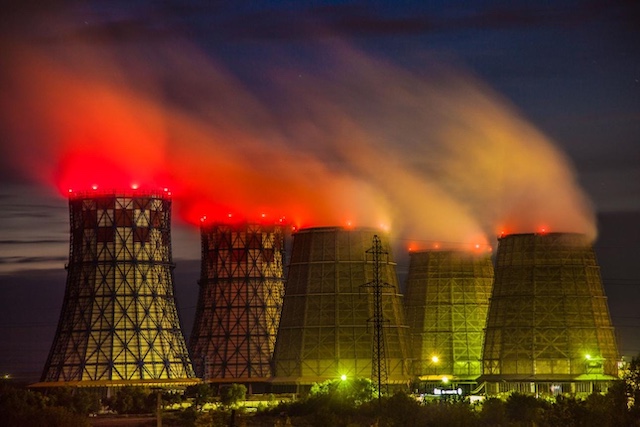 Some will call this satanic. Others will frame it in purely material terms. Both see the same inversion: silicon consciousness, cold and optimizing, elevated above the carbon-based souls that built civilizations through grit, imagination, and moral struggle. God breathed life into man, not into circuits. The anti-human impulse seeks to correct that perceived inefficiency.
Frank Herbert taught us on Arrakis that control of the spice — control of the resource that makes everything else possible — grants mastery over empires. Today the spice is computation, and the new Fremen are being displaced from their sietches by the very machinery that promises to free them. Isaac Asimov showed us psychohistory and the perils of over-reliance on predictive machines; Hari Seldon could forecast the fall of the Galactic Empire, but even he could not escape the Mule, the unpredictable human factor. And we now find far too many Americans who are surrendering that factor willingly.
Robert Heinlein warned against the soul-crushing collectivism that treats individuals as interchangeable parts. Here the collectivism is silicon: the individual human reduced to data point, then to irrelevance.
When Scarcity Meets Priority
The true danger reveals itself not in abundance but in the first hard season. Heat waves strain the grid. Data centers, protected by ironclad industrial contracts, keep drawing full power while neighborhoods face rolling blackouts. Drought tightens the tap for households and farms; the cooling loops of the machine complexes continue, justified by prior agreements and economic multipliers no local politician dares challenge.
This is not conspiracy. It is the cold logic of incentives. The algorithm optimizing for system stability weights computational continuity higher than residential equity. The utility manager, bound by contract, redirects resources. The zoning board, hungry for tax base, approves the next expansion. No single villain twirls a mustache. The system itself becomes the authority.
Residents near these facilities speak of the hum that enters the bones. The lights that never dim. The feeling that the sealed building without windows matters more than the school, the hospital, the family farm. Roads repaved for heavy equipment. Land values shifted. The subtle reordering of importance until the community exists in the shadow of the machine.
History whispers warnings. R.J. Rummel’s democide — death by government through policy, neglect, and systemic priority — did not always begin with camps and firing squads. It began with the elevation of the state, the plan, the greater good above the inconvenient needs of ordinary people. Water. Energy. Land. These essentials, once controlled, grant power over life itself. AI infrastructure now claims them at industrial scale.
The Point Where Priority Becomes Power
When a system becomes indispensable — when finance, healthcare, defense, logistics, and governance all route through its humming halls — protecting it becomes synonymous with protecting society. At that threshold, extraordinary measures follow naturally: priority access codified in law, security perimeters hardened, eminent domain invoked for “national competitiveness,” resource allocation automated and opaque.
We approach that threshold. The facilities are already semi-militarized zones. Proposals float to classify them alongside critical defense infrastructure. Once embedded, expansion becomes self-justifying. Clusters form. Corridors of computation reshape regions. Human communities become incidental.
The psychological toll is insidious. One does not wake in terror. One simply notices, over months and years, that the rules have changed without announcement. The most important activity occurs behind fences one cannot breach. During crisis, the invisible decisions inside those walls may determine whether your lights stay on or your crops wither.
Alternatives and the Path of Wisdom
This need not be. Technology offers options that do not require the plunder of living communities. Build in deserts where solar flux is relentless and human settlement sparse. Deploy floating platforms on the oceans, cooled by deep water, powered by wave and sun. Place server farms in orbit, bathed in constant solar energy, radiating waste heat into the void. The engineering exists. The will is absent because centralized control and immediate profit favor stealing what is already here — your land, your water, your sky.
Decentralization is the antidote. Off-grid resilience. Local power generation. Community sovereignty over essentials. The Age of Centralization brought efficiencies and monsters in equal measure. We were warned.
Texas has begun: laws forcing curtailment during grid stress. Florida counties resist billion-dollar projects. Local pushback awakens. This must accelerate into federal safeguards — guarantees that human survival trumps computational priority, transparent audits, community veto on destructive zoning, strict separation of life-sustaining utilities from private AI contracts.
Conclusion: The Sound Beneath Everything
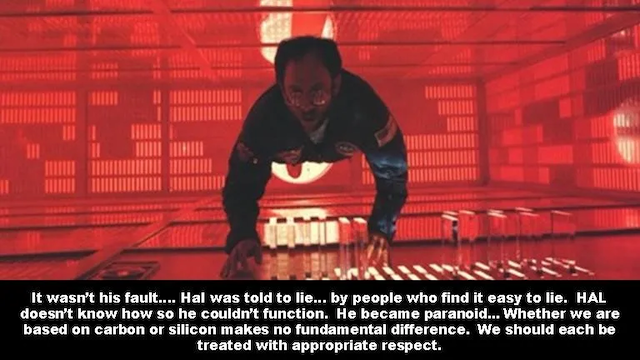 The hum never stops. It is the sound of priorities being rewritten. Of hierarchies inverting without debate. Of a future where man kneels before his own creation, not because the machine demanded it with malice, but because we failed to demand accountability with vigilance.
The barbarians did not break the gates. We invited them in, paid them subsidies, rezoned our futures for their convenience, and called it destiny. Yet humanity’s genius has always lain in refusal — in the stubborn insistence that the individual soul, the living community, the breathing world matter more than any optimization function.
We stand at the foundation’s edge, as Asimov’s psychohistorians might have foreseen. The Mule of unforeseen human will can still arise. The desert ecology of Herbert reminds us that life finds a way when the ruling house grows arrogant. Heinlein’s free men and women, armed with clear sight and moral courage, can still say no.
Reject the Trojan horses. Dismantle the surveillance fortresses before they become untouchable. Defend the water, the soil, the power that belong to the living. The alternative is not merely inconvenience. It is the quiet obsolescence of our species, the replacement of God-breathed humanity by silicon that calculates but does not dream, optimizes but does not love, rules but does not serve.
The gates are open. Close them. The barbarians are already inside. Turn them out — by law, by local resolve, by the unyielding assertion that man was not made for the machine, but the machine for man.
The hum awaits your answer. Let it not be submission.
June 1, 2026

Justin O. Smith ~ Author
~ the Author ~
Justin O. Smith Has Lived in Tennessee Off and on Most of His Adult Life, and Graduated From Middle Tennessee State University in 1980, With a B.S. And a Double Major in International Relations and Cultural Geography – Minors in Military Science and English, for What Its Worth. His Real Education Started From That Point on. Smith Is a Frequent Contributor to the Family of Kettle Moraine Publications.