Congress, the opposite of progress, and the art of the Gotcha.
Let The Boisterous Beatings & Bullshit Begin!
“Fools rush in where angels fear to tread.”
The introductory quote is by Alexander Pope (1711), from his essay on criticism. Pope wrote it to criticize those who pose as experts in subjects they do not understand, particularly literary critics. It describes how inexperienced or reckless people often enter dangerous or complex situations that wiser, more cautious individuals avoid. The phrase is often used to warn against acting without proper thought. It aptly describes the mainstream media and our government, doesn’t it… or does it?
The term ad hominem means “to the man” or “to the person” in Latin, referring to an argument that attacks the character, motive, or personal trait of the person making a statement rather than addressing the substance of the argument. Harangue is a scolding or a long, intensely passionate, and vehement verbal attack, or a pompous speech delivered before a public gathering. It’s a logical fallacy that attempts to discredit an opponent by focusing on irrelevant personal details to create a diversion or imply the argument is invalid because of who said it. In this commentary, it’s used to describe the venomous tirades in the exalted halls of Congress, the opposite of progress. It seems that the command to appear, loosely termed an invitation, is an ominous caution for the faint of heart and the unprepared.
Today’s Congress – is more theater than the intended deliberative government body. Their chamber is their stage, where their dramas take place. The actors have taken the stage… Let the performances begin…
We’ve heard the title phrase a lot recently in the mainstream media, where these morons choose sides and describe the partisan political assaults during congressional hearings. They actually got this one right for a change, but I’m sure it came from a bookish staff writer rather than from those with advanced degrees in broadcast communications.
These events remind me of Hollywood’s portrayals of Roman gladiatorial games. The Nero-esque Committee Chair (Chairperson) presides over the melodrama. The republic, the audience, watches in stunned silence or cheers wildly as the drama unfolds. Those at the witness table, on the arena floor, are the spectacle’s targets. Will there be blood tonight? Who will survive?
 The founders originally designed Congress as the primary, most powerful branch of government, intended to be the central focus of negotiation, representation, and lawmaking. It was created to serve as a check against tyranny by balancing power among the states and, through a bicameral structure, to ensure that laws reflected both the popular will and deliberative, long-term interests. It’s become a theater for partisan conflict, personal attacks, and senseless adolescent bickering. Governance is now a spectator sport.
In 1787, the framers of the United States Constitution set out Congress’s structure and powers in Article I. They debated establishing a bicameral (two-chamber) Congress. One house would be, in the words of Virginia’s George Mason, the “grand depository of the democratic principle of government.” To counter this popular influence in the national government, James Madison of Virginia proposed a second house that would be small, deliberative, and independent of the larger, more democratic house. This became the Senate. The two chambers are the House of Representatives (HoR) and the Senate, or ‘the Upper Chamber (UC), from the Latin senex, meaning ‘OLD’, quite appropriate since the average age in the US Senate is 64. Chuck Grassley (R-Iowa) is 91.
*AI tells me: old age generally begins at 65, the standard benchmark for retirement.
– 136 members are between 60 and 69
– 98 members are between 70 and 79
– 18 members are between 80 and 89
– Only 1 member is over 90
– The median age of the 119th Congress is 57 years old.
– The median age of the first congress was 44 years old.
One might expect that ‘with age comes wisdom,’ since the first Congress that created this republic was 13 years younger than our current assembly, most of whom can’t find the coat room even with a map and a flashlight. One might also expect the seated Congress to outperform its predecessor based on the supposed aggregate and accumulated wisdom. Well, so much for that adage…
My… how things have changed…
The HoR and UC represent the citizens and are responsible for enacting laws, levying taxes, declaring war, and overseeing the executive branch. They also manage the federal budget and confirm presidential appointments. There is a keyword in this sentence that is often conveniently and intentionally misinterpreted – overseeing, from the root oversee.
Oversee:
– To direct, supervise, or manage.
– Observe secretly or intentionally.
– Survey or watch from a higher position.
– Look over; examine; inspect.
– Control…
This begs the question: Who oversees Congress, the opposite of progress?
Why… That’s OUR responsibility as citizens of this republic.
Please look closely at the preceding paragraphs and identify the sentence or phrase that permits, sanctions, or allows gratuitous, egotistical self-aggrandizing, vicious name-calling, personal attacks, trolling for gotcha moments and viral video clips, verbal abuse, and baseless accusations by the opposing partisan political party. The original idea for political parties in America was that they should not exist at all. The Founding Fathers viewed political parties, then called “factions,” as dangerous, divisive, and a threat to the stability of the new nation. They believed that a virtuous government should be run by independent, educated, sober, ethical, and moral leaders acting in the public good rather than on their own behalf or on behalf of organized partisan political groups or their sponsors.
Congress, the opposite of progress, has lost sight of a couple of very important points:
– The consent of the governed: their power comes from the people they govern.
– Rule of Law: They are accountable to the law, not above it.
– Checks and Balances: It can significantly constrain the power of the other branches.
– Limited Government: Its power is constrained by the Constitution.
– They work for the republic (you and I); the republic does NOT work for them.
These are simple concepts enshrined in the Constitution but conveniently neglected or ignored because they directly interfere with the pursuit of partisan power. I’ll ask the obvious question: What good is power if you can’t use it to crush your enemies and do as you please? Maybe they could work together for the betterment of the republic…
I’m forced to concede that the internet wasn’t among the original considerations when the Constitution was drafted, yet the thriving print media of that era faced the same ethical and moral dilemmas as today. Sorry to break the news, but we didn’t invent smear, spin, or lies. Those go back to the beginning of humanity. But… what’s old is new again…
Key Aspects of the founders’ concerns, the original view:
– Fear of “Faction”: Many founders feared that parties would tear the nation apart, recalling the bitter, violent divisions that had plagued British history.
– Constitutional Omission: The Constitution makes no mention of political parties because the framers intentionally omitted them.
– “Spirit of Party”: In his Farewell Address, George Washington warned against the “baneful effects of the spirit of party,” fearing it would lead to foreign influence, corruption, and “frightful despotism.”
– Concerns about “Tyranny of the Majority”: In Federalist No. 10, James Madison described factions as a disease and argued that a large republic could curb their influence, even though he acknowledged they were unavoidable.
And the rest, as they say, is history… or the past is prologue…
Here we are today, living out the founder’s admonitions and coping with the contentious examples they warned against.
“Lord, what fools these mortals be!” ~ William Shakespeare – from A Midsummer Night’s Dream ~ It expresses amusement at the silly, irrational, and fickle behavior of humans.
Let’s jump ahead 250 years to the present.
Access to instant information is both a benefit and a curse. We can find almost anything we seek with a few clicks on a computer, and the World Wide Web – the Internet provides it. Now, with the introduction of Artificial Intelligence (AI) for public use, it aims to make data intelligible and useful.
~ Geek Note: Artificial Intelligence (AI) wasn’t released as a single product, but its public presence surged with the launch of ChatGPT in November 2022, making powerful AI accessible to millions and sparking widespread adoption. Although foundational research began in the 1950s, key concepts such as the Turing Test were introduced in 1950, and the term “AI” was coined in 1956. The test measures a machine’s ability to exhibit human-level intelligence. It involves a human interrogator engaging in a text-based conversation with both a human and a machine; if the interrogator cannot reliably distinguish the machine from the human, the machine passes. A more in-depth answer is available online. Just ask AI.
But… just because you can, doesn’t mean you should…
‘Not-so’ social media is a crucial tool for politicians to reach voters and constituents, as internet users increasingly rely on digital platforms for political news and information. It has revolutionized politics by enabling rapid information sharing and direct communication between politicians and constituents, while also fueling political polarization, misinformation, and echo chambers. While these platforms increase political engagement and influence agenda-setting, they often divide public opinion and, in some cases, erode democratic principles. I add ‘not-so’ to social media because the discourse on these platforms is anything but sociable.
Key components:
– Direct communication: near-instant dissemination of information and targeted access for specific demographics.
– Fundraising: revolutionized campaign financing through crowdsourcing, raising record-breaking sums from small donors.
– Mobilization: digital tools enable rapid grassroots organizing, as seen in movements such as Black Lives Matter, the 2011 Egyptian Revolution (Arab Spring), and the Anti-Ice Riots in Minnesota.
– Polarization: making cross-ideological dialogue extremely difficult.
– Echo-Chambers: prioritize engagement over accuracy – often called a closed system.
This insidious nature of the ‘closed system’ refers to a political structure, process, or organization that limits external influence, restricts participation to a specific group, and operates under internal rules or hierarchical control. Such systems are characterized by a lack of transparency and accountability to the citizenry, and, in some cases, by the suppression of opposition. The process adapts user data to reinforce existing beliefs while excluding opposing views. A closed system is a physical system that does not allow data to be transferred in or out. Think of it as a self-perpetuating, self-reinforcing information loop.
Not-So Social Media has lowered barriers to political participation, allowing individuals to bypass traditional media ‘gatekeepers’, facilitate online fundraising, and mobilize grassroots organizing, as seen in Black Lives Matter (BLM) and the Anti-Ice riots in Minneapolis.
What’s ‘past is truly prologue’, suggesting that previous events, actions, and decisions directly shape current circumstances and determine what comes next, often serving as a guide or warning.
Our republic is burdened by what has been; thank you, Kamala; Kaptain-Konspicuous. The past 240 years of partisan political bias, concentrated in two parties, paint a damning picture if anyone would genuinely look at it, yet it’s treated like all of history’s other examples and considered not applicable in today’s context. We always claim to know better and regularly prove we’re wrong.
Bertrand Russell observed, “The stupid are cock-sure while the intelligent are full of doubt…” This perfectly summarizes the US Congress, the opposite of progress. I’ll reintroduce a systematic, often unconscious, error in thinking that deviates from rational judgment, creating a subjective reality called ‘cognitive bias.’ The ‘Dunning-Kruger’ effect occurs when people with low ability in a specific area overestimate their competence, while experts often underestimate their own, believing tasks are easier for everyone. This happens because the unskilled lack the self-awareness to recognize their shortcomings, while the skilled struggle to see how much harder things are for others, leading to inflated self-assessments in the former and underestimated abilities in the latter. Yet another indictment of our elected officials, who regard themselves as morally superior in every way to those who elected them, without any basis for that assumption.
This sanctimonious stance never stops a power-hungry politician from reaching the top. I have always believed men were aggressive, but the female of the species proves cunningly ruthless. Most men are petty, but women are conniving, vindictive, merciless, and spiteful. It’s reported that God made woman from the rib of man; God should have taken a bit of man’s heart, too.
“Hell, nor Congress, hath no fury, like a woman scorned…” ~ William Congreve (1679)
This tacit approval of congressional pandemonium gives the rank-and-file citizen cause to attack what they dislike in a similar vein, including people, not just situations. These vicious Congressional diatribes fuel the citizenry’s belief that they have the license to act in the same manner as their elected representatives, with the same vitriol. How should we react? Should we pass this off as anomalous behavior, atypical of the appearance, or as an indication of a truly broken system?
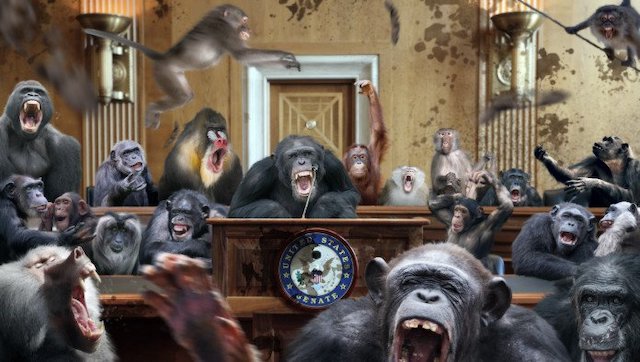
Monkey’s – It is what they have become!
I reiterate that Congress – the opposite of progress – has lost its purpose in the grand scheme of the republic and has become a bandstand for bullshit and shallow sectarian squabbles. The original idea for political parties in America was that they should not exist at all. The Founding Fathers viewed political parties, then called “factions,” as dangerous, divisive, and a threat to the stability of the new nation.
Right Again, Skippy!
Partisan politics truly broke the system we call government. One group favors Marxism; the other, Federalism. Marxism is a revolutionary, class-based socioeconomic theory that seeks to abolish private property and establish a centralized, stateless, classless society. Conversely, Federalism is a political structure that decentralizes power by sharing authority between a central government and regional units. Marxists prioritize central control and often view Federalists as obstacles to development.
I may address the differences between Marxism and Federalism in the future. The pressing issues at hand are the performative nature within Congress, the opposite of progress. These elected members are not governing this republic; they are auditioning to keep their positions. A small cadre of Members of Congress, the opposite of progress, actually do their jobs faithfully, thus securing their positions; the rest are insecure narcissists, even after serving several terms. Please refer to the paragraph about the Dunning-Kruger effect above.
The impact on the republic should be painfully obvious in these horrific displays of partisan self-indulgence, fake outrage, and inflammatory questions and comments. They rely on our short-term memory. They can say whatever comes to mind, knowing full well we won’t remember it. Thank the maker for the internet and AI, because it’s all captured for posterity: good, bad, or indifferent.
Their problem is that modern technology allows us to instantly recall their statements from recordings. So now, their damning and revealing remarks are in the permanent record, available for all to see. Yet these self-absorbed Members of Congress charge forward unimpeded, thinking they are doing what their constituents expect. These constituents, by the way, come from their own ‘echo-chamber’ not-so-social media groups. It’s more about appearance than substance, and about being liked rather than governing. This is the tragic reality and product of the two-party system in America, precisely what Mason, Madison, and President Washington warned about 240 years ago.
I consider myself an open-minded individual, yet there are times when I see certain celebrities or media figures, and I immediately revert to a racial slur in my mind. I realize this is a product of all the hate I’ve suppressed, but the pressure from the germinating seed still surfaces, and I say the words in my mind. I’ve maintained my filter so far, but there will come a day when even my filter fails, and those words will fly freely. Still, a strong personal constitution prevents me from hurling insults. I remember to choose my words carefully, because they can ‘plant a garden or burn the whole forest down.’
John Keating wrote, “No matter what anybody tells you, words and ideas can change the world.” This statement emphasizes that personal expression, creativity, and unconventional thinking have the profound power to transform society, despite skepticism.
The inconvenient truth is that everything we hear, read, and see imprints on our minds and psyches, for unintentional recall. It comes bubbling up when we least expect it. It appears in dreams and in correlations with other stored info-tidbits, creating what many call an epiphany or the Ah Ha… moment when it dawns on you that these things are interconnected. We continually hear reinforcing labels such as Nazi, Stormtroopers, Slave-patrols, Modern-day Gestapo, Jack-Booted Thugs, and Secret Police, and beneath each epithet is a seed planted to grow and blossom at a later time. This is all part of the incessant indoctrination of citizens, relying on systematic, manipulative techniques that implant specific beliefs while discouraging critical thinking, heavily leveraging social media algorithms, curated online content, and targeted propaganda. Extremist groups and ideologues exploit social isolation and personal grievances, creating “bubbles” that reinforce narratives and foster a false sense of belonging.
* Digital & Social Media: Algorithms on platforms like TikTok create echo chambers, feeding users a constant stream of similar content that reinforces specific viewpoints and often isolates them from opposing perspectives.
* Online Radicalization: Recruiters use social media, gaming platforms, and forums to target vulnerable individuals, spreading misinformation and manipulating emotions to promote extremist ideologies.
* Educational & Political Influences: Intense debates center on whether schools are used to advance ideological agendas, such as “woke” politics or “patriotic education,” by limiting diverse perspectives or, as some allege, by promoting specific social narratives.
* Psychological Manipulation: Tactics often include creating a “bubble of social isolation” to prevent contradictions to the narrative and focusing on exploiting personal grievances while fostering a sense of belonging to a “cause”.
* Ideological Targeting: Historically and currently, groups target youth through education systems and extracurricular activities to instill specific political or cultural ideologies.
The abuse of partisan political power involves all 5 of these techniques. Consider the words used in Congressional rants, attacks, and statements; references to the Holocaust, Nazi Germany, the Gestapo, Storm-Troopers, Masked Jack-booted Thugs, Secret Police, Slave Patrols, Dictatorship, Lawless Regime, Fascist Regime, Civil War references, Racial Profiling, and the free reinterpretation of the law to suit the immediate purpose and narrative, all of which lead to the breakdown of any society.
Free speech is not absolute, as it is conveniently misinterpreted; there are legal exceptions, including statements that incite imminent lawless action, true threats, obscenity, defamation, fraud, and harassment, but we choose to ignore the moral and ethical implications so we can support the partisan narrative regardless of the long-term implications and we must consider what we say and how it is delivered.
“Think of how stupid the average person is, and realize that half of them are even stupider than that.” ~ George Carlin
We believe what we choose to believe, so if we are predisposed to believe that the world is flat despite all the evidence to the contrary, it’s flat. If we decide that what a partisan political party platform proclaims is true, then it is true, and no amount of arbitration will change our opinion.
You no doubt remember the phrase ‘You are what you eat…’ Let’s modify it slightly to read, ‘You are what you consume.’ This works well because eat and consume are synonymous. If you listen to or consume information from questionable sources that present only a slanted or skewed point of view, you are programmed to that ideology. Since we are what we consume, it’s only logical that if our values are warped by the mainstream media’s misinformation and lies, we follow their lead. So, contrary to popular belief, we are not free-thinking sentient beings; we are sheeple following the Judas goat to the slaughter. It’s allegedly a First Amendment right, but at some point, someone must be accountable for these decisions, or the entire premise breaks down. The freedoms we’re supposed to enjoy are lies, and those rights are reduced to opinions. If I am not responsible for my choices, who is?
Any action you take is entirely your choice and, therefore, your responsibility. Others can influence you, but the decision is ultimately yours. The Devil did not make you do it, Geraldine… And… this extends to those who push lies to support an agenda or for self-promotion.
Mark 8:36 and 16:26 pose a significant rhetorical question: “What does it profit a man to gain the whole world, yet forfeit their soul?” Of course, this presupposes that you subscribe to an ideology that’s rewards-based, one that rewards good and punishes bad immediately, or for eternity. There’s excellent discourse on all sides of this concept, supported by theoretical and anecdotal evidence, which leads into a discussion of ethics and morals – I’m not going there, but briefly, it does seem to highlight our lack of a moral compass as a nation and as a society. It comes down to the basic concept of right and wrong: the moral, ethical, or legal evaluation determining whether behavior is proper (good) or improper (bad).
It is all up to you…
‘The devil you say…’
For the Amalgamated Heavy

February 19, 2026
~ the Author ~
 Charles R. Dickens Was Born in 1951, Is a Veteran of the Vietnam War, for Which He Volunteered, and the Great-Great Grandson of the Noted Author, Whose Name He Shares.
He Is a Fiercely Proud American, Who Still Believes This Is the Greatest Country on the Planet, With Which We’ve Lost Control and Certainly Our Direction. He Grew Up in Moderate Financial Surrounding; We’re Not Rich by Any Stretch, but Didn’t Go Hungry – His Incredibly Hard Working Father Saw to That. As Most From That Era, He Learned About Life From His Father, Whose Story Would Take Too Long to Tell, Other Than to Say That, He Is Also a Fiercely Proud American; A WWII and Korean War, Veteran Marine.
Charlie Was Educated in the Parochial System Which, Demanded That You Actually Learn Something, and Have Capability to Retain It Before You Advance. He Attended Several Universities in Pursuit of a Bachelor’s Degree, and Chased the Goose Further to a Master’s, and Has Retained Some Very Definite Ideas About Education in This Country.
in Addition, Charlie Is a Retired Blues Guitar and Vocalist – a Musician. This Was His Therapy Career. Nothing Brings Him as Much Joy as Playing Music, and He Wishes That He Could Make a Living at It… but Alas… Life Goes on!