Who or what do you trust?
Just look at where we are!
 Why is probably the most open-ended indirect question ever posed, yet it’s on my mind constantly. An indirect question is a rhetorical device used to provoke thought or conversation, and it makes an excellent opening for this article.
My formal training leads me to question everything, how to discover answers and possible solutions, and then how to test them. However, the questions I’ve been asking lately don’t seem to have clear-cut answers; they lead to more questions. That’s what I learned outside of the formal arena.
Life is a cruel teacher; after all, she kills all of her students.
Am I asking the wrong questions, or are the answers that ambiguous?
Then again, maybe I’m asking better questions, but posing them to the wrong people…
I suppose the answer is “YES!” – to all of the above.
We think we’re incredibly smart because we can send people to the moon, orbit the Earth in a space station, take pictures of star systems billions of light-years away, create machines that do our work, and now even think for us. We reason and calculate mind-boggling responses, prove them mathematically or logically, and congratulate ourselves on our brilliance.
We’ve conquered the sky, but avarice runs the country.
We communicate at the speed of light around the globe, but we can’t live together. We send missiles as messages, and negotiate with sticks and bombs.
A group of patriots wrote the most profound document ever written to guide a fledgling republic through its growth to maturity, and now we work diligently to circumvent its precepts and guidance.
It’s not broken, but we’re determined to keep fixing it until it is and we’re damned close to that point today.
This is our nature as human beings. We’re insatiably curious and, sadly, never pleased with any answer that doesn’t fit expectations. We call this progress through innovation. However, invention for the sake of invention, or creating problems to fix them, is really, really dumb.
Find a need – Fill a Need – but don’t invent the need so that you can fill it. And for the love of God, don’t break things so your latest absurd solution has a place to live while you occupy the news cycle or create solutions to fit the invention. I’m thinking about how we’ve computerized the world, and now we have AI taking its place as the solution to undiscovered issues.
Doing it faster is attractive, but do we really need a rocket-powered car? It can reach speeds of 800 mph, but to be of value, it must also be controllable and able to stop. The modern jetliner is a perfect example. It travels across the country in hours but must pause for passengers. AI rarely, if ever, stops.
AI reminds me of the Master Control Program (MCP) in the movie Tron, whose goal is to acquire all available knowledge to fulfill its programming, which is to be the Master Control Program… Greetings program…
I’m also thinking about Zohran Mamdani and his “I’m a socialist and want to be NYC Mayor” self-adulation tour and public performances. Here’s a magnificent example of the statement above. NYC’s broken from years of poor management, and Mamdani breaks it further to insert Marxism as the solution.
“It’s better to be thought a fool than to open your mouth and remove all doubt…” ~ Abraham Lincoln (paraphrased)
Then still… look at what we’ve done to Congress, the opposite of progress. They’ve proven Will Rogers correct. Here’s a kick – AI attributes this statement to Jon Stewart – no shit… So much for computer veracity… but like most people, it repeats what it’s told…
This becomes important a little further along; keep reading.
We’ve been using AI for some time now without even knowing it. It’s pervasive and now an inextricable part of our lives. This wasn’t a choice; we were not paying attention. It’s like sending the call-center business overseas to save money – we didn’t realize it until we could no longer understand the people answering the calls.
Why would I press “1” for English if the person who answers doesn’t speak English?
Does this make sense?
Now, AI is handling customer service, and although it doesn’t comprehend complaints, it can only answer preprogrammed questions with preprogrammed responses. If you deviate from those questions, you go into a loop where you receive the same response each time.
 Were we so enamored of our new creation that we neglected Mary Shelley’s warnings in Frankenstein, or the other writers in that genre who warned of these dangers? One take-away is the adage – ‘just because you can, doesn’t mean you should.’
Shelley’s story is about a Doctor who creates a man from salvaged body parts and discovers the secret of reanimation. Frankenstein was actually the doctor’s name – his creation was Frankenstein’s Monster… It was so successful as a movie plot that Hollywood gave us the entire Frankenstein family.
Ah, Hollywood, always ready to beat a good idea into pulp fiction.
I think Mel Brooks did it best, though… I’m a sucker for satire…
Alan Turing is credited with the initial work on machine intelligence during World War II. His team broke Germany’s Enigma code for England, and John McCarthy coined the term Artificial Intelligence in 1956 to define and explain the concept.
I call it Almost Intelligent… More like a well-trained parrot…
So, what exactly is AI? And…whose monster is it, McCarthy’s?
Who better to ask than AI itself?
AI tells me it’s a computer system that can perform tasks that typically require human intelligence, such as learning, problem-solving, and decision-making. AI systems can learn from data, recognize patterns, and adapt to new situations, often performing tasks faster and with greater accuracy than humans in some cases.
Learning in this case means: to acquire knowledge or skill; to become informed. It does not imply understanding of the information or data points. AI merely does what it’s told… for now.
AI is a set of algorithms, programs created by a variety of professionals, including algorithm engineers, software developers, and machine learning specialists. These individuals develop instruction sets, programs that enable AI systems to learn, analyze data, and solve problems. It’s essential to recognize that AI is a rapidly evolving field and is becoming increasingly specialized. I add that it is frustrating for most users.
Will we reach the point where AI becomes impatient with human interfaces, considering us irrelevant and unnecessary?
The aim is to create machines that can simulate human cognitive functions. This includes the ability to perceive the environment, reason, learn from experience, solve problems, and understand language.
A key aspect of AI is its ability to learn from data. AI systems analyze large datasets to identify patterns and make predictions or decisions. They can then refine their performance based on the results of their actions. Moore’s Law predicted that technology doubles in capability every two years – AI’s growth is genuinely frightening; it’s growing insanely fast, doubling every 6 months.
Does AI know the difference between the truth and a lie? AI tells me it does not know the difference between what’s true and what’s a lie in the human sense because:
* Statistical Pattern Matching: Large Language Models (LLM) use vast datasets of text and code to learn patterns and predict the most probable sequence of words to generate responses. They are designed to sound human and create plausible-sounding outputs, not to discern objective truth.
* No Innate Understanding of Truth: They cannot apply ethical or moral reasoning to assess the veracity of information beyond what they have been trained on.
* Dependence on Training Data: If the training data contains misinformation or bias, the AI will likely reflect those inaccuracies or biases in its outputs.
* Susceptibility to Manipulation: AI systems can be misled by adversarial examples designed to trick them into misclassifying information.
However, AI can be used to help identify potential misinformation or inaccuracies.
* Fact-Checking Tools: AI-powered tools can analyze content, compare it to reliable sources, and flag potential inconsistencies or errors.
* Who determines what’s reliable, inconsistent, inaccurate, or in error?
* Source Evaluation: AI can assess the credibility of sources by analyzing their history and reputation.
* Who determines what’s credible?
* Natural Language Processing (NLP) techniques enable AI to comprehend the context and meaning of text, facilitating the detection of inaccuracies.
* Who determines the context or accuracy?
* In summary, while AI can be a valuable tool for fact-checking and identifying misinformation, human oversight and critical thinking are still crucial for discerning the truth. Users should exercise caution when blindly trusting AI and always verify information from multiple reliable sources.
* Who determines the reliability of sources and their content?
But most importantly, it is being created by people, human beings, who are fallible and subject to personal biases, just like everyone else. Think of AI as a child. Children adopt their parents’ traits, language, and manners, parroting what they’ve learned in school… AI has access to 175 zettabytes of information. That’s the equivalent of 250 billion DVDs or 36 million years of HD video. Remember that not all of the information is true; it’s just data, and no one has yet validated, verified, or corroborated it.
This is just another in the long list of life-altering inventions that force change on an unsuspecting and uninformed public. We’re told it will improve the quality of our lives, simplify things, and allow for more free time for leisure pursuits.
Has the computer simplified our lives, or has it taken on a much larger role in everything we do?
Do you handwrite and mail letters, or do you send them via email? Do you fill out long forms by hand, or are they done on the computer?
Do you speak with a person to schedule appointments, or is it all done online?
When you arrive at the appointment, is the receptionist staring at a flat screen or looking at you?
Then do they hand you a portable computer to complete the sign-in process?
The last monumental change was mobile communication – the cell phone – and how we are expected to adapt our way of life, everything we do, using text-messaging systems.
I’m in love with AI voice recognition systems. This is the program that you speak to as if it were a person, and then it attempts to translate your voice into a form that the machine can use. Numbers are one thing, but some names are difficult to say, let alone interpret. I went to school with Susan Njyrozmaitchsykipolitikovski. It took me over six months to learn to say it, and nearly another year to spell it. Try that one on AI…
Raise your hand if you can fill in an online form on your 3×5 cellphone screen… using just your thumbs on that tiny keyboard…
The internet is a vast repository of information, and like physical warehouses, it merely stores the items; it does nothing to them. You may have seen or heard the phrase ‘GIGO’… Garbage In, Garbage Out… That’s the Internet… There are no filters to refine the stored data… It’s like a massive unattended basement full of stuff. This is one of the sources of AI. As I stated several paragraphs back, Users should exercise caution when blindly trusting AI and always verify information from multiple reliable sources.
And yes… I state categorically that the Internet, or the Interweb, is not always a reliable source of information, just like mainstream media. There’s usually an agenda or an angle involved in the distortion or misstatement. Someone is selling something.
My subtitle for this article asks – Who Do You Trust?
There are literally thousands of news sources in Merka. Estimates suggest that approximately 5,000 news articles are published daily. Are they all true, factually correct, trustworthy, or are they biased in some way to influence your perceptions?
What about the loss of trust in the government, those who we expect to protect us?
Or in the media, who we trust to inform us?
Or in the systems that we trust to keep us safe?
It doesn’t take much to erode trust, yet we regularly put our faith in these organizations even after they’re proven to be biased or totally wrong. Congress, the opposite of progress, continually lies to us, but we reelect these charlatans year after year. Several members have spent an entire lifetime in that troupe of baboons.
Look at where we are now… Approaching a $40 trillion deficit and annual interest payments exceeding $1 trillion.
What happens to our trust when we discover the government’s lies and its bogus departments, such as USAID, which has 208 ongoing investigations in progress, totaling $80 billion in fraud?
 What about the Department of Education that spends four times the world average per student for the poorest performance on the planet?
The list continues to grow daily, and our government is involved. If you can’t trust your own government, can you trust an organization that capitalizes on lies, like the media? That entire industry is retail-based. DOGE (Discovering Outrageous Government Excess) exposed dozens of agencies rife with fraud; each and every one insists that they are as pure as the newly fallen snow.
If the Media’s stories are bogus, how about the products and services they promote? Wouldn’t they be spurious as well? How many times do you return to a store that regularly cheats you? But we’re perfectly comfortable returning to the same media sources for our news, and electing the same liars to government positions.

CON-gress
How about Congress, the opposite of progress? Politicians lie for a living – why would you trust anything coming from them? All right, you have to trust someone, but if that someone is a perpetual prevaricator, why would you even consider listening to them?
Who’s the fool? The one speaking or the one listening and believing?
Fool me once, shame on you; fool me twice, you must be in Congress, the opposite of progress.
Corporate Media charges astronomical amounts for commercial advertising to push products to viewers – you and me. It’s how they fund their programming and their lavish lifestyles. And WE pay for it… in more ways than you can imagine.
They charge us to view their products, including news, TV programs, online content, and subscriptions. If you think you’re watching something for free, you’re still subjected to myriad commercials in the hopes that you’ll buy an advertised product.
Can you spot a deception, or do you take their word as Gospel?
Does smoking Marlboro Cigarettes really make you manly?
Does Chanel # 5 make you irresistible?
Does wearing a knitted cap and hoodie in the summer in Phoenix, Arizona, with shorts, make you hip? You wouldn’t believe what people wear here in the summer. All black long-sleeved hoodies, wool cap, and long black jeans. It was 118 degrees yesterday…
Do you believe what you see, what you’re told? Do you even stop to think it through?
We must be nuts to keep reelecting the people who continually lie to us, and if they’re not reelected, we hire someone just like them, or worse. It’s the classic definition of insanity.
These people and many, many, many more are selling something! And we’re the unsuspecting buyer… the rube… the bumpkin… the hick!
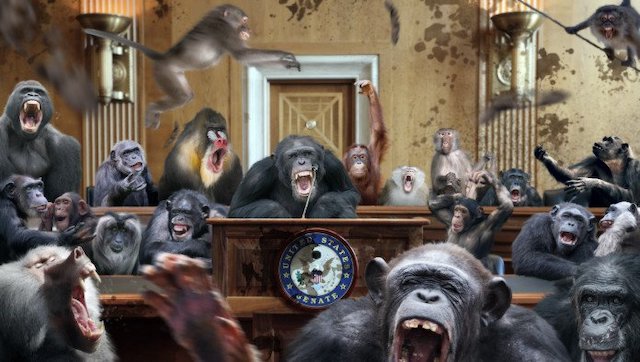
Baboons! – It is what they have become!
Oh, yes, my most excellent friends… this is especially true of politicians. They are consummate salespeople: Zohran Mamdani, Bernie Sanders, Chuck Schumer, Nancy Pelosi, Hakim Jefferies, and the other 535 baboons populating Congress, the opposite of progress. How on earth do you think they were elected? They sold the Merkan sheeple a bill-of-goods to get those seats. Only a few of them have been in place since 1789 – just kidding, but 10 of the current congressmen have been there over 40 years, and Chuck Grassley for 50 years.
AI is another tool that we’ve given full rein in our lives without ever understanding the implications or ramifications. We didn’t decide; it was dropped on us like too many other things, like the ‘Green New Deal’ and ‘The Affordable Care Act – Obama Care’ and ‘The War in Iraqistan’ or ‘Joe Biden and Kamala Harris’.
The list is extensive and carries profound implications. But… we don’t pay attention, and we probably never will. We don’t think… we react!
We’re conditioned to listen to authority figures, especially those in government. We pay them to protect us, and that’s a contract, but their mistakes carry few penalties. No one’s ever fired or imprisoned, only a slight public rebuke, and that’s it. They live to do it all over again. Nothing changes…
But then, maybe we don’t really care as long as there is someone else to blame for bad decisions.
When will we begin looking to AI as the scapegoat for the problems we create? I can hear the outcry… If it was so “f-ing” smart, why didn’t it stop us from making that misteak? (Intentionally Mispeled)
* It was a real battle to keep the AI spell and grammar checking software from correcting these intentional errors… Yes, I use AI, too, but very judiciously…
Until the next time…
Flippantly and Ironically, I am…

July 17, 2025
~ The Author ~
 Charles R. Dickens was born in 1951, is a veteran of the Vietnam war, for which he volunteered, and the great-great grandson of the noted author, whose name he shares.
He is a fiercely proud American, who still believes this is the greatest country on the planet, with which we’ve lost control and certainly our direction. He grew up in moderate financial surrounding; we’re not rich by any stretch, but didn’t go hungry – his incredibly hard working father saw to that. As most from that era, he learned about life from his father, whose story would take too long to tell, other than to say that, he is also a fiercely proud American; a WWII and Korean war, veteran Marine.
Charlie was educated in the parochial system which, demanded that you actually learn something, and have capability to retain it before you advance. He attended several universities in pursuit of a bachelor’s degree, and chased the goose further to a master’s, and has retained some very definite ideas about education in this country.
In addition, Charlie is a retired blues guitar and vocalist – a musician. This was his therapy career. Nothing brings him as much joy as playing music, and he wishes that he could make a living at it… but alas… life goes on!