
Much Ado About Nothing!
I want to thank William Shakespeare for the sub-title; I honestly couldn’t find anything more fitting. It says it all.
Isn’t that the purpose of the title? It entices us to read, listen, and watch more because we’re interested in what it promises. It piques our curiosity.
Shakespeare’s play is a romantic comedy about two couples, but the plot is almost beside the point. The title does the work. It promises drama, confusion, conflict, and entertainment before the curtain even rises.
Sound familiar?
That’s the point of this piece. Modern American news isn’t just news anymore; it’s theater — expensive, sprawling, profitable, professionally produced theater. It keeps us anxious, divided, and glued to the screen while pretending to perform a public service. The problem isn’t simply bad information. The problem is that fear, outrage, and attention have become the business model.
Nobody clicks on dull. Nobody lines up for boring. That’s not an accident; it’s the first hook.
Would you willingly sit through a movie titled “Two Hours of Carefully Packaged Nothing”?
How about a YouTube video titled “A Loud, Urgent Warning About Something That Hardly Matters”?
Open any news feed and look at the headlines, thumbnails, or video lead-ins. The pattern is hard to miss. Each one is a tiny advertisement for your attention, designed to make you curious, angry, afraid, or certain you need to know more. It is not just a headline. It’s bait.
There’s an old newsroom adage: “If a dog bites a man, that’s not news. But if a man bites a dog, now that’s news.” That line explains more about modern headlines than most media outlets would care to admit. The stranger, louder, angrier, or more alarming the story sounds, the more effective it becomes as bait. The headline doesn’t have to capture the truth of the story. It only has to pull you in.
Well, kids… here’s the truth. This is clickbait: misleading packaging designed to pull us in and keep us moving. These sites make money from clicks, watch time, ad impressions, and whatever else we engage with once we’re inside the maze. Much of this content is protected or excused as commentary, opinion, editorial judgment, or entertainment, making exaggeration hard to punish even when it distorts the story beyond recognition. The bait doesn’t have to be honest. It only has to work.
Why do we keep believing what we hear and see when the machine is built to get past our defenses? The hard truth is that only we can change this behavior. We’re here because we let the machine set the tone and tempo, and train us to follow along. How easily we get played.
This is performative art at its most profitable. It follows a playbook: programmed, produced, packaged, and professionally presented to provoke us and keep us watching. We’re not just being informed. We’re being played.
That same logic drives the modern news feed. Package the ordinary as urgent, dress the minor as catastrophic, and the audience stays close enough to click again. We’ll sit for hours watching and listening to news feeds that exaggerate, distort, and dress up ordinary stories as national emergencies, all to keep us engaged, enraged, and afraid to look away.
Speaking of entertainment… how about the news media in America? Not the old idea of journalism as a civic duty, but the modern machine: polished sets, urgent banners, theme music, staged conflict, professional outrage, commercial breaks, and a constant sense that something terrible is happening right now. They call it information, but too much of it is packaged, staged, and sold as a product.
The modern term for this is “infotainment,” a polite way of saying the news business took information, dressed it up as entertainment, and sold it as knowledge. Somewhere along the way, news stopped being treated as a public service and became a product. Once dedicated news channels arrived, the product went full-time. CNN — Cable News Network — helped turn the whole thing into a permanent feed: 24 hours a day, seven days a week, with urgency, conflict, analysis, outrage, and just enough truth to keep the machine respectable.
I should also include the Public Broadcasting Service (PBS), which, by charter, is supposed to operate in the public interest. That sounds noble enough. The problem is that even PBS is now trapped in the same partisan meat grinder as everyone else. Every fundraising pitch and political ad about its federal funding becomes another warning about the Right’s impact on the Left. Is that really public-interest broadcasting, or just another institution asking one side to save it from the other? Maybe it’s time for a more honest name: the Partisan Broadcasting System.

CON-gress
Since I mentioned Congress, have you watched what passes for Congressional hearings? They’re more like orchestrated attacks, with a viral ‘gotcha’ photo-op as the goal! Any witness is ‘chum’ for the circling sharks. The two sides align on partisan issues, hurling and volleying insults and accusations disguised as questions. I justly append the tag “Congress, the opposite of progress.” Which begs the question: What about the Republic — how does this help the citizenry?
Between 4,500 and 5,000 news programs air across America every day. Let that sink in. Add podcasts, streaming clips, social feeds, and digital-first programs, and the total may reach the tens of thousands. Americans spend much of the day immersed in media, and a meaningful share of that time is spent intentionally watching news or news-adjacent programming. That is not civic awareness. That is saturation.
This saturation doesn’t affect every generation the same way, but no one escapes it. Older Americans remain the backbone of traditional news consumption. Younger viewers get more of it through clips, feeds, and accidental exposure. Different doors, same pressure.
– 65 and older: ~83+ minutes per day — this group is the backbone of traditional news
– 30 to 49: ~68 to 74 minutes per day
– Under 30: ~45 minutes per day
Pew Research Center has tracked the shift from intentional news to incidental news. That matters. Many people no longer sit down at 6:00 p.m. to watch the evening broadcast. The news finds them — in clips, feeds, alerts, and whatever the algorithm decides to shove in front of their faces.
When Infotainment finds you all day, every day, dressed as urgency, danger, and crisis, it stops being background noise and starts rewiring your sense of reality.
Could this constant pressure be linked to the mental health of this country? I don’t think it explains everything, but I don’t think it should be excused, either. Mental Health America and the National Alliance on Mental Illness report that roughly one in five Americans lives with a diagnosed mental health condition. I’m one of them, though mine are service-related, and that distinction matters.
Where does this all lead? Straight into a pressure system. The volume, urgency, accidental exposure, and constant sense of crisis work together to keep us watching even when we know it’s wearing us down.
News programming is designed to reach the oldest parts of the human brain. We tell ourselves we’re staying informed, but the machine knows exactly what keeps us watching: fear, uncertainty, urgency, and the quiet suspicion that if we look away, we’ll miss something that matters.
Negativity Bias:
Our brains are wired to notice danger first. That made sense when the threat was a predator in the grass. Miss the predator, and you might not make it home. Miss the sunset, and life goes on. Modern news exploits that old survival wiring by feeding us crime, instability, political conflict, disaster, and crisis until the world starts to feel like one long warning siren. We keep watching because an ancient part of the brain still thinks our safety depends on it.
FOMO – Fear of Missing Out:
Before 1980, the news aired at set times. You either caught it, or you didn’t. Now the cycle never stops, and every event can be framed as a breaking crisis. Alerts, banners, and “new developments” keep telling us that something important is happening right now, and if we look away, we may be the only fool in the room who missed it. That’s the hook. The fear isn’t just missing information. It’s being left behind.
News organizations know exactly how to exploit that fear. They don’t just report events; they package them as privileged knowledge. Breaking-news banners, exclusive reports, urgent alerts, and “what you need to know now” language all send the same message: something important is happening, everyone else may already know it, and you’d better catch up. That isn’t information. That’s leverage.
Social Currency and the “Echo Chamber” Mandate:
News has also become social currency. At work, at family dinners, online, and wherever people gather to argue, the day’s headlines are the price of admission. If you don’t know the latest outrage, crisis, scandal, market panic, viral controversy, or political ambush, you risk sounding out of touch, uninformed, or just plain behind. That’s where FOMO really digs in. It’s not only the fear of missing the story. It’s the fear of being the only person in the room who doesn’t know the script.
Affective Forecasting – Pre-emptive Regret:
FOMO doesn’t just keep us watching. It makes us rehearse regret before anything even happens. We close the app, turn off the news, and immediately start playing the what-if game. What if the market crashes while I’m away? What if another conflict erupts? What if something important happens and I’m the last to know? So we reopen the stream, not because we learned anything useful, but because the anxiety became uncomfortable.
The Infinite Scroll Loop:
Traditional news had a natural endpoint. The newspaper ended. The evening broadcast signed off. Digital news offers no such mercy. Apps use the same machinery as social media — infinite scrolling, algorithmic recommendations, auto-playing clips — to ensure there is always one more update, one more angle, one more reason not to stop. Since the story never really ends, stopping feels like falling behind. That’s how watching turns into checking, and checking turns into addiction.
That is where the habit gets a name. Once watching becomes checking, and checking becomes addiction, we stop talking about ordinary news consumption. We start talking about doomscrolling.
Doomscrolling is the name for that loop: endlessly pulling in upsetting headlines, grim updates, and crisis after crisis, even when you know it’s making you feel worse. Doomsurfing is the same habit, but with a wider net — bouncing from feed to feed, site to site, looking for the next bad thing. At some point, it stops being awareness. It becomes self-inflicted surveillance. There’s even a term for the chronic stress that comes from living under that constant headline pressure: Headline Stress Disorder.
Mean World Syndrome:
Consume enough violent, hostile, and distressing media, and the world starts to look worse than it is. Not just troubled. Not just divided. Dangerous. Hostile. Rigged against you. That is the damage: the screen doesn’t just show the world; it trains you to expect the worst.
This is not just theory. A study published in Health Communication found that 16.5% of Americans showed signs of severely problematic news consumption. In that group, news was no longer just something they watched. It dominated their waking thoughts, interfered with work or school, disrupted time with family, and made sleep harder. At that point, staying informed had crossed into something else.
For people with severely problematic news consumption, the harm isn’t abstract. Many report anxiety, depression, hopelessness, fatigue, pain, stomach problems, and trouble sleeping. That should not surprise anyone. The human nervous system was never built to process a 24-hour global crisis cycle. At some point, the body starts keeping score.
 The CRAP & SIFT Tests:
There are ways to slow the machine down, but they require action. CRAP asks us to check Currency, Reliability, Authority, and Purpose. SIFT asks us to Stop, Investigate, Find better coverage, and Trace claims back to the source. Simple enough, right? Except the system is designed to keep us reacting before we verify. First, we have to recognize the problem. Then we have to want to SIFT the CRAP.
And no, I didn’t make up those acronyms. Honest.
Intent to Mislead:
This is why trust has collapsed. Roughly half of Americans believe that national news organizations are not merely making mistakes; they believe these organizations intend to mislead, misinform, or push the public toward a particular point of view. Another 52% don’t believe these networks act in the public interest. That is not a minor credibility problem. That is a public indictment.
Perceived Bias:
The distrust does not stop there. Pew Research Center data shows that 77% of Americans believe news coverage intentionally favors one party over the other rather than treating different perspectives fairly. That belief is especially high among Republicans, at 90%, but it remains high among Democrats, too, at 67%. Only 28% of adults say they have confidence in the media to report fully, accurately, and fairly. In other words, the suspicion is no longer on the fringe. It has moved into the center of American life.
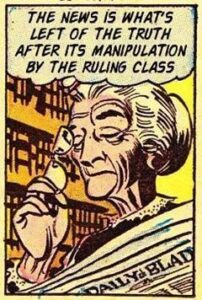 Manipulation vs. Personal Immunity:
Here is the part almost nobody wants to admit: we believe media manipulation is real, but we also think it mostly works on other people. A Verasight survey found that only 15% of people believe they are more affected by media manipulation than others. Everyone else sees themselves as average or immune. That is the trap. The system does not need us to be stupid. It only needs us to be certain we are the exception.
So is it any wonder America is coming apart along so many lines? If the information is distorted, the choices based on it will be distorted too. You can’t build sound judgment on crooked facts.
That collapse in trust doesn’t remain abstract. It follows people home. When citizens no longer share a basic set of facts, neighbors, families, and entire communities begin to live in separate realities. Disagreements stop being policy arguments and become moral battles. Eventually, people grow tired of filtering every headline for bias, so they tune out national media, retreat into niche online spaces, or cling to hyper-local news they can verify with their own eyes.
That retreat into niche media creates its own trap. People leave mainstream outlets because they no longer trust them, but many end up in smaller echo chambers that reinforce what they already believe. These outlets survive on loyalty, outrage, and the promise that everyone else is lying to you. Without real editorial guardrails or independent fact-checking, rumors can masquerade as truth. The audience thinks it has escaped manipulation, but too often it has only traded one machine for another.
So what powers both machines? Money.
The outrage machine runs on attention, and attention translates into revenue. Every click, every angry share, every extra minute we spend scrolling tells the system to keep feeding us more of the same. If we want the machine to change, we have to change what it’s rewarded for. That means starving sensational “hate-bait” headlines, supporting journalism funded directly by readers rather than by advertisers, and demanding privacy laws strong enough to stop platforms from building psychological profiles they can sell to the highest bidder.
In other words, we are not powerless, but we are responsible.
The outrage machine is not going to disappear. There is too much money in it, and too many people know how to profit from it. But its monopoly is starting to crack. More readers are turning to independent journalists, subscription-based outlets, nonprofit newsrooms, and local sources they trust. The old corporate model still has power, but it no longer owns the whole room.
What is replacing it is less tidy but perhaps healthier. Nonprofit newsrooms, independent journalists, subscription-based outlets, and local reporting are giving people ways to step outside the corporate outrage cycle. That does not mean the noise goes away. It means the old gatekeepers no longer control every entrance.
The danger is that this new landscape may not rebuild a shared public square. It may shatter it for good. People with money and patience will pay for better information from subscriptions, nonprofits, and independent journalists. Everyone else may be left with the free stuff: AI sludge, outrage bait, corporate propaganda, and whatever keeps the ad money flowing. That is not a healthier society. That is a caste system built on information.
The other danger is tribal retreat. People may escape the corporate machine only to vanish into smaller worlds that answer every question for them. Instead of one public square, we get thousands of locked rooms, each with its own facts, villains, heroes, and rules. That is not freedom from manipulation. That is manipulation with a smaller audience.
That’s what “balkanized” means: a larger whole shattered into smaller factions that distrust and fight each other, and eventually stop believing they belong to the same whole. The word comes from the Balkan Peninsula, but the useful part here is the warning. Once a society breaks into isolated tribes with separate realities, compromise does not just get harder. It starts to look impossible.
That fragmentation doesn’t happen in a vacuum. It sits atop the same business model we’ve been feeding all along.
How the Machine Gets Paid
Social media and info-tainment platforms make money by selling our attention. The apps are free because we are the product. Every click, pause, search, like, share, location ping, and late-night scroll helps build a profile of who we are, what we fear, what we want, what keeps us watching, and what might make us spend. Advertisers pay for access to that profile because guessing is expensive and targeting is profitable.
The platforms have also learned to monetize on both sides. If users hate ads, fine — sell them a premium subscription. If they want status, sell them a verification badge. If money changes hands in apps through tips, memberships, or shopping, take a cut there, too. The business is no longer just selling attention. It is turning every part of the user’s behavior into a tollbooth.
YouTube is a good example of how clean the machine can look on the outside. The platform calls it the YouTube Partner Program, and on paper it is simple enough: creators get a share of ad revenue, YouTube keeps the rest, and everyone pretends the incentives are neutral. But the system rewards what holds attention. Long videos, Shorts, outrage clips, reaction content, crisis commentary — if it keeps people watching, it has value. The split matters less than the incentive: attention goes in, money comes out.
Creators are not limited to ad revenue, either. Once they have an audience, the platform helps turn that audience into revenue. Memberships, Super Chats, live-stream tips, sponsorships, merchandise, affiliate links — every layer adds another way to cash in on attention. The creator may look independent, and sometimes they are, but the incentive remains the same: keep the audience watching, clicking, buying, and coming back.
The business model gets uglier once platforms stop measuring attention and start mapping behavior. They don’t just watch what we click. They watch what we search for, where we go, how long we pause, what we like, what we share, and what we keep coming back to at 2:00 a.m. All of it becomes a behavioral profile: a map of our habits, fears, weaknesses, interests, and impulses. That profile can be sold to data brokers, rented to advertisers, or used by the platform itself to keep us inside the machine.
At some point, tracking stops being creepy and becomes dangerous. A breach no longer just exposes an email address. It can expose patterns: where we go, what we fear, what we believe, and what we click when we’re tired, angry, lonely, or scared. Scammers, political operatives, advertisers, and propagandists can use that information to target our weak spots. Meanwhile, the platform keeps feeding us whatever keeps us there the longest, even when it leaves us anxious, isolated, addicted, or easier to manipulate.
Tech companies don’t need our permission. They already have it. Platforms bury data collection in Terms of Service agreements most people will never read and cannot realistically negotiate. Want the app? Click agree. Want the network everyone else uses? Click agree. Want the convenience? Click agree. That is the trick. Consent becomes less of a choice and more of a toll paid at the door. Then the details disappear into pages of legal language written to be accepted rather than understood.
Dark patterns are how platforms make privacy feel like punishment. Saying yes to tracking is quick, bright, and easy. Saying no means digging through menus, warnings, toggles, and language designed to wear you down. They don’t need you to confess everything directly. Your income, health interests, political leanings, habits, fears, and weak spots can be inferred from what you do and where you go online. Those guesses become targeting data. In the United States, our patchwork privacy laws leave plenty of room for companies to operate in the gaps. That is not real consent. That is guided surrender.
Pardon my cynicism and skepticism, but we’re in real trouble. We can’t change what we won’t acknowledge, and this is the elephant in the room that almost no one wants to face. The machine feeds on our attention, studies our behavior, sells our weaknesses, and then calls it all choice. Either we don’t care enough, or we’re waiting for someone else to fix it. But no one is coming to save us from a system we keep rewarding. Ben Franklin reminds us: “The trouble with doing nothing is not knowing when you’re finished.” Maybe the real problem is that we keep doing nothing, and the machine keeps counting on it.
For the Amalgamated Heavy
‘The devil you say…‘

September 21, 2026
~ the Author ~
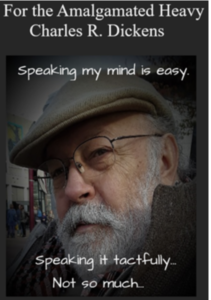 Charles R. Dickens Was Born in 1951, Is a Veteran of the Vietnam War, for Which He Volunteered, and the Great-Great Grandson of the Noted Author, Whose Name He Shares.
He Is a Fiercely Proud American, Who Still Believes This Is the Greatest Country on the Planet, With Which We’ve Lost Control and Certainly Our Direction. He Grew Up in Moderate Financial Surrounding; We’re Not Rich by Any Stretch, but Didn’t Go Hungry – His Incredibly Hard Working Father Saw to That. As Most From That Era, He Learned About Life From His Father, Whose Story Would Take Too Long to Tell, Other Than to Say That, He Is Also a Fiercely Proud American; A WWII and Korean War, Veteran Marine.
Charlie Was Educated in the Parochial System Which, Demanded That You Actually Learn Something, and Have Capability to Retain It Before You Advance. He Attended Several Universities in Pursuit of a Bachelor’s Degree, and Chased the Goose Further to a Master’s, and Has Retained Some Very Definite Ideas About Education in This Country.
in Addition, Charlie Is a Retired Blues Guitar and Vocalist – a Musician. This Was His Therapy Career. Nothing Brings Him as Much Joy as Playing Music, and He Wishes That He Could Make a Living at It… but Alas… Life Goes on!