
For the first time in modern history, a generation scores lower than the one that raised it. The reason sits on every school desk in America.

The $30 Billion Classroom Experiment That May Have Made Kids Worse at Learning. Image credit: Shutterstock
James Welsch teaches American politics at Gorham High School in Maine. His classroom runs almost entirely on screens. Students write blog posts, trade articles, and pull up videos mid-discussion. But a few years ago, Welsch noticed something wrong with the writing. Essays submitted digitally had grown choppy. Whole passages looked copied. The fluency he expected on the page was not there.
So he changed the routine. In some courses, Welsch now requires students to write first drafts by hand.
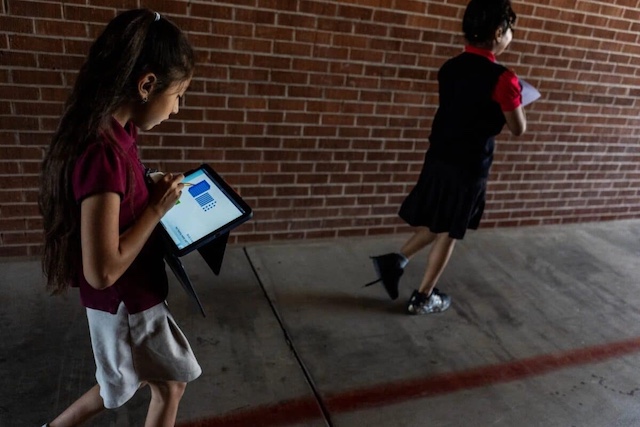
A textbook might be better after all. Credit: Melina Mara/The Washington Post
That small retreat from the screen captures the tension inside a 24-year national experiment. In 2002, Maine became the first state to put a laptop in the hands of every seventh grader, distributing Apple iBooks to 17,000 students across 243 middle schools. The goal was straightforward: close the digital divide and connect every classroom to the internet. What the state learned instead is that wiring a classroom and improving it are not the same thing.
Maine Paid $12 Million a Year. Test Scores Did Not Move.
By 2016, Maine schools housed roughly 66,000 laptops and tablets. The annual cost had settled near $12 million, about one percent of the state’s total education spending. After fifteen years, NPR found that statewide standardized test scores remained flat.
Amy Johnson researches education policy at the University of Southern Maine. She told NPR the problem was execution, not the underlying idea. Schools received the hardware, but teachers did not receive enough training on how to use it for actual instruction. “The fact that we’re not seeing large-scale increases in student learning leads us to suspect we still need to do some work with helping schools and teachers understand and keep up with the best ways to use technology for student learning,” she said.
Maine spent $12 million yearly on student laptops but saw no rise in test scores after 15 years. Image credit: Shutterstock
NPR’s reporting uncovered a second failure. In wealthier districts, students used their laptops for creative, collaborative work. In poorer and more rural schools, students mostly opened PowerPoint and Microsoft Word. A program designed to narrow disparities had instead created new ones.
Then-Governor Paul LePage did not qualify his assessment. He called the initiative a “massive failure,” a phrase Fortune later cited as the sharpest political verdict on Maine’s long experiment.
The Country Followed Maine’s Lead
Maine was the early mover, but the rest of the country soon caught up. Bloomberg reported in February 2026 that American schools spent roughly $30 billion on education technology in 2024. That figure is ten times what schools spent on textbooks the same year. Bloomberg’s editorial board noted the number could double inside six years.
What did not rise during this wave of spending was student performance. According to the same Bloomberg analysis, IQ scores in Western nations climbed for more than a century as schooling expanded. About two decades ago, that trend reversed. Gen Z now scores lower than their parents on measures of numeracy, literacy, and creativity. They are the first generation in modern record-keeping to post that kind of decline.
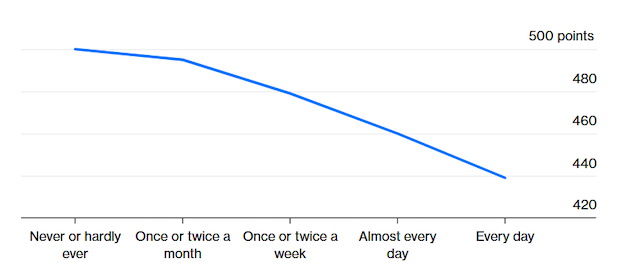
More Screen Time, Worse Scores. Gen Z is the first generation scoring lower than its parents. Credit: Organization for Economic Cooperation and Development
Screen time inside schools now fills a large portion of the day. A 2021 survey from the EdWeek Research Center found that 55 percent of teachers said students spent one to four hours daily on educational technology. Another 27 percent reported more than five hours. Only one teacher in a hundred said students used none at all.
Nearly Two-Thirds of Laptop Time Goes Off Task
One reason more screen time may not yield more learning is straightforward. Students are looking at other things.
A study published in 2014 in the journal Computers and Education tracked laptop use inside a university lecture hall with nearly 3,000 enrolled students. The research team combined direct classroom observation with student surveys. They found that students spent 63 percent of their screen time on activities unrelated to the class. Surveys pegged the figure at 61 percent. Note-taking was the most common on-task activity. Social media browsing topped the list of off-task behavior.
Students spend 63 percent of class time on off-task laptop activities, with social media as the top distraction. Image credit: Shutterstock
The researchers noted that in a cavernous lecture hall, students faced almost no risk of being caught drifting away from the lesson. The study examined higher education, not high school classrooms. But the pattern matches what Welsch saw in Gorham. Copy-and-paste habits crept into essays. Sentences grew stiffer when students typed instead of writing by hand.
The Apps on Those Screens Are Built to Hold Attention
A study from Baylor University helps explain why educational material struggles to compete with whatever else lives on a student’s screen. The research, published in 2025 in the journal Cyberpsychology, Behavior, and Social Networking, compared three short-form video platforms. TikTok outperformed Instagram Reels and YouTube Shorts on three design features: how effortless it feels, how accurately it recommends content, and how often it surprises the user.
Meredith David co-authored the study and teaches marketing at Baylor’s Hankamer School of Business. “But the prerequisite is effortlessness,” she said. “Without that ease of use, the other two wouldn’t matter as much.” TikTok begins playing video the moment the app opens. Competing platforms require a click. That seamless entry, the researchers concluded, is what enables the deeper engagement that turns into compulsive use.
David added that TikTok’s own materials acknowledge users can become hooked after less than thirty minutes on the platform. The study found that the app’s design features increase addiction by first increasing engagement. Users stop noticing the clock.
One Teacher’s Small Corrective

Teacher, James Welsch
The sources do not equate a school laptop with a social media feed. They document a parallel set of findings. The United States poured tens of billions of dollars into putting screens in front of students.
The earliest and most comprehensive state-level test of that approach produced no measurable improvement in academic outcomes. Meanwhile, a generation raised with those screens is now showing cognitive declines with no precedent in modern data.
In Gorham, James Welsch still teaches most of his class online. Students blog. They share clips. They discuss. But when the first draft is due, he puts the laptops away.
Written by Arezki Amiri for The Daily Galaxy ~ April 22, 2026