
Words and actions have prodigious corollaries…
 My subtitle highlights the immense and far-reaching consequences of what we say and do. It suggests that even small gestures or brief comments can trigger a massive “ripple effect” of logical or incidental outcomes. These outcomes can be far larger than their initial causes; careful consideration of both speech and behavior is essential to creating positive change.
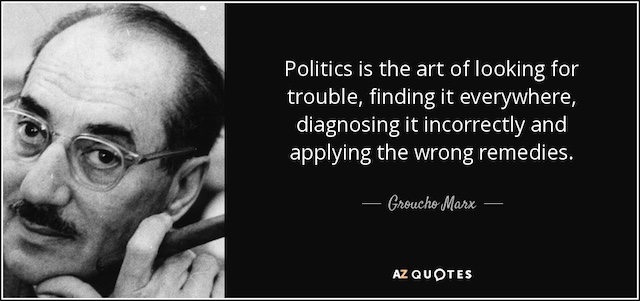
Groucho Marx famously described politics as “the art of looking for trouble, finding it everywhere, diagnosing it incorrectly, and applying the wrong remedies“. Julius – Groucho’s real name – was a self-described liberal Democrat who supported left-wing causes in the 1930s. He often mocked authority, politicians, and political institutions with cynical, witty humor, famously claiming he wouldn’t belong to any club that would accept him as a member.
Partisanship in the 1930s differed significantly from today, defined more by intense economic and class-based disagreements than by the rigid ideological, cultural, and partisan identities seen in modern politics. While the 1930s were marked by fierce debates over the Great Depression and the New Deal, the political landscape was less polarized in several important ways: Political parties were less consistently ideological than they are now. Both parties contained broad internal spectrums; for instance, there were progressive “Northern” Republicans who supported labor rights and conservative “Southern” Democrats who favored states’ rights. Because of this internal diversity, cross-party cooperation was more frequent. Financial programs and some New Deal social welfare initiatives often garnered bipartisan support, as the focus was on solving immediate economic crises rather than on fundamental value-based conflicts.
Politics is “the art of looking for trouble, finding it everywhere, diagnosing it incorrectly, and applying the wrong remedies…” What’s missing is how we ‘apply strictly partisan solutions and shift blame when they fail’. I call it hyper-partisanship and see this as the main differentiator, but the lack of partisan cooperation for the good of the republic is a close second.
I’m convinced that Congress, ‘the opposite of progress,’ has forgotten its purpose in our republic. The decline in a shared focus on the “good of the country” in the United States is widely understood as a long-term erosion rather than a single event, with key shifts becoming evident in the 1960s, as the ideological distance between the parties widened after the Civil Rights Movement and Watergate. Newt Gingrich’s leadership in the 1990s is widely seen as a turning point, when constitutional hardball and media-focused, performative tactics became standard. More recently, the lack of ideological overlap between radical liberals and conservatives accentuates this lack of a ‘Country over Party’ focus and is the dominant factor in our disaffection as a republic.
Since we’re a representative republic, we elect (hire) people to administer for us, fully intending that they speak for us, not for themselves or their party. There were a few times when a single partisan party gained control of both houses of Congress, ‘the opposite of progress,’ which marked turning points in our disaffection. The concentration of partisan control highlights the distance we have drifted from the original idea of this country and from why we wanted to separate from England.
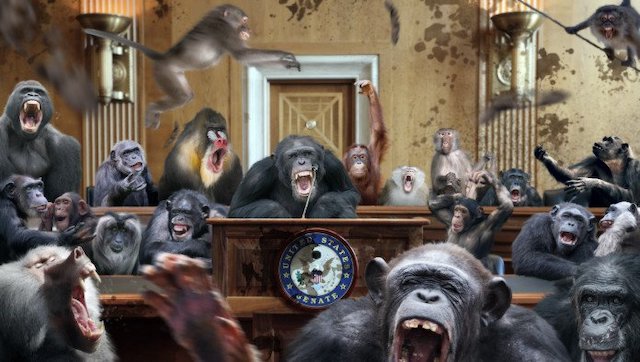
Monkey’s – It is what they have become!
Recommendation: There are 535 voting members in Congress, ‘the opposite of progress’, including 100 Senators and 435 Representatives. That’s far too many to be effective. Reducing the number of Representatives to 200, 4 from each state, evenly divided between the parties, would make governing more straightforward and less prone to partisan bias. Maybe the best option is to allow everyone to participate in the process by voting, which ensures that our voices are heard and eliminates the incessant bitching about not being involved in running this country. We already do this at the state level. Why not extend it to the national level as well? There are significant steps to deploy this idea, but it makes more sense than the debacle we suffer today.
The United States is a constitutional federal representative democracy, often described as a constitutional republic. It is a republic because officials are elected to represent the people, and our Constitution limits their power, protecting minority rights from the majority. It is democratic because citizens govern themselves through voting.
America is not a direct democracy! That’s a system in which citizens make decisions and pass laws themselves rather than electing representatives to do so. In its purest form, every member of the community has an equal voice and a vote on every policy.
I’m not sure whether it’s the Constitution, our genuine need for leadership, or our reluctance to accept responsibility for our mistakes. Perhaps it’s the emphasis on winning and our tendency to view mistakes as weaknesses, sources of shame, or threats to our personal and professional reputations, rather than as opportunities to learn. We seem to prioritize protecting our self-image over accountability. But what about our duty to each other and to this country as citizens? Yes, this is something else we neglect. We truly are a conglomeration of individuals in search of purpose and leadership.
There have been a few times in our brief history as a country when we came together to face an enemy. It proved we can, but that, too, has been co-opted by charlatans in government for nefarious purposes. We once came together to fight the Nazis, the Commies, Socialists, Marxists, the Fascists, Racists, Carpetbaggers, and external villains. Now, partisan politicians convince us that there is an existential threat to democracy and link it to these old enemies as a pretext for their own dominance. They expect us to unite against their chosen imaginary enemy with the same fervor and vigor, while they wave their banner for partisan political dominance.
Words and actions have prodigious consequences… even small gestures or brief comments can trigger a massive “ripple effect” of logical or incidental outcomes.
Political violence began to rise in 2015 and reached an all-time high in the mid-2020s. Starting in 2017, threats against members of Congress increased more than fivefold compared with previous years. By 2025, targeted political violence grew by another 40% year-over-year. It’s no coincidence that this closely followed Trump’s win in 2016. The surge in 2017 is attributed to a “perfect storm” of extreme partisan sorting, dehumanizing rhetoric, and the intentional use of intimidation as a political tool.
Before the 1990s, Americans often held overlapping identities (e.g., a religious conservative who was also a union member). By 2017, these identities had “sorted” into two homogeneous blocks. Republicans were increasingly white, male, Christian, and rural, while Democrats were increasingly diverse, urban, and secular. This alignment makes political disagreements feel like personal attacks on one’s entire identity, triggering deep anger and a “group-threat” response that can lead to violence.
Dehumanizing rhetoric that casts political opponents as “evil” or “subhuman” became more common after 2017. By early 2021, over two-thirds of Republicans and half of Democrats viewed the other party as “downright evil.” Significant percentages of both parties described opponents as “like animals” (16% of Democrats and 20% of Republicans). When opponents are seen as less than human, the psychological barriers to violence disappear.
Researchers note that violence is used as a campaign strategy, and threats have been deliberately deployed to achieve political ends. High-profile figures have used rhetoric to target specific officials, such as Secretary of State Brad Raffensperger, prompting death threats that forced his family to go into hiding. Threats have also pressured officials to resign or change policy positions, using intimidation to “whip” votes or clear the field of opponents. This has normalized extremism. Ideas once confined to fringe groups have moved into the mainstream via social media and political rallies, making paramilitary groups like the Proud Boys and Oath Keepers more visible in political life.
The point is that we are significantly better followers and are horrible leaders. The reason we often find ourselves acting like “followers” rather than “leaders” in our roles as citizens usually boils down to a few psychological and systemic factors: cognitive ease, the comfort of the tribe, the comfort of the consumer mindset, fear and the strongman trap, and overwhelming complexity.
In short, we aren’t “poor leaders” because we lack ability; we’ve been conditioned to believe someone else is in charge.
Recommendation: “Leading” as a citizen usually starts small.
* Stop the “Echo”: Avoid just repeating talking points you heard online.
* Local Focus: It’s easier to lead in your neighborhood or on your city council than in national politics.
* Listen to the “Other”: Real leadership means having the courage to talk to someone you disagree with without trying to “win.”
We’re trained and socialized, even indoctrinated from a young age, to fear mistakes, so we hide them or blame others to avoid social disapproval. Yet the best teacher of all is failure. Do you know anyone who sat at a piano for the first time and played Rachmaninoff’s Piano Sonata No. 2 without a single error? By the way, this is one of the most difficult pieces ever written – there are others. My point is that it is exceptionally rare for anyone to execute any task perfectly the first time, and some never master anything; these are the Mediocrates – close enough…
Remember the phrase “Practice Makes Perfect”?
I’ve used the term “Sheeple” in several past articles, and I’m bringing it back for this piece as well. I don’t mean to offend or demean anyone; I’m making the point that there are many more followers in America than there are leaders.

Sheeple May Safely Graze
“Sheeple” is a derogatory, informal term for people perceived as docile, compliant, or easily influenced. It is a portmanteau of “sheep” and “people,” implying that a person or group follows orders or trends blindly, without thinking for themselves, much like a flock of sheep following a shepherd.
Here’s my premise for this piece. There are pernicious problems in politics, especially in American politics. I believe most of these issues stem from the alienating and polarizing effects of hateful partisan rhetoric and warfare.
Americans in general are not leaders; we are followers… Sheeple. Yet when asked, roughly 44% say they are leaders and 29% say they are followers. This causes me serious concern. I would think that if roughly half of adults are leaders, why isn’t there more political independence and unbiased thought about our governance? Surely there are more than two ways to deal with any issue or situation, yet we’re limited to one of two hyper-partisan political parties and their decisions. Surely, there are other alternatives…
The current widespread discontent in America stems from a combination of recent international conflicts, persistent economic pressures, and deep-seated mistrust of political institutions. If that is true, why do these political institutions continue to fight with one another in public view, and why are they the only two viable partisan options?
Political parties continue to fight despite low public trust because their primary goal is to win elections, and modern political systems often reward conflict over cooperation. The ongoing battle only diminishes trust in the administrators and in our government as a whole. How can you trust anyone or anything that fosters dissent in the system? At that point, who’s right or wrong becomes a matter of partisan and ideological alignment. That’s no basis for an informed choice.
Partisan Political Strategists have found that negative partisanship, demonizing the opponent, or fear or dislike of the opposing side is a more powerful motivator for voters than positive policy proposals.
People increasingly view the “other side” as an affective-polarization threat, leading to “justified moral aggression,” in which harming a political opponent is considered a moral duty.
The U.S. winner-take-all system lacks a “third way,” forcing voters to choose between two sides. This heightens the stakes, as losing an election can feel like losing your way of life.
Politicians often fear a challenge from the “more extreme” members of their own party in primaries more than they fear a general election loss. This fear prevents them from moving toward the center or from compromising.
Redistricting and geographic sorting (gerrymandering) for many congressional seats virtually guarantee one party’s advantage. This incentivizes politicians to cater only to their most ardent supporters rather than to the general public.
Outrage fuels both campaign donations and social media engagement. Algorithms and political pundits often amplify the loudest, most divisive voices because they generate more “ragebait” and viewership.
Recent research suggests that 76% of people would rather conform than go their own way in group settings. Overall, people followed the wrong group 33% of the time. It seems that 40% prioritize feelings over critical thinking. While most people (over 70%) are capable of conforming to a group in a lab setting, only about 33% report high trust in the authorities they are “following.”
These are compelling reasons people follow certain patterns, and there may be statistical evidence supporting them. Proponents of the Climate Catastrophe also presented evidence for their assertions. Was it real, or was it contrived to support their premise? This supports my assertion that we are followers, not leaders. A true leader would investigate and weigh the facts.
And don’t you know that partisan political parties know we’re all that gullible and use it to their advantage? You should be comforted that gullibility is not a sign of low intelligence; it is a side effect of how the human brain evolved to prioritize speed, survival, and social belonging over perfect accuracy. The current state of political gullibility is not a “fault” in the sense of a single person’s failure, but leadership plays a major role in incentivizing it. Leaders often treat gullibility as a mobilization tool rather than a problem to be solved. In our current digital age, these ancient biological shortcuts are being exploited by modern technology and partisan politicians.
Oh yes… we’re being exploited!
When we stitch this together with the information about being followers rather than leaders, we arrive at 21st-century America…
America is widely regarded as a highly developed, influential, and diverse nation marked by intense political polarization, technological innovation, and significant economic inequality. We operate as a wealthy superpower with unparalleled cultural reach, yet we face internal challenges, including social cohesion, gun violence, and shifting demographics. We feel that society is struggling with compassion and that the political system is increasingly dysfunctional. We also contend with gun violence and mental health concerns, and there is notable, high engagement with social media, which is often seen as a driver of division, misinformation, and negativity.
Internally, the American two-party system is a political duopoly in which two major parties, the Democratic Socialists and the Republicans, dominate nearly every level of government. Although other parties exist, the structural “winner-takes-all” nature of U.S. elections makes it nearly impossible for third-party candidates to gain significant power. The rules governing ballot access, campaign finance, and televised debates are often set by the two major parties, creating significant hurdles for outsiders.
How’s that for a résumé or a biographical summary of America?
The current political climate fuels violence through a combination of extreme partisan polarization, dehumanizing rhetoric, and the rapid spread of misinformation, all of which normalize aggression and radicalize individuals. This environment erodes social norms, making threats against officials commonplace and casting political opponents as existential enemies.
Politicians and media figures often use violent or dehumanizing language, signaling to followers that aggressive action is acceptable. Online platforms and AI-generated content spread misinformation, accelerating polarization and fostering a “post-truth” environment in which conspiracy theories fuel anger. Ideas once considered fringe, including white supremacist ideologies and violent threats, have moved into the mainstream.
High levels of partisan polarization foster an “us vs. them” mentality, in which people perceive a threat to their shared identity and resort to violence as a defensive measure. A significant share of the public believes that leaders fail to condemn violence by their followers. This climate has led to a surge in threats against public officials and a rise in far-right and, more recently, far-left extremist activity.
There is an important point in that last paragraph. While we may find these actions distasteful, we still wait for leadership to act. Sure, a few individuals voice their disapproval, but they are in the minority. Now, larger protests are bought and paid for by political activists who fund them to advance their particular political agendas.
Leaders use vague or emotional language that invites followers to project their desires onto the message, bypassing the need for facts. They often win by validating a group’s fears and biases rather than challenging them with nuance. By framing the other side as an existential threat, leaders make followers feel that questioning “their” side is an act of betrayal. Many leaders gain influence by attacking traditional institutions (science, journalism, courts), leaving the public without a shared “truth” to rely on.
Leadership isn’t just about politicians; it also includes the heads of tech companies and media outlets. Tech leaders prioritize “time on site.” Algorithms are designed to promote content that triggers outrage, the fastest way to bypass critical thinking. Media leaders often find that “rage-bait” or partisan echo chambers are more profitable than complex, moderate reporting.
While our biology makes us susceptible, leadership bears the responsibility of stewardship. A leader’s failure isn’t that they caused human psychology to work this way, but that they often use that knowledge to deepen divisions rather than build resilience. Leadership is at fault when it chooses to exploit biological weaknesses for short-term power instead of strengthening civic tools, such as education and civil discourse, that protect against them.
Recommendation: To change this culture of exploitation and gullibility, experts advocate a “whole-of-society” approach that pairs individual psychological resilience with systemic reforms to government and technology. Instead of reading a single article, open new tabs to verify the source and the claim against established organizations. Deliberately choose to stop engaging with low-quality or “rage-bait” content designed solely to trigger an emotional response. Join cross-partisan movements such as Braver Angels or the Sandra Day O’Connor Institute’s Public Square to engage in civil discourse that humanizes the “other side.” The most effective way to lower political temperature is to publicly condemn misinformation or violent rhetoric when it comes from your own political “tribe.” This is what a true leader would do.
Many experts and bipartisan commissions argue that the “design flaws” in the current system can be corrected through specific electoral reforms:
– Ranked Choice Voting (RCV): As of 2026, RCV is used in dozens of U.S. cities and states, including Maine and Alaska, to ensure winners have majority support rather than just a plurality.
– Open or “Nonpartisan” Primaries: Moving toward “Top Two” or “Top Four” primaries, in which all candidates appear on a single ballot, forces leaders to appeal to a broader electorate early on, rather than to the most ideological 10% of primary voters.
– Independent Redistricting Commissions: Establishing nonpartisan bodies to draw legislative maps can end partisan gerrymandering, which currently creates “safe seats” that discourage compromise.
– Campaign Finance Reform: Proposed solutions include ending “dark money,” banning large donations from government contractors, and implementing small-donor matching programs to amplify the voices of individual citizens.
Restoring faith in leadership requires closing loopholes that allow for corruption or the appearance of corruption:
– Banning members of Congress and their families from trading individual stocks can reduce conflicts of interest.
– Expanding federal ethics laws to include the president and vice president and creating more robust, independent ethics watchdogs.
– Proposed constitutional amendments aim to prevent “corrupt” or preemptive pardons for political allies or family members.
Reform is not just about laws; it is about the social fabric that prevents violence and polarization.
– Civil society depends on individuals and leaders calling out bad behavior within their own party or “tribe” rather than attacking only the opposition.
– 2026 initiatives, such as the “Freedom 250” tour, focus on strengthening K through 12 civic knowledge to help young Americans navigate misinformation and understand shared democratic values.
– Democracy is often “healthier” at the local level. Participating in parent-teacher associations, local councils, or bridge-building groups such as Braver Angels can help de-escalate national tensions.
This “partisan political morass” is driven by incentives that make conflict more profitable than cooperation. Shifting these incentives through RCV and redistricting reform aims to make “moderate and cooperate” a winning political strategy once again.
Real American leaders will tackle these challenges head-on. Partisan, party-political leadership will stall and impede attempts to change the status quo because it threatens their power. Sheeple will follow along, nod knowingly in agreement, and continue grazing on what they’re fed, comfortable in their echo chambers, yet insist on their constitutional rights to complain and protest, changing absolutely nothing.
Words and actions have prodigious consequences… even small gestures or brief comments can trigger a massive “ripple effect” of logical or incidental outcomes.
The devil you say…
For the Amalgamated Heavy…

May 4, 2026
~ the Author ~
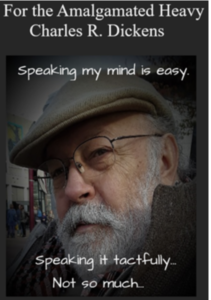 Charles R. Dickens Was Born in 1951, Is a Veteran of the Vietnam War, for Which He Volunteered, and the Great-Great Grandson of the Noted Author, Whose Name He Shares.
He Is a Fiercely Proud American, Who Still Believes This Is the Greatest Country on the Planet, With Which We’ve Lost Control and Certainly Our Direction. He Grew Up in Moderate Financial Surrounding; We’re Not Rich by Any Stretch, but Didn’t Go Hungry – His Incredibly Hard Working Father Saw to That. As Most From That Era, He Learned About Life From His Father, Whose Story Would Take Too Long to Tell, Other Than to Say That, He Is Also a Fiercely Proud American; A WWII and Korean War, Veteran Marine.
Charlie Was Educated in the Parochial System Which, Demanded That You Actually Learn Something, and Have Capability to Retain It Before You Advance. He Attended Several Universities in Pursuit of a Bachelor’s Degree, and Chased the Goose Further to a Master’s, and Has Retained Some Very Definite Ideas About Education in This Country.
in Addition, Charlie Is a Retired Blues Guitar and Vocalist – a Musician. This Was His Therapy Career. Nothing Brings Him as Much Joy as Playing Music, and He Wishes That He Could Make a Living at It… but Alas… Life Goes on!