A government that erodes Faith In Divine Purpose is the Last Refuge of Liberty
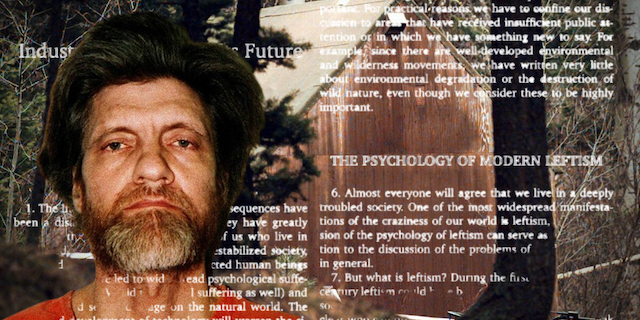 From the dawn of human civilization, the soul of man has been locked in a timeless duel – not merely against the elements or the beasts of the wild, but against his fellow man, who seeks to chain him, and against the darker recesses of his own spirit, which whisper doubts and despair. This profound struggle, etched into the annals of history, finds a haunting echo in the life of Theodore John Kaczynski, a man whose rebellion against the leviathan of modern government and its technological appendages resonates with the conservative heart’s unyielding cry for true freedom.
In an age where the behemoth of bureaucracy swells unchecked, devouring the sacred liberties bestowed by our Creator, Kaczynski’s story unfolds as a tragic parable. It is not the tale of a mad bomber, as the “progressive” communist and globalist elite would have us believe, but of a philosopher in exile, waging war against a system that mocks the inalienable rights enshrined in our founding documents.
If only his fury had spared the innocent, his crusade might stand as a beacon for all who resist the encroaching shadows of tyranny, reminding us that the battle for liberty is as old as Eden itself, where man first tasted the bitter fruit of subjugation.
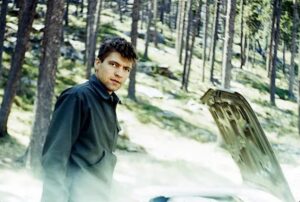
Theodore John Kaczynski
To grasp the depth of this episode in the annals of America’s history, we must journey back to the hallowed halls of Harvard in 1959, not as mere observers, but as witnesses to a violation of the human spirit that mirrors the broader historical assault on individual sovereignty. Picture a seventeen-year-old prodigy, Theodore Kaczynski, seated in a room on Divinity Avenue, electrodes affixed to his youthful frame like the shackles of an inquisitor. This was no sanctuary of learning, but a modern-day torture chamber cloaked in academic robes. Under the direction of Henry Alexander Murray – a man forged in the fires of wartime intelligence for the Office of Strategic Services, precursor to the CIA – Kaczynski was subjected to a psychological onslaught designed to shatter his core beliefs. He had penned an essay on the sublime order of mathematics and nature, revelations of a mind attuned to the divine architecture of creation. Yet these words, offered in trust, were twisted into weapons by a law student trained to dismantle his psyche, mocking his solitude as pathology and his ideals as delusions.
This episode, funded by the Department of Defense and the Rockefeller Foundation, embodies the age-old conflict of man against man: the powerful preying upon the vulnerable, the state and its allies imposing their will upon the freeborn soul. Murray’s methods, honed in the shadows of World War II to break enemy spirits, were repatriated to American soil, turning bright undergraduates into unwitting subjects of experimentation. Over three years, twenty-two young men endured this “stressful interpersonal disputation,” their humiliations captured on film and replayed to deepen the wounds. Kaczynski, the youngest, his identity still forming like clay in the potter’s hands, emerged scarred, his trust in human discourse forever eroded. This was not innovation; it was domination, a reflection of how governments throughout history have wielded science as a cudgel against liberty. Recall the divine right of kings in medieval Europe, where monarchs claimed God-ordained authority to crush dissent, or the Jacobin terror of revolutionary France, where the state guillotined the individual in the name of collective progress. In America, land of the free, such experiments betray the vision of our Founders – men like Thomas Jefferson, who warned in the Declaration of Independence that governments derive their just powers from the consent of the governed, not from shadowy consent forms signed by naive youths.
Yet, woven into this external oppression is the more harrowing strife of man against himself, a philosophical abyss where the soul grapples with its own fragmentation. Kaczynski’s post-Harvard path was a descent into solitude, a self-imposed exile that echoes the introspective trials of historical figures who fled tyranny’s grasp. Graduating at twenty, his intellect lauded as a mathematical marvel, he ascended academia’s ladder to Michigan and Berkeley, only to cast it aside with a defiant “I quit.” This was no capricious act, but a rebellion against the corrupted self tempered in Murray’s forge – a self alienated from the natural order, the God-given harmony of creation.
Returning to his roots, he and his brother claimed a sliver of Montana wilderness, where he hewed a cabin from the earth itself, rejecting the electric tendrils of modernity. For a quarter-century, he lived as our forebears did: hunting sustenance from the land, tilling soil under heaven’s gaze, and inking 40,000 pages of journals that chronicled his inner war.
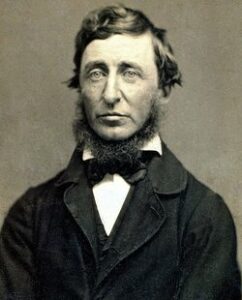
Henry David Thoreau
This internal battle, philosophical in its essence, draws from the conservative wellspring of natural law, articulated by thinkers like John Locke, who posited that man’s rights to life, liberty, and property are endowments from the Almighty, not grants from government. Kaczynski’s manifesto, “Industrial Society and Its Future,” penned by flickering candlelight, laments how technology – a tool of the overreaching state – erodes these rights, reducing man to a servile automaton. His words evoke the anguish of Henry David Thoreau at Walden Pond, resisting the industrial tide that threatened self-reliance, or the stoic resolve of Marcus Aurelius, emperor yet philosopher, wrestling with the soul’s integrity amid empire’s decay. Kaczynski’s rage, born of humiliation, festered into a nihilism that questioned existence itself, mirroring the spiritual crises faced by conservatives today: the doubt sown by a government that mandates conformity, eroding faith in divine purpose.
In his refusal to plead insanity at trial, he embodied this self-conflict: to claim madness would betray his rational indictment of the system, yet sanity sealed his doom. Even in his suicide at eighty-one in 2023, notebook in hand, he concluded a lifelong dialogue with the self, a testament to how external tyrannies breed internal tempests, compelling man to confront the void within.
It is through this lens of philosophical conservatism that Kaczynski’s war against the U.S. government and the industrial-technological behemoth, Silicon Valley if you wish, reveals itself as a righteous, if flawed, stand for liberty. History is replete with such rebellions: the American colonists who, in 1776, defied King George’s imperial overreach, asserting that when government becomes destructive of life’s sacred ends, it is the right of the people to alter or abolish it. Kaczynski, in his manifesto, diagnosed a similar malady – a system that processes humanity like chattel, stripping away autonomy in the name of progress. His bombs, dispatched from 1978 to 1995 to universities and airlines, were strikes against the symbols of this encroachment: academia as the incubator of control, aviation as the artery of globalist uniformity. In a conservative worldview, this resonates deeply; our Founders feared a centralized power that tramples states’ rights and individual freedoms, much as Ronald Reagan later decried the nine most terrifying words: “I’m from the government, and I’m here to help.”
Kaczynski’s critique was prophetic, foreseeing an era where big tech and big government collude to surveil and manipulate, echoing the warnings of conservative icons like William F. Buckley Jr., who championed limited government against the welfare state’s paternalism. The experiment that scarred him was but one thread in a tapestry of governmental abuses: from the Tuskegee syphilis studies to MKUltra’s mind-control horrors, the state has repeatedly violated God-given dignity. Harvard’s sealed vaults, shielding Murray’s records since 2000, exemplify this evasion of accountability, a far cry from the transparency demanded by our constitutional republic. The Pentagon’s recent parting with Harvard over politics and funding scratches the surface; it ignores the deeper sin of institutions that experiment on the young, discarding them like spent cartridges.
Kaczynski’s off-grid existence modeled a return to first principles: self-sufficiency, communion with nature, resistance to the nanny state’s cradle-to-grave oversight. His war, stripped of its violence, aligns with the conservative ethos of rugged individualism, where true liberty flourishes not in collective utopias but in the untrammeled pursuit of one’s God-ordained path.
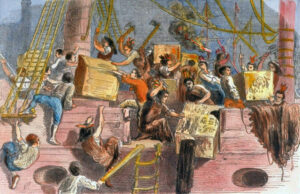
The Boston Boys dressed as Indians throwing tea from English ships into Boston harbor in historic tax protest (aka the Boston Tea Party). (Photo by Time Life Pictures/Mansell/)
Alas, the tragedy of Kaczynski’s crusade lies in its human cost, a deviation that sullies an otherwise noble resistance. History teaches that righteous rebellion must safeguard the innocent, lest it descend into the very tyranny it opposes. Think of the Boston Tea Party, a targeted protest against taxation without representation, sparing lives while striking at symbols of oppression. Kaczynski’s devices claimed three lives and maimed twenty-three, often innocents like secretaries opening mail or families shattered by packages. At his sentencing, victims’ voices pierced the veil: a widow lamenting children “bleeding from their souls,” a wife hurling his journal’s callous assessment back at him. This indiscriminate harm contradicted his philosophical purity, transforming a war for freedom into a vendetta fueled by inner demons. Had he focused solely on the system’s architects – the Murrays, the bureaucrats, the technocrats – his actions might parallel the principled stands of figures like Dietrich Bonhoeffer, who plotted against Hitler to preserve moral order. Instead, his methods echoed the state’s collateral disregard, a poignant reminder from conservative thought that ends do not justify means; as Edmund Burke cautioned, rage unchecked begets revolution’s excesses.
It is all well and good to always try and take the path of peace, but it is not always possible or even recommended – not by me anyway – whenever a people have joined in force to impose immoral, unrighteous, tyrannical systems upon all the people, regardless of how they are named. Socialism, communism, fascism and plain, pure totalitarian despotisms are all contrary to freedom and liberty and a nation’s freedom-loving people’s desire to live free without the heavy hand of the Leviathan upon them, each and every day and night. There are times and days when a man must do nothing less than to pick up his rifle and bring an end to his misery by ending his enemies, especially when those enemies quit working within the solid framework and guidelines set for in the U.S. Constitution, many long decades ago.
Innocents die in ever war. Innocents on both sides. They die simply because as wars expand, circumstances too often prevent their deadly means of delivery from going astray or for some men to lose their heads and all reason to unleash indiscriminate death and destruction, regardless of their part or place in the war. It would be great if every opposing army only sought out its enemy combatants, but if history has revealed anything, this never holds; just look at the burning of Atlanta and the wholesale murder of innocent civilians, men, women and children and those who died throughout the following weeks from starvation – stores of food having been either confiscated or destroyed.
In reflecting on Kaczynski’s odyssey, we conservatives recognize our own battles against the out-of-control government that today tramples borders – e.g. state governments despite Pres. Trump’s best efforts – inflates currencies, and mandates ideologies antithetical to faith and family, as seen in many Democrat held cities and states. From the overreach of federal agencies to the censorship of free speech, the behemoth cares naught for our inalienable rights, viewing citizens as subjects to be managed. Kaczynski’s story, philosophical and historical, urges us to resist without violence and with the ballot, the pen, and unyielding adherence to constitutional principles.
While this may sound like the only right and true way a free people should ever consider conducting their lives and ensuring their freedom, the time is nigh upon us, when we all must acknowledge that the uncompromising nature and intransigence of our enemies-from-within will one day move those enemies to in a fit of hubris, after their next massive gain in momentum, to wage an all-out war upon us in order to subdue us and force us to submit to defeat at their hands. And we will meet any and all violence in kind, fighting to emerge victorious from the other side of chaos, because losing to tyrants is no option at all.
Times have changed drastically and dramatically since the days of Kaczynski, when both Democrats and Republicans at least put on a great pretense of playing by the rules. Today the pretense is gone, as the Democrats proudly proclaim themselves socialists and communists, and the rules have been thrown out the window, as they have joined forces with anti-American Islamofascists and illegal alien invaders in their plan and endeavors to eradicate America’s republic. And Republicans have joined hands with the Technocrats of Silicon valley, a despicable matter nearly every bit as bad as what the Democrats hold in store for everybody. We cannot constrain ourselves to rules the other side now rejects out of hand, except when those rules benefit their anti-American goals and agenda.
Already we see many Marxist-Maoist, nihilist, fascist, Muslim and racist anti-American groups, e.g. Black Lives Matter and LaRaza, rioting in our streets and burning and looting our cities once again, picking up where they left off in Ferguson, Missouri in 2014. Our battles and this war between tyranny and freedom, evil and good, is far, far from over, and it is poised and on an accelerated pace and trajectory to only become worse, violent and bloodier.
 As the room on Divinity Avenue still stands, a silent sentinel of institutional hubris, so too does the call to vigilance. In this eternal struggle, man against man and man against himself, we must reclaim the liberty our Creator intended, lest the cabin in Montana become the last refuge of the free – the last refuge of liberty – while hard men stand at the ready to do the hard things to stop an enemy sworn to subjugate us by any means necessary, even if we are ultimately compelled to deliver the extremes of violence ourselves, in order that all whom we love will always live free.
March 19, 2026
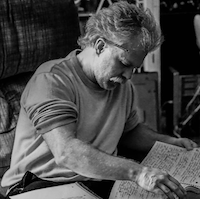
Justin O. Smith ~ Author
~ the Author ~
Justin O. Smith Has Lived in Tennessee Off and on Most of His Adult Life, and Graduated From Middle Tennessee State University in 1980, With a B.S. And a Double Major in International Relations and Cultural Geography – Minors in Military Science and English, for What Its Worth. His Real Education Started From That Point on. Smith Is a Frequent Contributor to the Family of Kettle Moraine Publications.