 For the past several years, probably more than I care to admit, decisions have been made that affect nearly all of us. I’m referring to the Portable Altar of Enlightenment: the modern smartphone, or cellphone, as many people call it. I prefer the moniker I’ve coined, PAE.
This ubiquitous personal appendage is in nearly every hand, from age 8 to 80 and beyond, across the country. The latest count puts the number of wireless subscriptions at over 331 million, and because many people own more than one connected device, the total number of phones and related units exceeds 380 million.
The PAE is the quintessential communication device. It provides instantaneous, bidirectional information transfer across the globe. There are precious few places on this planet these devices cannot reach; where they cannot, the satellite phone – Sat Phone, if you prefer – can still find us.
So as we watch, we are also being watched. But that is not entirely my point.
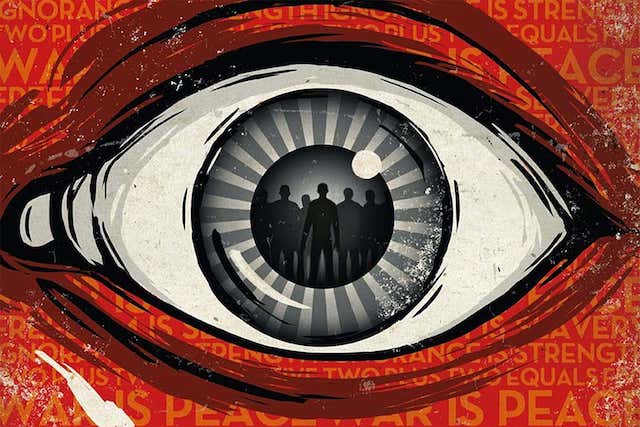 Big Brother is truly watching us, but the more immediate problem is that Big Brother also expects us to conduct business through the same tiny screen.
Being a veteran, I take advantage of the U.S. Veterans Administration’s offerings, better known as the VA. Although the system moves at the speed of dark, there are rewards for the infinitely patient. Factually, darkness travels at the speed of light, which is pretty fast: 186,282 miles per second. It just seems slower. Darkness seems to sneak up on us, but if you think about it, so does dawn.
 The Edge of Darkness is an unsolicited, albeit gratuitous, plug for my friends’ podcast; so my analogy should be slow as a common garden snail, or molasses, or oil paint drying. What I’m circling, or perhaps circumnavigating, is the way the VA and other government agencies deliver, request, and respond to information.
As for the Personal Altar of Enlightenment, the PAE, it has become the favored information delivery and acquisition mechanism of every agency on the planet. All of our communications are directed through and to this device. The effective size of this print, called font point, is programmed at between 14 and 17 points, but the actual size relative to the screen is about 8 points.
Here are some samples for reference: 17 point – 8 point. It is officially known as micro-text. Your phone usually displays data at a much smaller size unless you have modified your settings. But that has its downside, too. Larger, more readable font consumes more space on that tiny screen. So you are either continually scrolling or reaching for a magnifier to read your message. This document is written in 12-point Times New Roman. Even with glasses, that can be tiny; and depending on your particular device, it may appear even smaller.
Who thought this up? Allow me to correct that last sentence: why didn’t anyone consider this when moving all communications to these Portable Altars of Enlightenment?
Perhaps we have all noticed people holding their phones very close to their eyes. Now imagine, or recall, trying to fill in a form on a phone while scrolling side to side and up and down just to read the options and instructions.
I’m 75 years old, and I’m quite proud of outliving my original warranty, which according to national statistics is 71.2 years. Approximately 40 million people are over 70 years old, about 12% of the total 349 million in the U.S. population. Even allowing for some rough edges in those figures, the point still stands – millions of older adults are expected to conduct essential business on devices that were not designed around their comfort, safety, or health.
The point of my kvetch is that most companies in the service industry have made one major mistake: they don’t know their customers.
 They don’t know their customers. Or maybe they don’t give a rat’s ass. Remember: profit is king.
Imagine selling potatoes, but only in 50-pound bags.
Most customers only need two or three pounds at a time.
If a commercial dealership sells automobiles only to the corporate rental industry in lots of 100 to 200 cars at a time, it is missing a large portion of the available market.
Private buyers still exist, and many of them need one vehicle, not a fleet.
What if a company sells bib overalls only in XXXXX size, while most of its clientele is normally sized? Obviously, not Americans – we’re all “plus-sized.” According to U.S. statistics, the average male wears a large, and the average female also wears a large, although women’s sizing is far more complex and far less standardized than men’s. It’s a long explanation, and an emotionally loaded one.
Consumer ego and psychological marketing play a massive role in why women’s clothing sizes are different and inconsistent. Retailers deliberately exploit the link between clothing size, body image, and self-esteem through a targeted marketing tactic known as vanity sizing.
But that’s all a bit off topic. I’m pointing out that our economy is market-driven, not consumer-driven.
Why do we put up with this intentional manipulation of market dynamics? Who is working for whom?
Every user of these Portable Altars of Enlightenment, the PAE, is forced onto the same predetermined six-inch diagonal screen regardless of individual need. Okay, I’ll admit there are tablets and larger screens, but those come with a premium price; and the larger the device, the less portable it becomes. It is not a huge problem for someone with a purse or briefcase, but our Pavlovian conditioning tells us to respond at the bell, retrieve the device, and see what it wants. It must be important, or they wouldn’t have called.
So now, to retrieve the PAE, we have to stop what we’re doing, fumble for the latch on a briefcase, or dig through a purse to find this cursed device and answer before the fourth ring, or whatever the setting happens to be. Unless we’ve mastered the quick draw, we’re distracted and fumbling, and we probably miss that ever-so-important call or message anyway.
And by the way, I don’t need XXXXX bib overalls, and I have a phone for convenience, not as a tether or leash. But now every service and information company sees this device as a license to pummel us with advertising; and should we choose not to partake, it becomes our responsibility to block these invasions of privacy, if that is even possible.
Apparently, purchasing these devices is treated as permission to be annoyed, even though federal laws are designed to protect mobile users from unsolicited advertising. If we receive unwanted marketing calls or text messages, the senders may be violating federal privacy regulations.
But – and here’s the big but – it is still up to us to stop it. Federal law may make unsolicited mobile advertising illegal, but the modern telecom system relies on a “report and enforce” model rather than proactive blocking. Then comes the consent loophole: advertisers often slip permission clauses into long Terms of Service agreements when we buy a product, sign up for a website, or join a loyalty program. Because we technically “agreed” to it in the fine print, carriers cannot automatically block the company without our explicit command, such as replying STOP.
Millions of illegal robocalls originate from overseas scammers using spoofed, or fake, local numbers. Because these illegal actors constantly switch numbers, automated software cannot block them all without accidentally blocking legitimate calls, such as a doctor’s office or a delivery driver.
The average user receives between three and four unsolicited contacts per day. I tracked my own for a month – yes, I’m that curious – and my average was eight calls or texts per day.
Phone carriers don’t read our text messages or listen to our phone calls to decide whether they are annoying. Doing so would violate federal wiretapping and consumer privacy laws. So the carrier relies on us to tap the Report Junk button and train its algorithms.
It doesn’t seem to be helping, because our reports are fighting a multibillion-dollar digital arms race. Our carrier may successfully block one number or spam script based on a report, but scammers bypass those defenses in seconds by exploiting massive technological loopholes.
The monster we created has outgrown the laboratory: “We have built an industry so good at capturing attention that we have left our customers desperate to unplug.” – Industry adaptation of Pico Iyer
Robocalls and spam are the visible irritation, but they are only the symptom. The deeper problem is that the same device used to interrupt us is now being treated as the required portal for serious business.
This is all fine and good for general robocalls and spam, but what about being forced to do business on our PAE?
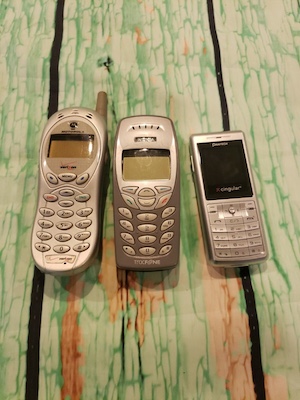
Yeah, Yeah, Yeah – I know – these are old ones!
Using a smartphone for complex tasks – reading micro-font contracts, filling out detailed business forms, or checking boxes with legal consequences – is frustrating because the hardware was designed for quick consumption, not serious production. Yet when companies force us into mobile-only transactions, we are left fighting the physical limits of a small screen and touch interface.
We shouldn’t have to accommodate them, and the frustration is entirely justified. The traditional idea that “the customer is always right” has been flipped upside down by corporations using technology to cut their own operational costs.
When a business forces us onto a mobile workflow, it is essentially outsourcing its data-entry labor directly to our thumbs.
When we physically check a microscopic box on our own phone screen, the burden shifts. If there is a typo or mistake in the transaction, the company can point to the entry and call it user error on our end, neatly protecting itself from responsibility.
Modern software companies design heavily for mobile devices because that is where much of the consumer traffic is. They optimize for scale and corporate efficiency, often at the expense of individual users who prefer desktop computers, larger screens, or physical paper.
We have economic and regulatory leverage to reject these digital demands, at least in theory. Accessibility laws and digital-accessibility expectations often require companies to provide reasonable alternatives when a form is unreadable or unusable. But the system still puts the burden on us to initiate the contact, explain the barrier, and ask for a human or paper alternative.
If an optional business or service provider refuses to offer a desktop or paper alternative, we can vote with our wallets and move to a competitor that offers a human-centric or multi-device interface. Federal laws like the ESIGN Act recognize that consumers cannot always be forced into electronic documents or signatures without consent, and that principle matters. But again, the burden still falls on us to object.
 What really pisses me off about this entire situation is the de rigueur expectation – the mandatory assumption – that we accept it without being asked. And yet again, we are at the mercy of the vendor; we serve them, and we are expected to pay for the privilege.
The flip from corporate “customer service” to customer-accommodating “self-service” did not begin with the smartphone, but the phone made it personal. It was a calculated, multi-decade corporate drift that accelerated dramatically around 2010. Once businesses discovered that customers would tolerate doing small pieces of unpaid administrative work, they rebranded “doing the work yourself” as convenience and speed while quietly slashing their own labor costs and shifting the work to us.
The first major shift arrived in the early 1980s with Interactive Voice Response systems, better known as the automated phone tree. Before that, calling a business usually meant speaking to a human operator who routed the call. With automated menus, corporations transferred the labor of routing a telephone call from a paid employee directly to our index fingers.
Artificial intelligence (AI) has made that exchange even stranger. It often forces the human to behave like a computer, while the computer tries, badly, to behave like a human.
The second wave arrived with the mainstreaming of the internet in the early 2000s. Corporations downsized physical call centers, reduced printed manuals, and launched Frequently Asked Questions pages and digital knowledge bases. When a consumer had a problem, the new corporate answer became: “Look it up online, research it yourself, and diagnose your own technical issue.”
The tipping point arrived in the early 2010s with the explosion of smartphone apps. Banking, airlines, healthcare, and retail moved heavily into mobile-first service and began nudging, penalizing, or outright forcing consumers away from human interaction. Airlines charged fees to book by phone, banks closed branches to push app usage, and support numbers disappeared behind endless layers of automated text chatbots.
Corporations pulled off this transition with a neat psychological trick: they branded the outsourcing of labor as consumer empowerment. Waiting for a human became old-fashioned; scanning our own groceries, printing our own boarding pass, and typing our own data into a mobile form became proof that we were efficient, modern, and in control. Once enough customers accepted that trade-off, companies dismantled much of the human-service infrastructure and left the rest of us doing administrative work on tiny screens.
That is the daily insult hidden inside the word “CON-venience.” A task that should take two minutes becomes a high-friction ritual of tiny text fields, rigid formatting errors, disappearing progress, and long answers typed on a cramped virtual keyboard. Instead of saving time, the system turns a simple exchange into an eye-straining chore that makes a paper form, or even a desktop screen, look like civilization itself.
That leaves the average consumer trapped in forced compliance: businesses have shifted the administrative workload onto our phone screens while quietly removing the exits.
Companies cut costs by eliminating paper, closing physical offices, and removing human staff; then they hand the clerical work back to us and call it progress.
The real cost of this “no choice” landscape shows up as a customer-service tax, technological coercion, and a loss of consumer leverage. We spend our own time fighting rigid digital interfaces, error loops, and broken drop-down menus before we can even get what we already paid for. If our eyes strain on small screens, our fingers miss the tiny buttons, or our cellular connection drops mid-form, the system simply locks us out without an escape hatch. And when there is no phone number to call and no physical counter to visit, we lose the ability to negotiate, explain a nuanced problem, or make a human being responsible for fixing it.
Ultimately, the system forces us, the consumers, into an unfair trade-off: accept the friction and eye strain of the phone screen, or go without the service entirely.
When we run into these broken digital walls, the choices are rarely satisfying. We can hunt for a workaround, appeal through public complaint channels, or give up on the business entirely out of sheer frustration.
We can sometimes claw our way around these broken systems by hunting for hidden phone numbers, alternate forms, or browser tools that reduce the typing. But notice the trick: even the workaround becomes another unpaid task. The burden still lands on us, and we must spend more time learning another tool and building a private escape hatch from a system the company should have made usable in the first place.
Here is the exact irony: to escape the frustration of a cellphone form, we are forced to use the cellphone even more intensely just to set up the workaround. That paradox creates a deeper layer of tech fatigue because it demands that we become IT technicians merely to complete a simple service questionnaire. Real relief comes only when we put the phone down and move the task to a desktop computer or laptop, where a full-sized keyboard, larger monitor, and traditional mouse make corporate data transactions infinitely less painful.
The ultimate question behind modern digital transformation is simple: technology is no longer serving us; we are serving the technology.
When automation shifts from a convenient option to a mandatory requirement, the traditional relationship between business and consumer is flipped. We are no longer customers being served by a business; we are pressed into the role of unpaid data-entry clerks for that company.
Businesses use mobile apps, IVRs, and rigid digital questionnaires to protect their own balance sheets, not to improve our lives. By forcing us to click the buttons, navigate the error messages, and format the data perfectly into their databases, they offload their operating costs onto our personal time and energy. It is a highly effective corporate trick: they extract our labor, call it “self-service convenience,” and leave us holding a glowing piece of glass, doing the work they used to pay someone else to do.
That raises the final question: will this trend eventually trigger a widespread consumer backlash demanding a return to human service, or has corporate cost-cutting locked us into this loop for the foreseeable future?
The harsher answer is that corporate cost-cutting has already made that loop feel normal by turning human empathy and human time into premium services. Consumers cannot realistically boycott every airline, bank, hospital, utility company, and government portal at once, so organizations face little financial risk when they hide behind rigid, cost-saving digital walls. The result is a growing digital class divide: immediate human support is increasingly reserved for high-fee subscriptions and VIP tiers, while the average consumer is left fighting glitchy mobile interfaces as an unpaid data-entry clerk. We are not returning to the old way easily; the modern service system is designed to wear us down until we accept personal strain as the price of protecting someone else’s balance sheet.
That is the fundamental scam of the modern service economy: the consumer is hit with double extraction, paying once with hard currency and a second time with personal time, labor, and cognitive energy. By locking us into a digital landscape with no practical exit, corporations have commercialized what used to be their own overhead costs. They eliminate receptionists, bank tellers, and data-entry staff, but they don’t pass those savings back to us. They pocket the savings while we perform the clerical work on our own phone screens. We pay the full sticker price for the product, then pay an administrative tax of eye strain, confusion, and frustration just to claim what we already bought. In this flipped arrangement, we are no longer valued customers but exploited resources; service is no longer about helping us, but about making us serve the corporation’s database.
From that premise of near-total capture, the next question is how corporations psychologically train us to accept this double payment as normal – and how the same extraction is spreading into automated grocery checkout, self-diagnostic healthcare, and every other place where service quietly becomes unpaid labor.
At some point, convenience stops being a service and becomes a transfer of work disguised as progress.
The PAE didn’t make our lives easier; it made our labor invisible.
But that’s another kvetch…

For the Amalgamated Heavy…
August 13, 2026
~ the Author ~
 Charles R. Dickens Was Born in 1951, Is a Veteran of the Vietnam War, for Which He Volunteered, and the Great-Great Grandson of the Noted Author, Whose Name He Shares.
He Is a Fiercely Proud American, Who Still Believes This Is the Greatest Country on the Planet, With Which We’ve Lost Control and Certainly Our Direction. He Grew Up in Moderate Financial Surrounding; We’re Not Rich by Any Stretch, but Didn’t Go Hungry – His Incredibly Hard Working Father Saw to That. As Most From That Era, He Learned About Life From His Father, Whose Story Would Take Too Long to Tell, Other Than to Say That, He Is Also a Fiercely Proud American; A WWII and Korean War, Veteran Marine.
Charlie Was Educated in the Parochial System Which, Demanded That You Actually Learn Something, and Have Capability to Retain It Before You Advance. He Attended Several Universities in Pursuit of a Bachelor’s Degree, and Chased the Goose Further to a Master’s, and Has Retained Some Very Definite Ideas About Education in This Country.
in Addition, Charlie Is a Retired Blues Guitar and Vocalist – a Musician. This Was His Therapy Career. Nothing Brings Him as Much Joy as Playing Music, and He Wishes That He Could Make a Living at It… but Alas… Life Goes on!