
 A song I recently “discovered” on TikTok, entitled ‘Alone’, had a theme of unimaginable acceptance of death and a defeatist attitude that made me hurt for the person who was so low in his life to even have thought to create such a song. It made me contemplate how many men and women might be in just such similar circumstances, that they view their daily lives as a burden and prefer to welcome death, as if finding a new friend.
How hurt a man would have to be to believe he had fallen so low in life that he welcomed death to come, even wished for it, at any point in his life. No matter one’s circumstances – no matter how poor one may be or how hard one must work to survive from day to day, one should never, must never, simply give up on themselves and their own life. They must fight to hold onto any spark of hope – the one thing in this world that they love the best – that helps them wage their day-to-day battles against the doubts swirling in their minds, that war within their mind.
Life isn’t easy for anyone, although many may initially have it easier than most at birth, being born with a silver spoon in their little hands, but with the passage of time, Life has a way of turning events that sometimes see the rich being struck down low by events and the poor raised up by those same events, or different occurrences over the passage of time.
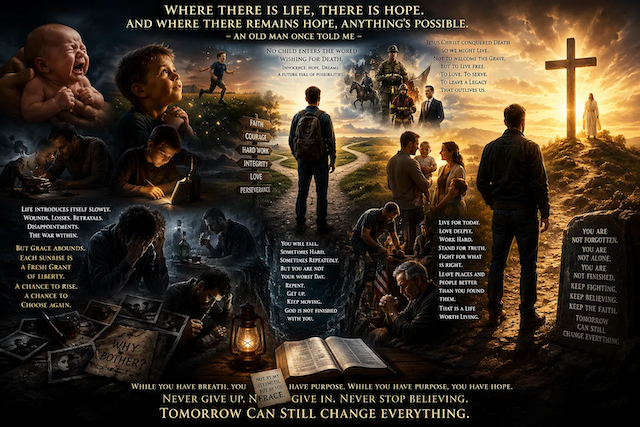
As an old man once told me … “Where there is life, there is hope. And where there remains hope, anything’s possible.”
This is why one should never just give up and welcome death at any point in his or her life, because everything can change in the passing of one moment. And it makes me question just exactly how and why any person could follow a path that would lead him or her to such a dark place as what the songwriter lays out in the following song lyrics:
“I went into a bar and sat down. The bartender took my order and left, and returned quickly with my shot of whiskey.
And she asked me, if death sat next to you in a bar, looked you in the face and said your time is up, what would you say?
My first question would be, oh … what took you so long? I’ve sent the invitation long ago. You’ve rejected me so many times. Sorry, man, one last thing … can we just sit together for a bit, so I can finally have a friend, please?
Oh I don’t mean to make you cry, but when I die just box me off; I need no headstone, no names, no titles — I’m a piece of shit who will be forgotten anyway.
My mind has been a war zone, at least I pray I find peace now.
And if I die no matter what, don’t bring me back here. It’s dark here. And I hate the dark, but at least I tried, even tho’ I tried with memories I would love to relive again.”
Such words chill the blood of any soul still clinging to light. Yet they are the honest confession of a heart that has let the long dark night creep too close. From a liberty-minded, Christian vantage, we must answer this despair not with wallowing pity and too much sentiment but with the steel of Scripture. Life is no easy pasture, silver spoon or not. But while one has breath, there is hope – and where hope remains, a man may yet rise again.
There are few things more tragic in all this world than a man who has forgotten the sound of his own laughter.
No child enters the world wishing for death.
The infant who draws his first breath beneath the Good Lord’s Heaven knows nothing of despair, bankruptcy, betrayal, loneliness or grief. He enters the world crying, demanding life with every ounce of strength his tiny lungs can muster. His small hands reach instinctively toward warmth and comfort. He seeks his mother’s embrace, his father’s protection, and the simple assurance that he belongs somewhere in this vast and often frightening world.
In those earliest days, before the world has laid its burdens upon him, he possesses a treasure that many grown men spend their entire lives trying to recover. He possesses innocence. He trusts. He hopes. He believes tomorrow will come and tomorrow will be good.
Consider the arc of a single life, lived beneath the open sky of God-given liberty. A man is born squalling into a broken world, not as a meaningless speck but as an image-bearer of our Creator. In his infant cry lies the raw material of destiny. He is no slave of fate nor puppet of circumstance. Liberty is his birthright: the freedom to choose, to strive, to fail and rise again. The Christian knows this freedom was purchased at terrible cost upon a Roman hill. Jesus Christ did not die so we might welcome the grave like an old drinking companion. He conquered Death and rose from the grave.
Childhood passes in a blur of wonder and small wars. The boy learns the sting of scraped knees and broken toys, the warmth of a father’s calloused hand, the quiet instruction of a mother’s prayers. He senses, even then, the war within – the pull toward selfishness, the whisper of cowardice, the first shadows of doubt. Yet grace abounds. Each sunrise is a fresh grant of liberty: another day to master fear, to love someone, to discover his calling and the work he was meant to perform.
Perhaps he grows up beneath a sturdy roof. Perhaps he runs through fields in the summer heat and chases fireflies beneath a twilight sky. Perhaps he dreams of becoming a soldier, a rancher, a fireman, a businessman, a husband, a father or some other noble thing that fills a young boy’s imagination. He watches heroes in stories. He imagines himself among them. He believes hard work is rewarded, truth matters, and goodness ultimately triumphs over evil. The world appears large, mysterious and filled with possibilities.
And in many ways, it is.
Yet life possesses a cruel habit of introducing itself slowly.
At first the wounds are small enough to dismiss. A childhood friend moves away. A beloved grandparent dies. A trusted teacher disappoints him. He learns that adults are not invincible and that promises are not always kept. These hurts sting, but they pass. Youth is resilient. Hope remains abundant. One disappointment is quickly replaced by another dream.
Youth brings fire. The young man steps into the arena of manhood with dreams large as mountain ranges. He may be born poor or rich, but the Good Lord levels such distinctions in time. Hard work becomes his companion – long hours under sun or lamplight, callouses earned honestly. Liberty demands responsibility. No man is owed ease. Yet in the sweat of his brow he tastes dignity. He woos a woman, builds a hearth, perhaps raises sons and daughters who will carry his name into tomorrow. Love kindles hope, and hope steels the will, more often than not.
But as the years pass, the wounds deepen.
The boy becomes a young man and discovers that life is not measured by effort alone. He learns that hard work does not always guarantee success. He discovers that love is not always returned. The girl who once swore she would never leave eventually does. The friend who promised loyalty proves to be disloyal. The promotion goes to another man less capable but connected. The business fails despite years of sacrifice. Opportunities vanish. Doors close. Circumstances beyond his control alter the course of his life.
Still, he presses forward.
Most men do.
They endure because they must. they rise before dawn. They punch the clock. They carry responsibilities. They pay mortgages. They raise children. They bury parents. They shoulder burdens because there is no one else to carry them. The world rarely pauses to ask whether a man is tired. It merely demands that he continue.
For a time, he does.
Suffering possesses a peculiar characteristic. Any single hardship can often be endured. Men survive wars. They survive poverty. They survive heartbreak. What destroys them is seldom one catastrophe. Rather, it is the accumulation of wounds over many years. It is the steady drip of disappointment wearing grooves into the soul much as water carves stone.
Life, as both Service and Scripture attest, is no gentle ballad. Storms gather. The economy turns treacherous. Friends betray. Illness strikes without mercy. A child sickens. A wife weeps in the night. War – whether of nations or of the soul – leaves scars that ache plumb down into the bone. The mind becomes a battlefield where doubts swarm like black flies hovering over cow manure in the barnyard. Memories of brighter days torment rather than comfort. The man who once roared with laughter now stares into empty bottles and wonders why he ever bothered.
And all the while, he continues fighting battles that no one else can see.
That is perhaps the most devastating truth hidden within the songwriter’s words.
“My mind has been a war zone.”
Every man knows something of this battlefield.
Within its borders reside old humiliations, bitter regrets, forgotten dreams, and wounds that never entirely healed. They live in the memories that arrive uninvited in the darkness. The mistakes he cannot undo. The words he wishes he had never spoken. The opportunities he failed to seize. The people he could not save. The roads not taken. The life he imagined set beside the life he actually knowingly or inadvertently built for himself.
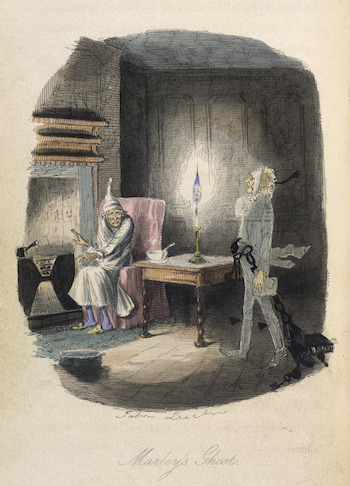 In youth, these ghosts are few, but by middle age, they often form an army.
When our songwriter asks Death to sit with him a little while because he would finally have a friend, the true wound becomes visible. Human beings can survive hunger. They can survive hardship. They can survive astonishing levels of physical suffering, either accidents or physical abuse and even torture. What often breaks them is isolation. The belief that they are unseen, unheard, unloved, and ultimately, unnecessary.
“What took you so long”, the young man asks of Death.
He views death as the first honest friend who has arrived in years, a thought that carries an unbearable loneliness at its core – not because he wishes to die, but because he no longer remembers why he wished to live.
He imagines himself forgotten, because he has already forgotten his own worth. Yet this is where the darkness tells its greatest lie.
Here the descent begins. Isolation creeps in. He pushes away the very souls who might stand with him. Liberty misused become license for self-pity. Instead of crying out to our Good Lord who hears, he turns inward, nursing grievances until they fester into a narrative of utter worthlessness. “I am a piece of shit”, he tells himself, echoing the tavern ghost. The lie feels true, because he has rehearsed it in the dark watches far too often, Hope, once a roaring fire, shrinks to a sullen ember. The long dark night seems almost a friend – quiet, final, free of struggle.
The measure of a man’s life has never been wealth, fame or status. Most of the truly important people who have ever lived were ordinary men and women whose names vanished from history. Fathers who worked exhausting jobs so their children could prosper. Mothers who sacrificed dreams so families could survive. Laborers who built towns they would never own. Soldiers who stood watch while others slept. Farmers who fed people they would never meet.
The world remembers very few of them, yet civilization itself rests upon their shoulders.
The subtle roads to hell are not paved with great leaps into vice. but rather a thousand small surrenders. The Enemy does not rely on any grand strategy, since he recognizes the damage that can be done by driving one into quiet despair.
Warriors battered by relentless foes spit on any such surrender to those physical enemies as well as those enemies of one’s own soul and spirit; they know the cost of holding the line when every muscle screams quit, men who knew far too well that they had to keep moving in certain circumstances, placing one foot after another, because to stop meant death.
The Christian warrior faces a colder enemy still: the lie that his life holds no meaning.
Yet the Gospel thunders against this Darkness. You are not a piece of shit soon forgotten. You are bought with a price. Your name is written on the palms of nail-scarred wrists. The same Good God who spoke of galaxies so numerous that they surpassed the hairs on your head and collects your tears in a bottle reminds us of this in The Word. The war zone in your mind is real — on the front line in defense of the universevbut it is not hopeless.
“We are afflicted in every way, but not crushed”, wrote Paul. Liberty and personal wellbeing finds its highest expression not in escape but in defiant obedience to the One True God who lived and died as a man in the flesh, overcame the world, and left us with a promise as He returned to his home in Heaven.
Consider the man’s journey further. Suppose in the blackest hour, a single spark remains — that “one thing in this world that they love the best.” A grandchild’s laugh. The memory of an Ol’ Sweet Mutt, faithful beyond compare. The stubborn refusal to let evil men win the day. The quiet voice of conscience that still says, “Not yet”. From that spark, hope can blaze again. The Christian knows resurrection is the pattern of reality: death, burial, then astonishing new life. Joseph in the pit. David in the cave. Peter after denying God. Jesus Christ Himself in the tomb. Everything can change in a moment.
The despairing man in the bar cannot see these possibilities, because despair narrows his vision until all he can see is darkness. Yet darkness itself is never permanent. Every night eventually yields to dawn, whether we believe in the coming sunrise or not.
That is why a man must never surrender completely.
This is the reason a man must rage. Not with futile cursing at the heavens, but with the holy violence of faith that lays hold of our Good Lord each and every day and will not let go. Rage by rising at dawn to labor again. Rage by seeking out the brother who has fallen further than you and offering him your hand. Rage by opening the Scriptures and letting the Truth rebuke the lies swirling in your head. Rage by loving your wife when she is hardest to love, disciplining your children with both firmness and tenderness, tending the small plot of ground given you as if it were Eden itself.
Life and liberty without Jesus Christ devolves into license and despair. Christ without liberty becomes mere moralism. Together they forge a man who stands tall though the night presses close. The poor man works his plot, the rich man loses his fortune; events swing like a great pendulum. Yet the soul anchored in Christ rides the storm. He may die poor in goods but rich in honor. Or he may see his latter days blessed beyond his youth. Either way, he does not welcome the Grim Reaper as a friend.
Everyone’s life matters. Their lives have always mattered. And until the Good Lord Himself calls them home, they possess a sacred obligation to keep trying and moving forward, however slowly, however painfully, however imperfectly.
When at last the long dark night draws near, not invited, but inevitable, the raging man will not whisper plaintively, “What took you so long?” He will square his shoulders, look Death in His hollw eyes, and say with the apostle, “O death, where is thy sting? O grave, where is thy victory?” He has fought the good fight. He has kept the faith. He has finished the course. There will be no plea for a quiet corner and a final friend in nothingness. Instead, he will go as a conqueror summoned home by his King, the King of Kings.
No headstone? Fine, if that’s his choice; I’ve never really wanted any marker of any significance myself. But it’s nonsense anyway. A good man’s legacy is written in the lives he touched, the children he raised, the truths he defended, the grace he passed on. Forgotten? Never. The Good Lord who sees in secret will remember. The Darkness he hated will flee before Eternal Light. The memories he longed to relive will be perfected, not erased — every honest joy, every faithful tear, every hard won victory made new in a country where night never falls.
To the man in the tavern, the songwriter, and to every soul tempted by that same despair, the answer rings clear across the ages. Do not welcome the Dark, Do not box yourself off unmarked. Fight. Hope. Pray. Work. Love. Rise. Rage, rage against the long dark night, for morning is coming. Jesus Christ has promised it, and He keeps His promises.
The old man was right. Where there is life, there is hope. Cling to it with bloody hands and knuckles and a singing heart. The battle is fierce, the night long, but the victory was secured long ago on a hill called Cavalry. Therefore, take your shot of whiskey, if you wish, but then stand up, square your jaw and clench your teeth, and walk back into the fight. Your story is not over until the Author of all Life says so. And when He does, it will not be an ending, but the first glorious page of the real tale.
June 24, 2026
Justin O. Smith ~ Author
~ the Author ~
Justin O. Smith Has Lived in Tennessee Off and on Most of His Adult Life, and Graduated From Middle Tennessee State University in 1980, With a B.S. And a Double Major in International Relations and Cultural Geography – Minors in Military Science and English, for What Its Worth. His Real Education Started From That Point on. Smith Is a Frequent Contributor to the Family of Kettle Moraine Publications.