“It was the best of times, it was the worst of times, it was the age of wisdom, it was the age of foolishness, it was the epoch of belief, it was the epoch of incredulity, it was the season of Light, it was the season of Darkness, it was the spring of hope, it was the winter of despair, we had everything before us, we had nothing before us, we were all going direct to Heaven, we were all going direct the other way – in short, the period was so far like the present period, that some of its noisiest authorities insisted on its being received, for good or for evil, in the superlative degree of comparison only.” ~ Charles Dickens – opening paragraph from A Tale of Two Cities (1859) ~ Link to the book [Link]

A Tale of Two Cities, First-Edition, Rare (Estimated value $8,800.00)
A ‘A Tale of Two Cities’ is set during the French Revolution and explores its impact on ordinary people’s lives in London and Paris. At its core, it is a story of love, revenge, and ultimate self-sacrifice during one of history’s bloodiest eras. Written by legendary English author Charles Dickens and published in 1859, it is widely celebrated as one of the most famous and best-selling novels of all time.
It’s really interesting to read the opening paragraph with America in mind, rather than England and France, and to consider the impact of the two-party system’s intense political and social polarization on America. I find little love or self-sacrifice in Merka, yet the parallels are striking, almost as though Dickens saw our future; his novel was fictional and almost prophetic. And, oh, by the way, there was a lot going on in America at that time.
The opening paragraph of the book highlights the stark contradictions and social inequality of the late 18th century. Dickens uses opposites to show that the period leading up to the French Revolution was marked by conflict, passion, and uncertainty. It conveys the extreme polarization of opposing forces, with no middle ground amid near-total chaos.
Now, consider the parallel with modern America.
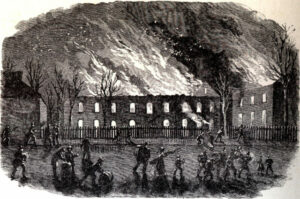
Harper’s Ferry – September 12–15, 1862
America at that time was a deeply divided nation on the brink of civil war, marked by intense political tension and rapid industrial and geographic expansion. The most critical events that defined the United States that year included racial conflict, major natural resource discoveries, and infrastructure milestones. John Brown led an armed raid on the federal arsenal at Harpers Ferry, Virginia. The American oil industry was in its infancy. The American West was rapidly expanding. Major gold and silver deposits were discovered. Oregon became the 33rd U.S. state, and America was hit by the largest geomagnetic solar storm in recorded history. So it was far from a quiet year.
Can you see the correlation to America in 1859?
How about the analogy to America today?
America is at war with itself.
My God, if you don’t see this in front of you, you are either blind or suffering from cranial-rectal insertion: your head is up your ass.
And of course, there’s a third choice: you might not care at all, joining the nearly 90 million registered voters who act as bystanders, spectators, onlookers, and observers, opting not to participate yet still expecting the benefits of America and criticizing its direction and the decisions of its contributors.
Ah… democracy…
Remember that America’s government — our government — depends on our active involvement. It works best when we participate; without our engagement, we risk leaving ourselves open to those who do get involved and to the officials they choose. While this may seem obvious, if we don’t recognize our duty to the republic along with our own needs and wishes, our elected representatives could go unchallenged. They already tend to do so, but by ignoring our voices, they will only listen to the loudest opponents — such as major donors and mainstream media.
Just so it’s clear, the mainstream media includes any source of information in any format: the internet, radio, television, and print newspapers (broadsheets).
When was the last time anyone from either of the main parties, or from any party for that matter, asked you what you wanted or needed?
~ Is this Democracy? ~
Democracy fundamentally implies choice. At its core, the word democracy (from the Greek demokratia) means “rule by the people.” For the people to genuinely rule, they must be able to make meaningful choices about how they are governed.
Do you investigate the candidates and propositions before you vote, or do you accept the media’s interpretation as fact?
Recommendation: Research the candidates and propositions before you vote. It’s catastrophic to make selections without knowing who they are or what they mean. Think back to when you were very young and touched a hot pan on the stove. “Once burned, twice shy,” as the proverb says, yet we continually re-elect the same kleptocrats to Congress, ‘the opposite of progress,’ year after year after year. This is an obvious indication of either a systemic learning disability or very effective advertising.
It appears there’s much more telling and very little asking lately… I’ve been around this country for 75 years, and what I recall are surveys with clever questions meant to steer me toward a predetermined conclusion.
Does this mean they already know what I want or what’s best for me, leading to predetermination, which seems to be the new definition of Merkan Democracy?
Since there’s more telling than asking, it would appear that Merka’s an autocracy, regardless of how they phrase the question or the options that lead to their predetermined conclusion.
The midterm elections are a salient example, with each side already claiming victory and declaring what they will do when they win, not if. I appreciate the attempt at a positive attitude, but burning the bridge before you’ve crossed it seems cavalier, if not reckless. The messaging is more divisive than supportive of the republic; self-serving, self-absorbed, almost pompous. If they’ve already won, why bother voting?
Isn’t the primary purpose of government to maintain social order, protect fundamental individual rights, and promote the general welfare of society, rather than merely serving the partisan faithful?
Isn’t this supposed to be about all of America, not the factions within it?
At their core, democracy and autocracy represent two fundamentally different ways of running a country. The main difference comes down to where power lies, how leaders are chosen, and how decisions are made.
Merkan Democracy ain’t what you think it is!
I use the word citizen frequently throughout this article, so it would be appropriate to define it to ensure we’re all clear. A citizen is a person legally recognized as a member of a country or state. This status grants them full civil rights, legal protections, and specific duties, such as voting or paying taxes. This means they are a Legal Member of the Nation: a person who belongs to a country either by birth or through a legal process called naturalization.
Most people mistakenly consider America a democracy, so I’ll reiterate – America is NOT a pure democracy; we are a Constitutional Federal Republic and a Representative Democracy. This means that in the United States, no single person has absolute power, and citizens run the country by electing representatives. The operative phrase here is ‘no single person’, yet political parties hijack that role.
In a Representative Democracy (Republic), citizens elect officials to deliberate and make decisions on their behalf. This model is more feasible for large, modern states but faces challenges with elite capture and accountability between elections.
The U.S. Founders deliberately avoided direct democracy, which they viewed as “spectacles of turbulence and contention.” Instead, they established a republic, a representative system designed to balance the will of the people with institutional safeguards to prevent factional infighting and the excesses of the masses.
– Nice try, but it seems they missed the mark on the “Spectacle, Turbulence, and Contention parts.
In 2024, 73.6% of eligible people registered to vote, and 65.3% actually voted. They decided what the rest wanted, yet the group of nonparticipants comprises the largest share of the more vocal dissenters. This was a Presidential election, and these armchair politicians are royally pissed off by the popular decision.
Can you imagine the fallout if we had to vote on each of the roughly 5 million laws and policies in America, which is what we’d face if America were a pure democracy? Can you imagine the chaos? Many of these laws and statutes are obscure and arcane, requiring a deep understanding of the US Constitution and its myriad nuances. Studies indicate that roughly 20% of Americans have even read it, and about half that number actually understand it. In a pure democracy, we would be expected to know our Constitution to vote intelligently. We barely know the people we hire to represent us, let alone the intricacies of the legal processes they administer.
How could you vote on economic or fiscal bills if you can’t balance a checkbook, manage your credit accounts, or handle your finances? Even state and federal taxes require expert assistance; could you honestly manage them at the national level?
I’m not trying to make you feel stupid. I’m making the point that our modern culture and society are extremely complex, requiring highly developed skills and knowledge. That’s precisely why we must be diligent and judicious in selecting the people who represent us to our government.
If you’re looking for examples of our outrageously bad choices, look at the $40 trillion deficit as proof. It is a stunning example of out-of-control spending, ill-advised policies, and preposterous partisan political choices. The people making these decisions on our behalf were our choices. We put them into office, or they were seated in positions of power.
Imagine the lines to vote on over 5 million laws, bills, statutes, and policies – they would be staggering, and nothing would ever get accomplished.
Even if we voted remotely, it would open the door to even greater fraud and interference. There is no simple answer except to educate people about their responsibility to the republic and to ensure that only those with the right to vote do so.
Yes, I am strongly in favor of voter ID, and I would take this a step further by requiring periodic citizenship testing for everyone… but that’s another topic and another potential article.
Recommendation: Take the US Citizenship Test [Link]. Can you pass it?
– And yes… I did, but today only 36% of Americans can pass this test, which I find disgraceful!
Who among us would show up to vote, and more importantly, who among us would have the background to understand these proposed laws? Most people can’t read a contract, much less understand complex legislation. Most people who sign these documents don’t read or understand them. The Affordable Care Act (ACA) is a perfect example. It was over 11,000 pages of political babble and insurance jargon. Nancy Pelosi recommended passing the law, then reading it to find out what it says…
– Note: Fewer than 10 single-volume books in human history have more than 11,000 pages.
The law achieved its primary structural goal of providing medical insurance for millions of people, but at the cost of higher out-of-pocket expenses, severe market consolidation that limited choices, and greater reliance on government spending. It proved to be an enormous financial boon to the private health insurance industry, despite the industry’s initial opposition to the law… wink-wink, nudge-nudge… by the way, most of the ACA was written by the insurance companies.
This is the dichotomy in our system. We hire – elect – people who know the technical aspects of these topics and processes, and we trust them to do what’s right for the republic… but do they? Or are they self-serving, counting on our ignorance? I’ll let you be the judge…
I looked for the percentage of people who vote without knowing what they are actually voting for… I wanted to know whether people used facts or opinions in their decisions. Most research indicates that only about 30% of voters are informed, so it’s safe to say the remaining majority follow informational or misinformational trends… that is, social media and Mainstream Media stories, or vote along party lines. You can do the math, but that means a majority would follow these misleading suggestions. And that, folks, leads us to where we are in Merka today.
Please go back and reread the introductory paragraph…
~ Perception is Reality ~
Democracy is our perception of how America works. There’s a crucial point we often overlook – perception is not reality. We create what we want to believe. That’s why Trump Derangement Syndrome (TDS) is so popular, as is the notion that Socialism is the solution to Merka’s problems. We choose to believe the loudest voices or the most prominent opinions, even though we may be deceived for partisan political purposes.
The phrase ‘perception is reality’ was popularized in modern strategy by political operative Lee Atwater in the 1980s and underscores that people act on what they believe to be true, regardless of objective facts. To fully navigate this concept, it helps to break down the gap between how we perceive things and how they actually are.
Reality is the absolute, objective state of things as they exist outside the mind, independent of human choices or beliefs. Perception is a mental impression or interpretation of reality, serving as a lens or filter. The Gap is that human sensory systems do not record reality like a video camera; instead, the brain infers reality from incomplete sensory input, biological factors, energy levels, and past experiences.
People do not respond to objective facts; they respond to their internal interpretation of those facts. If someone perceives a harmless rope as a dangerous snake, their fear and physical response are entirely genuine. This holds true for all advertising, especially in the political arena. Advertising often invents sensory cues that we eventually accept as “reality,” even when they are functionally meaningless or set up false ideas, such as comparing someone to a heinous criminal, labeling them a fascist, or calling them a genocidal totalitarian dictator.
Advertising is the practice of paying to place messaging or branding in specific locations to draw public attention to a product, service, or cause. It is a structured marketing tactic designed to persuade a target audience to take a specific action, such as making a purchase or adopting an idea. Politics is all about advertising. The more you see something, the more likely you are to believe it.
The more you see something, the more likely you are to believe it.
I repeated this last line to emphasize this crucial concept. This is what advertising really is, and it’s critical that we break the habit of getting our information and news from a single source. Variety is the spice of life, and it also offers a more balanced view of what’s going on around us.
Ask yourself… Is America really in the shitter, or is that what we’re told to believe by the information and news we choose to consume?
This carries over to the title of this piece… Democracy, It Ain’t What You Think.
Think about the actual definition of democracy, then consider what Merkans believe it to be…
The prevailing opinion seems to suggest that we officially accept democracy as a matter of practical governance, but culturally, we view it as a license to do as we please.
Recommendation: Read Alexis de Tocqueville’s warnings from the 1830s on American democracy. This is a perfect use of any AI search engine. Search for ‘de Tocqueville’s Democracy in America – synopsis’. [Link]
– “Look back to get your bearings; look forward to find your destiny.” ~ Unknown Author
This quote serves as a strategic guide to personal or professional growth by balancing reflection and ambition. It breaks down into two core principles:
– “Look back to get your bearings”: Use your past experiences, successes, and mistakes to understand exactly where you stand.
– “Look forward to finding your destiny”: Shift your focus to the future and use your baseline knowledge to pursue your ultimate goals confidently.
We know where we’ve been and what we’ve done, but we must first own our choices and accept responsibility for them. Next, we must admit that we are here because of them. The current condition is of our making, and only we can change it. We can easily blame politics, advertising, or the mainstream media for misleading us, but ultimate liability and accountability are ours, both collectively as a republic and individually as citizens.
Democracy does not absolve or negate this; it spreads this debt across the population, which is why it is our solemn duty to act for the good of the many, not the few or ourselves.
Democracy is not a license but the rule of law that all citizens, including the government, must obey.
Legitimate political authority derives entirely from the consent of the governed, not from those who govern. It makes every eligible citizen equal and grants them the right to participate in decision-making.
We elect representatives to make our laws and vote on policies on our behalf. This requires free, fair, and regular elections, free from manipulation or reprisal. It relies on our freedoms of speech, assembly, and the press.
Personal responsibilities in a democracy are the voluntary actions individual citizens must take to keep their society free and properly governed. While legal duties (such as paying taxes) are mandatory, personal responsibilities ensure that power remains with the people rather than shifting toward tyranny.
Citizens must actively research public issues, follow current events, and critically evaluate media sources to distinguish facts from misinformation.
Individuals have a responsibility to register, research candidates and ballot initiatives, and vote in local, state, and national elections. This also includes attending local town halls, joining community organizations, volunteering, or running for public office.
Democratic societies depend on citizens listening to opposing views, engaging in civil debate, and accepting peaceful compromises.
Citizens must monitor the actions of elected officials and use their voices—through letters, protests, or petitions – to challenge misuse of power.
Legally, non-participants retain their full rights to complain, protest, and criticize the government. In a democracy, fundamental civil liberties, such as freedom of speech and assembly, are guaranteed to all citizens by law, regardless of whether they choose to vote or participate in civic life. However, this question highlights a major philosophical tension between legal rights and social expectations.
In a democracy, these social expectations are the unwritten cultural norms and moral duties that citizens expect of one another to keep society peaceful and functional. While laws dictate what citizens must do, social expectations define what citizens should do to prevent political decay and polarization.
When citizens neglect their social responsibilities, a democracy undergoes gradual systemic decay, often leading to polarized, corrupt, or authoritarian governance. Democracy is not self-sustaining; it depends entirely on the active, constructive engagement of its population to function properly.
Democracy is not a license; it is a partnership. A license implies one-way permission to act without further obligation, whereas democracy is a fragile system of government that requires ongoing maintenance, mutual restraint, and reciprocal duties between citizens and the state. When people treat democracy as a license, they mistake freedom for unchecked entitlement, which ultimately destroys the system from within. In a democracy, your rights end where another person’s rights begin; individual liberty is constrained by laws that protect the safety and freedoms of the entire community.
Democracy is not a license for total self-interest: Citizens cannot treat government as a vending machine, pulling the lever of a vote to get what they want while ignoring the common good or the needs of minority groups. It’s not a license to violate democratic norms; winning an election does not give a majority or a leader the right to dismantle the rule of law, attack the free press, or suppress the opposition.
Again, read the introductory paragraph and consider where Merka is now.
Are we living in a country of unity or of division?
Does this paragraph define this republic as it is now?

George Washington by Gilbert Stuart
According to George Washington, America was the Great Experiment. It’s an “Unfinished Journey.” Proponents of this view point out that the founders never claimed to have built a perfect nation, but rather tasked future generations with the ongoing work of creating a “more perfect union.” They knew they were attempting something radically unproven, namely, building a lasting republic based on popular sovereignty, a model that had repeatedly failed or collapsed into tyranny throughout history.
In his 1789 Inaugural Address, he stated that “the preservation of the sacred fire of liberty, and the destiny of the Republican model of Government, are justly considered as deeply, perhaps as finally, staked on the experiment entrusted to the hands of the American people.”
In Federalist No. 1, Hamilton framed the entire constitutional-making process as a grand trial to determine “whether societies of men are really capable or not of establishing good government from reflection and choice, or whether they are forever destined to depend, for their political constitutions, on accident and force.”
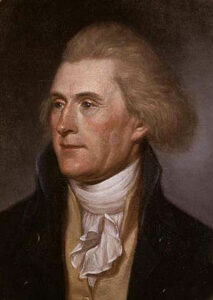
Thomas Jefferson
Thomas Jefferson explicitly described the nation as a laboratory of political theory, writing in 1804: “No experiment can be more interesting than that we are now trying… that man may be governed by reason and truth.”
The founders’ view of America as an ongoing experiment directly shapes how citizens’ duties are defined. If the nation is an experiment, the government is not a permanent machine that runs on its own; it requires continuous human maintenance, which implies participation.
Ultimately, the founders believed that if citizens neglect these basic duties, the experiment fails. The data they left behind suggests that a citizen who refuses to participate in these basic requirements is essentially abandoning the lab while expecting the science to still work.
Democracy is a system of government in which power rests entirely with the people, so its survival depends on active citizen responsibility. Because a democracy is an ongoing experiment rather than a permanent machine, it collapses into corruption or tyranny if citizens view it as a license for unchecked freedom without personal obligation.
Democracy is like flying an airplane with a highly advanced autopilot. It can maintain a steady course in clear skies, but it is never a substitute for the human pilot. Leaving the system entirely on autopilot, without human oversight or intervention, invites disaster.
‘The devil you say…‘

For the Amalgamated Heavy…
June 16, 2026
~ the Author ~
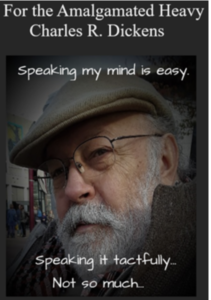 Charles R. Dickens Was Born in 1951, Is a Veteran of the Vietnam War, for Which He Volunteered, and the Great-Great Grandson of the Noted Author, Whose Name He Shares.
He Is a Fiercely Proud American, Who Still Believes This Is the Greatest Country on the Planet, With Which We’ve Lost Control and Certainly Our Direction. He Grew Up in Moderate Financial Surrounding; We’re Not Rich by Any Stretch, but Didn’t Go Hungry – His Incredibly Hard Working Father Saw to That. As Most From That Era, He Learned About Life From His Father, Whose Story Would Take Too Long to Tell, Other Than to Say That, He Is Also a Fiercely Proud American; A WWII and Korean War, Veteran Marine.
Charlie Was Educated in the Parochial System Which, Demanded That You Actually Learn Something, and Have Capability to Retain It Before You Advance. He Attended Several Universities in Pursuit of a Bachelor’s Degree, and Chased the Goose Further to a Master’s, and Has Retained Some Very Definite Ideas About Education in This Country.
in Addition, Charlie Is a Retired Blues Guitar and Vocalist – a Musician. This Was His Therapy Career. Nothing Brings Him as Much Joy as Playing Music, and He Wishes That He Could Make a Living at It… but Alas… Life Goes on!
It was over when republic became democracy.
Athenian democracy always ends in disaster.