 The American experiment in ordered liberty stands at the precipice of extinction. Not through foreign invasion or sudden catastrophe, but through the slow, deliberate strangulation of the very principles that once made this nation a beacon of individual sovereignty. The midterm results of 2026 reveal not merely partisan frustration, but a deeper, more corrosive truth: the machinery of soaring debt, engineered inequality, and permanent servitude grinds on regardless of which faction temporarily occupies the White House or Congress. Voters rage at prices, borders, tariffs, and endless foreign adventures, yet the fundamental architecture remains untouched.
There comes a time in the life of every nation when the people must stop arguing over the furniture and take a good, hard look at the foundation. America may well have reached that point. We have spent decades changing presidents, trading congressional majorities, shouting at one another over the latest political outrage, and promising ourselves that the next election will finally set things right. Yet somehow, when the campaign bunting comes down and the politicians return to Washington, the same old machinery keeps grinding away. The debt grows, the dollar buys less, government gets bigger, ordinary working people struggle to get ahead, and the political establishment assures us that everything is proceeding according to plan.
Well, perhaps that is precisely the problem.
The Last Chance to Restore the Republic
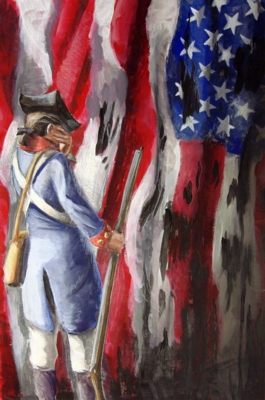
Death of the Republic
The two-party system functions as competing brands of the same product, both owned by the same interests, both committed to the same trajectory of centralization, currency debasement, and demographic transformation.
This is not a polite policy paper. It is an indictment, a warning, and a demand. Americans who still value liberty must act with urgency to abolish the Federal Reserve, dismantle the income tax, restore sound money, secure elections beyond the reach of fraud and foreign influence, and remove every illegal alien from this territory. Failure is not an option. It is the near-certain path to economic collapse, civil upheaval, and a tyranny that will make the present administrative state and Democrat Party communist regimes of our recent past look mild by comparison.
Begin with the debt. In 1980 the ratio of total credit market debt to GDP — in terms of the private sector’s total credit outstanding — stood at roughly 1.67. Today it exceeds 3.7. More than $119 trillion in obligations sit atop an economy that produces roughly $33 trillion in annual output.
This is not prosperity. It is the systematic transfer of claims on future production to the present, financed by the continuous expansion of credit that only a central bank can enable. Both parties have perfected the art of promising more while delivering less purchasing power. The Federal Reserve, created in 1913 under the false pretense of stabilizing the banking system, has instead institutionalized the boom-bust cycle that enriches the asset-owning class while stripping the productive majority. Low interest rates and quantitative expansions inflate the prices of stocks, real estate, and financial instruments held overwhelmingly by the top decile. Wages as a share of national income have declined in stair-step fashion for half a century. The result is a stratified society in which the Haves interact with the Have-Nots primarily through delivery apps and service labor.
The comparison is not a conventional measure of federal solvency, since it combines different categories of debt, but it certainly illustrates the enormous scale of America’s accumulated financial obligations. We have become remarkably accomplished at spending tomorrow’s earnings today, and then acting surprised when tomorrow finally arrives with its hand out.
The trouble is that the American economy has increasingly become an exercise in borrowing from tomorrow to make today look better. Politicians spend money they do not have, promise benefits they cannot honestly finance, and then congratulate themselves when the economic statistics appear favorable.
No election has reversed this trend because no election was ever designed to reverse it. The political class and the central bank are codependent. One creates the fiscal deficits; the other monetizes them. The citizenry pays through inflation, the silent tax that requires no legislation and leaves no fingerprints on any ballot.

The Clock of Inflation
Inflation is not simply an unfortunate number on a government chart. It is the gradual destruction of purchasing power. A dollar saved today should represent the fruits of somebody’s labor tomorrow. Yet Americans have watched the value of their currency diminish dramatically over generations. A retiree who carefully saved his money, a young family trying to purchase its first home, and a tradesman attempting to build a modest retirement account all discover that their dollars do not purchase what they once did.
Milton Friedman famously observed that inflation can operate as taxation without legislation. There is considerable truth in that observation. When the purchasing power of money declines, citizens lose economic ground without Congress having to pass a new tax bill announcing precisely how much of their savings it intends to take.
Milton Friedman, no radical, stated plainly that abolishing the Federal Reserve and replacing it with a fixed monetary growth rule would be preferable. He also judged that it would never happen. History has vindicated his pessimism about political will, yet the empirical case against the Fed has only strengthened. From 2008 onward the institution flooded the system with more new money than had been created in the previous century. Near-zero rates for a decade fueled debt accumulation across households, corporations, and government. When the inevitable inflationary surge arrived in 2021–22, ordinary savers and wage earners absorbed the damage while leveraged asset owners rode the wave higher.
That is a curious arrangement, isn’t it? Private institutions enjoy the profits when times are good, but the public is expected to help absorb the losses when the music stops.
The Fed’s own history is a catalog of failure: the Great Depression, the 1970s stagflation, the dot-com and housing bubbles, the everything bubble of the pandemic era. Early central banks in American history were dismantled for precisely these destabilizing effects. The Federal Reserve has simply perfected the technique while surrounding itself with academic mystification that treats its existence as an indispensable given rather than a century-old experiment that has failed its own stated purposes.
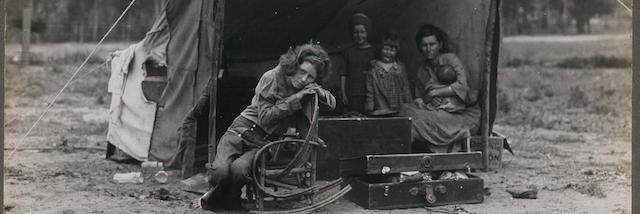
Migrant Mother and Family ~ Dorothea Lange, 1936
Sound currency is not a nostalgia project. It is the prerequisite for genuine economic calculation and long-term planning by free individuals. A currency whose supply is determined by political and bureaucratic discretion will always be expanded to accommodate the fiscal appetites of the state and the speculative demands of its clients. Gold and silver, or competing private monies disciplined by market forces, impose limits that no committee of central bankers will ever voluntarily accept. Without those limits the political class can fight wars of choice, fund permanent bureaucracies, and paper over structural imbalances indefinitely—until the moment confidence collapses.
The trajectory is visible. Debt service already consumes an ever-larger share of federal revenue. Entitlement obligations expand without corresponding revenue or productivity growth. When the market finally refuses to absorb the next tranche of Treasury issuance at tolerable rates, the Fed will be forced either to monetize at accelerating scale or to allow interest rates to rise to levels that bankrupt leveraged households and institutions. Either path ends in crisis. The only question is whether the crisis arrives while some residual capacity for reform still exists, or after the administrative state has concentrated enough power to suppress dissent under the banner of emergency.

Karl Marx
The income tax is the second pillar of this system of controlled plunder. It is not an accident that both the Federal Reserve Act and the 16th Amendment arrived in the same year, 1913. Marx’s Communist Manifesto lists the progressive income tax and the centralization of credit in the hands of the state as two of its ten planks. Before that year the federal government financed itself primarily through tariffs and excises — taxes on consumption and commerce that left the individual free to keep the product of his labor.
The income tax has evolved into an enormous apparatus of government intrusion. Americans work, earn, save, invest, and build businesses, only to discover that Washington expects an increasingly elaborate accounting of their financial lives. The small businessman, the independent contractor, the farmer, the carpenter, and the professional all spend valuable time and money complying with a tax code that seems to grow more complicated with every passing Congress. The government does not merely collect revenue. It establishes an extensive supervisory relationship over the earnings of the very people who finance its operations.
The issue is not whether government needs revenue. Of course it does. Courts, national defense, legitimate infrastructure, and constitutional responsibilities do not operate on good intentions. The issue is whether the federal government should possess such an extensive and intrusive claim upon the earnings of its citizens.
IT SHOULD NOT!
The income tax inverted the relationship. It made the citizen a tenant of the state, required to account for every dollar earned and to surrender a portion determined by political majorities and bureaucratic interpretation. The practical effect has been the growth of a surveillance and enforcement apparatus that reaches into every paycheck, every bank account, every financial decision. Combined with the Fed’s inflation, it creates a double extraction: first the direct taking, then the silent erosion of what remains. Those who claim that the income tax is the price of civilization ignore the historical record. America industrialized, expanded across a continent, and became the world’s leading economy under a system that did not claim a permanent lien on private earnings. Restoration of that arrangement is not radical. It is restorative.
A man who works for a living ought to be permitted to keep the fruits of his labor without first negotiating with a bureaucracy that treats his paycheck as government property.
And that brings us to the growing economic divide between those who own substantial financial assets and those who depend primarily upon their labor. For half a century, Americans have watched the financial landscape change. The cost of housing has climbed, access to affordable credit has become increasingly important, and financial asset appreciation has frequently rewarded those who already possess considerable wealth. Meanwhile, wage earners struggle to accumulate enough capital to enter the very markets that have produced so much prosperity for others.
There is nothing wrong with wealth. There is nothing wrong with successful businessmen, investors, entrepreneurs, or people who build substantial fortunes through productive enterprise. A free economy should reward initiative, innovation, thrift, and hard work. The problem arises when government-created distortions, artificially cheap credit, political favoritism, regulatory advantages, and financial bailouts allow the well-connected to enjoy advantages unavailable to ordinary competitors.
A country cannot remain economically healthy if the fellow who builds something, repairs something, grows something, or provides a useful service finds himself increasingly disadvantaged against those whose greatest talent is navigating the financial machinery of government and Wall Street.
America needs more productive enterprise, not more political favoritism. More independent businesses, not more government-dependent corporations. More opportunity for the working man to accumulate property and savings, not an economic system that increasingly rewards proximity to the financial establishment.
But economic freedom requires political freedom, and political freedom requires something else that has become increasingly important: confidence in elections.
The ballot box is not a ceremonial decoration. It is the peaceful instrument through which the American people exercise their sovereignty and hold their representatives accountable. If citizens cannot trust that elections are conducted honestly, lawfully, and transparently, the legitimacy of the entire political arrangement begins to suffer.
 Elections must be secure, safe, and free if any of these reforms are to occur through political means. The 2026 midterms, like the 2020 presidential contest before them, raise unavoidable questions about the integrity of the process. Vote totals in certain jurisdictions that exceed historical patterns, the inclusion of illegal alien invaders in population counts that determine representation, the expansion of mail-in and early voting systems that dilute chain-of-custody standards, and the documented history of illegal alien invader registration in multiple states all point to a system that no longer commands the confidence of large segments of the citizenry. When one party benefits systematically from demographic change driven by illegal entry, and when that same party resists every meaningful verification measure, the result is not democracy. It is demographic engineering dressed in procedural formality.
That is why election integrity must be treated as a national priority rather than a partisan talking point. Every eligible citizen should be able to vote. Every ineligible individual should be prevented from voting in federal elections. Voter registration must be accurate, ballot custody documented, voting systems auditable, and election results subject to meaningful scrutiny. Identification requirements should be reasonable and accessible. Independent observers should be able to perform their lawful duties, records should be preserved, and credible allegations of fraud or official misconduct should receive impartial investigation.
Sadly, we are finding that far too many Americans today feel much the same way as this old friend of mine, who uses the pseudonym, Exiled In Texas and wrote on November 9th 2026:
“Stopped voting after 2016, after 40 years of voting. Collapse or mercy killing is the only way to reform America’s system. I’m too old to fight, and I can’t run or escape.”
Illegal aliens do not merely consume public resources or depress wages in certain sectors. They alter the political balance by their sheer numbers in the census, by the political pressure their presence creates for amnesty and expanded benefits, and by the practical impossibility of policing the franchise when the underlying population is fluid and untracked. A nation that cannot control its borders cannot control its elections. A nation that cannot control its elections cannot preserve the consent of the governed.
 The answer is straightforward: secure the borders, enforce existing immigration laws, prosecute trafficking and smuggling operations, hold employers accountable, and remove those who have no lawful basis to remain in the country. And place a twenty year moratorium on all asylum claims and immigration applications, because national sovereignty cannot depend upon pretending that unlawful and even legal entry without intent to assimilate carries no consequences.
A nation must be able to decide who may enter and who may remain. That is not an act of hostility toward immigrants. It is a basic responsibility of self-government.
The removal of illegal aliens is therefore not an optional cultural preference. It is a precondition of sovereignty. Sovereignty is the capacity of a people to decide who belongs to the political community and under what terms. When that capacity is surrendered — whether through deliberate policy, judicial obstruction, or administrative non-enforcement — the result is the progressive dissolution of the nation-state into a mere administrative zone managed for the benefit of global capital, domestic political machines, and foreign interests.
The economic argument is straightforward: labor markets are not infinitely elastic, public services are not free, and the fiscal burden of educating, treating, housing, and policing a large non-citizen population falls disproportionately on citizens who did not consent to the arrangement.
The political argument is sharper. Representation based on total population rather than citizen population hands political power to jurisdictions that attract and retain illegal populations.
The cultural argument is the most fundamental. A free society requires a shared commitment to the constitutional order and the habits of self-government. Mass illegal immigration, especially from cultures with little experience of limited government or individual rights, imports populations that can be mobilized against those very principles. The refusal to enforce existing law is itself a form of lawlessness that trains citizens to regard the state as selective and arbitrary.

Crooked Voting
The American republic cannot survive indefinitely if millions of citizens conclude that their votes are meaningless, their savings are vulnerable, their earnings belong primarily to government, and their political institutions serve interests other than their own. When people lose confidence in peaceful remedies, the risk of social instability increases.
History offers plenty of warnings. The collapse of the Weimar Republic demonstrates how economic devastation, political extremism, and institutional weakness can reinforce one another. Aleksandr Solzhenitsyn’s account of Soviet repression reminds us what happens when government becomes an authority unto itself and the individual is reduced to an object of administrative control.
The alternative to decisive action is not stasis. It is acceleration. The debt trajectory continues. The currency continues to lose purchasing power. Inequality continues to widen as asset inflation outpaces wage growth. Elections continue to be contested on grounds of legitimacy. Illegal populations continue to expand. Each of these trends feeds the others. Economic pain produces political radicalization. Political radicalization produces demands for greater state control. Greater state control produces further economic distortion. The historical pattern is familiar: Weimar inflation, Latin American populism, the slow erosion of republican institutions under the pressure of permanent emergency.
Civil unrest follows when large numbers of citizens conclude that the formal political process offers no remedy. Civil war becomes conceivable when factions no longer share a common understanding of legitimacy and when the state’s monopoly on force is itself contested.
There is no certainty that America will experience economic collapse, civil unrest, or civil war. Such outcomes are not inevitable, and anyone claiming to know precisely how the next decade will unfold is selling something. But a country combining enormous debt, monetary instability, declining institutional confidence, and deep political hostility is playing a dangerous game.
The administrative state, once it has concentrated sufficient power, will not voluntarily relinquish it. It will expand surveillance, speech controls, financial deplatforming, and selective prosecution under the justification of protecting democracy from its enemies. The cartridge box becomes the last remaining metaphor not because anyone desires violence, but because the other three boxes — soap, ballot, and jury — have been systematically compromised.
Étienne de La Boétie understood the mechanism centuries ago. Tyranny persists not primarily through force but through the voluntary cooperation of the many. “They only seem tall because we are on our knees.” Aleksandr Solzhenitsyn recorded the same phenomenon in the Soviet system: the gradual accommodation to untruth, the refusal to speak the obvious, the hope that someone else would act first.
Americans have been trained in the same habits. We vote harder, hoping that the next election will reverse trends that neither party has any incentive to reverse. We seem to accept inflation as a natural phenomenon rather than a policy. Too many of us treat the income tax as an immutable feature of modernity rather than a contingent political choice. We debate the details of immigration enforcement while the underlying principle of sovereignty is abandoned. The result is the progressive loss of the habits of self-reliance and the progressive growth of dependency on the very institutions that extract, command and control.
A liberty-minded response rejects this accommodation. It begins with the clear recognition that the Federal Reserve is not a neutral technical institution but a political engine of redistribution and control. Ending it requires legislation that terminates its charter, returns monetary functions to a transparent and limited framework, and allows competing currencies or commodity-based standards to emerge under market discipline.
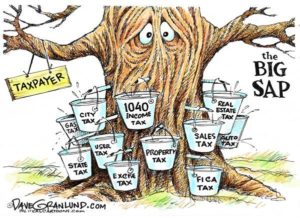
Sap-Payers for the Mooches
A government that borrows beyond its means becomes increasingly dependent upon monetary intervention. Monetary intervention distorts credit markets and can reward financial speculation over productive effort. Inflation diminishes the value of wages and savings. An intrusive tax system reduces economic independence. Financial inequality and declining opportunity breed resentment. Uncontrolled immigration can intensify pressure upon already strained housing and labor markets. And when citizens begin to doubt the integrity of elections, they lose confidence in the very mechanism through which they might peacefully correct these problems.
One problem feeds another, and before long the whole contraption begins shaking like an old tractor running out of oil.
Meanwhile, Washington continues arguing over who gets to drive.
Ending the income tax requires repeal of the 16th Amendment or its functional nullification through a shift to consumption-based revenue that does not claim a prior lien on labor. Sound currency follows as the natural consequence: money that cannot be expanded at political will.
Secure elections require citizenship verification, paper ballots with robust chain of custody, same-day voting or tightly controlled early voting, and the exclusion of non-citizens from both the franchise and the population counts that determine representation.
Removal of illegal aliens requires the consistent application of existing law, the end of catch-and-release, the denial of benefits that create magnets, and the political will to withstand the inevitable media and institutional resistance.
None of this will be achieved by the existing party structures as currently constituted. Both are too deeply entangled with the interests that benefit from the present arrangement. Real change will require a critical mass of citizens who refuse further cooperation with the mechanisms of extraction and who build parallel institutions of commerce, education, and mutual aid that do not depend on federal favor. It will require local and state governments that interpose themselves against federal overreach where the Constitution still provides residual authority. It will require a willingness to endure short-term disruption for the sake of long-term solvency and freedom.
The alternative is the continued illusion of choice within a system that has already decided the outcome: more debt, more inflation, more inequality, more demographic transformation, and more concentrated power in the hands of those who manage the decline.
The window for action is measured in years, not decades. The debt compound interest curve does not negotiate. The currency’s residual credibility is finite. The demographic shifts are cumulative and, once past certain thresholds, politically irreversible under current rules. Americans who still remember what genuine self-government felt like must decide whether they will continue to participate in the LARP of electoral theater or whether they will treat the preservation of liberty as the non-negotiable priority it once was.
The choice is not between comfort and austerity. It is between a controlled descent into managed dependency and the hard recovery of the conditions under which free people can again plan, produce, and associate without permanent political permission, even if it means we must once again pick up our rifles to fight for true freedom and our Inalienable God-Given Rights. The Federal Reserve must end. The income tax must end. Sound money must return. Elections must be made secure. Illegal aliens must leave. Anything less is collaboration with the forces that are dismantling the republic, while the citizens argue about the seating chart on the deck of a ship already taking on water, and America remains at full speed ahead towards Her next full blown, hot, violent civil war.

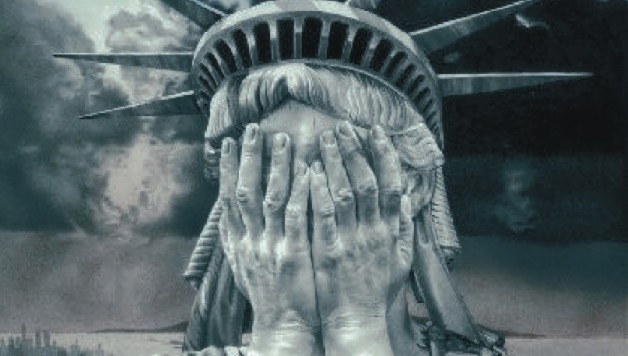
Tears of a Nation by Belinda Threeths
A nation that cannot preserve the value of its money, the integrity of its elections, the sovereignty of its borders, and the independence of its citizens will eventually discover that it has preserved everything except the very freedom it was established to protect.
America does not need to be made great by another government program, another central-bank intervention, another political slogan, or another carefully choreographed election campaign.
It needs to be made free again.
And that responsibility belongs not to Washington, not to Wall Street, not to the political parties, and not to some future generation of Americans who will inherit whatever mess we leave behind.
It belongs to us.
A republic does not die merely because its citizens disagree. It dies when they cease believing that they possess the power, the responsibility, and the courage to govern themselves.
And that is a fate America must not accept!
November 11, 2026
Justin O. Smith ~ Author
~ the Author ~
Justin O. Smith Has Lived in Tennessee Off and on Most of His Adult Life, and Graduated From Middle Tennessee State University in 1980, With a B.S. And a Double Major in International Relations and Cultural Geography – Minors in Military Science and English, for What Its Worth. His Real Education Started From That Point on. Smith Is a Frequent Contributor to the Family of Kettle Moraine Publications.