There are times that writers take a step away – and provide us with something to enjoy – and take a look at things from a different aspect. ~ Editor
 The sun was beginning to settle behind the western ridge, when I pulled an old wooden chair out onto the back porch, set my coffee beside me, and leaned back far enough that the chair gave a little groan beneath my weight. I took that as a good sign. A chair that has known you for twenty years and still complains when you sit down is a chair with character, and I have always trusted character more than furniture advertised as “ergonomically engineered.”
The evening was one of those soft Southern evenings that seem to arrive without making much fuss about it. The heat of the day was finally giving up, the trees along the fence line had turned almost black against the orange sky, and somewhere down in the hollow a bird was making the last argument of the day about whether it intended to go to sleep or keep everybody else awake until midnight.
I have spent a great many evenings sitting exactly where I was sitting then, and I have learned that there are certain hours when a man begins remembering things he thought he had forgotten. Maybe it is the lowering sun. Maybe it is the quiet. Maybe when you get old enough you simply acquire too many ghosts and they eventually figure out where you live.
I was thinking about good and evil that evening, which is a dangerous subject for an old man because once you get started you can find yourself sitting there until midnight trying to solve problems that have been troubling mankind since somebody first looked at his neighbor’s cow and thought, “I wonder if anybody would notice.”
I had been reading something earlier by Aleksandr Solzhenitsyn about the line between good and evil running not between nations or classes or political parties but straight through the human heart, and I had to put the book down for a while because the man had managed to say in a few sentences something it takes most men a lifetime to discover, but a thing I’d grown to recognize by my early teens.
The older I get, the less convinced I am that there are two kinds of people in this world, the good people and the bad people, neatly sorted into opposing camps like teams on a baseball field. There are good people, certainly, and there are bad people, and there are extremely despicable, vile and evil people who have done terrible things, but the dividing line is not nearly as tidy as we’d like. I have known men who would give you the shirt off their backs and then lie about whose shirt it was. I have known women who could organize a church supper for two hundred people while simultaneously carrying a grudge against the neighbor over something that happened in 1987. I have known people who were courageous when courage was required and petty when nobody was watching. I have even known a few fellows who were so consistently unpleasant that I occasionally wondered whether their mothers had dropped them on their heads or simply neglected to finish raising them.
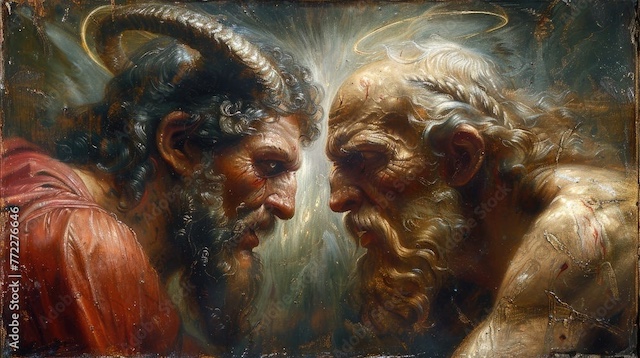 The line between good and evil wiggles. It slides. One day it’s over here by the carrot sticks, the next day it’s snuggled up next to the leftover chicken wing coated in demonic barbecue sauce. Even the purest heart keeps a little unweeded corner of mischief, and even the blackest heart holds on to one stubborn bridgehead of decency. That, my friends, is the human condition in a nutshell — or, more accurately, in a slightly dented Tupperware container.
Now, if that sounds a little highfalutin for a Thursday night essay, allow me to bring it down to kitchen-floor level, where most of life’s great moral dramas actually take place.
There is a difference between being imperfect and being evil. That distinction has gotten a little blurry in our time, and I think that’s a shame, because once you call everything evil, you eventually lose the ability to recognize the real thing. A man who loses his temper is not necessarily a monster. A woman who tells a selfish lie is not necessarily corrupt beyond redemption. A fellow who eats his wife’s leftover chicken wing at two o’clock in the morning may be guilty of poor judgment, questionable ethics, and a complete misunderstanding of marital property law, but that doesn’t make him a murderer. It makes him Ralph.
Picture Ralph. Middle-aged, pajama-clad, standing in the soft blue glow of the refrigerator like a pilgrim before a neon shrine. In his hand: one lonely, slightly bruised chicken wing. He is Hamlet with a waistline and a mortgage. “To eat, or not to eat — that is the messy question.” Science has told him he is a creature of high ideas. Philosophy has whispered about virtue and the common good. Conscience, that tiny accountant living in his left ear, is shrieking, “Ralph, that belongs to your wife for tomorrow’s lunch!” But the wing glistens. The sauce is glorious. Evil, he notices, does not calorie-count. Evil does not lock the pantry. And the cat? The cat is corrupt. The cat would sell his own tail for a Friskies pellet.
So Ralph takes the bite.
A moment later the overhead lights slam on like the Last Judgment. Enter Alice, bathrobe-clad, expression of unbothered clarity, the avenging angel of the lunchbox. She surveys the scene: one husband, one clean chicken bone, one permanent barbecue stain on the pajama pants that will now serve as the family crest of moral failure. “Oh, look,” she says. “Hamlet has raided the icebox again.”
She does not speak of abstract monuments built of carrots and sorted plastics. She speaks of a woman who works a forty-hour week and simply wanted her leftovers. Evil, she points out, is not a tragic fall from grace. Evil is lazy. Evil has a soft midsection, bare feet, and a crumb caught in its chest hair. Then, with the calm of a prosecutor who already knows the verdict, she reaches past him, extracts the premium Belgian chocolate-chip ice cream that had been carefully hidden behind the frozen peas, and takes a deliberate, eye-contact-maintaining bite. “The dark side may have ranch,” she announces, “but the righteous just took custody of the Belgian chocolate chip.”
And from atop the kitchen cabinets, Troubles the tuxedo cat — one notched ear, soul of pure cynicism — licks a stray drop of sauce from his paw and delivers the only honest theology in the room:
“Humans. They think they are the authors of high drama”.
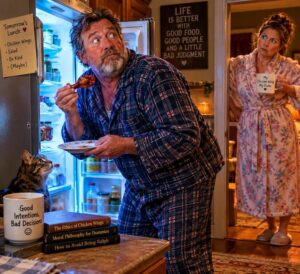 The trouble was that Ralph knew perfectly well the chicken wing belonged to Alice, his wife, and he also knew Alice had been saving it for lunch the next day. Now, a man of strong character would have closed the refrigerator door and gone back to bed. A man of extraordinary character might even have eaten a carrot. Ralph stood there staring at that chicken wing as though it had personally challenged his understanding of the universe. He later told me he had a philosophical crisis. I told him that from where I was sitting he appeared to have a poultry crisis, but Ralph insisted there was more to it. He said that he began thinking about Shakespeare, morality, free will, temptation, Heaven, Hell, and the eternal struggle between the better angels of our nature and the beast inside us. I asked him how long this intellectual struggle lasted. He said approximately seventeen seconds. Then he ate the chicken wing.
Now that, my friends, is human nature.
We like to think our moral struggles are grand affairs. We imagine ourselves standing on mountaintops with thunder rolling behind us, making heroic choices while choirs sing somewhere in the distance. Most of the time morality is considerably less glamorous. It is standing in a kitchen holding something that isn’t yours. It is finding money on the floor and deciding whether anybody saw you pick it up. It is hearing a rumor about somebody and deciding whether to repeat it. It is being furious with your wife and choosing not to say the one sentence you know will hurt her most. It is discovering that the cashier gave you twenty dollars too much change and deciding whether you are going to hand it back. It is seeing somebody weaker than yourself being mistreated and deciding whether you are going to walk away or step in. Most of life does not present us with trumpets and angels. It gives us little decisions, one after another, and waits to see what sort of person we are becoming.
There absolutely is good. There absolutely is evil. But most usually there is only the tax. Ralph thinks he sneaked the wing past the authorities. He forgets that the cat is the authority. Alice thinks she has restored cosmic order with ice cream and saltines. Both of them will sleep. And when they sleep, the unrinsed ice-cream container in the trash will become a beacon of sweet, sugary cream just begging for a tongue rough enough to scrape the corners.
If you want the food, you take the food. If someone tries to stop you, you hiss. If they are bigger than you, you wait until they go to sleep and then knock a glass of water off the nightstand.
That, ladies and gentlemen, is the entire moral history of the species, condensed into one suburban kitchen at 2:17 a.m.
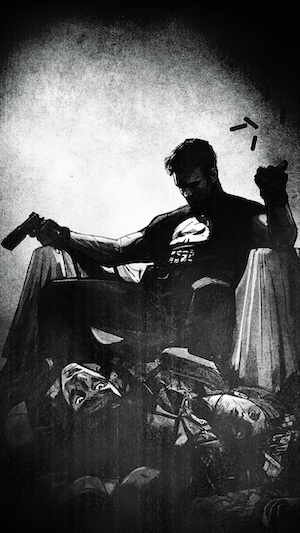 We like to pretend otherwise. We like to dress up in the language of crusades. “It is your Corrupt I claim!” some inner voice thunders. “With every breath I shall hunt them down!” We recite the simple codes that every faith can embrace: Do not kill. Do not rape. Do not steal. These are not polite suggestions; they are the load-bearing walls of civilization. Cross them and one day you will look over your shoulder and find something looking back. Yet even as we thunder, we know the quieter truth: the line is still inside us, oscillating with the years.
And then there is the other voice, the one that smashes the empty glass just to watch the little machines scurry out and clean up the pieces. “Life,” it purrs, “comes from destruction, disorder, and chaos. By creating a little destruction, I’m in fact encouraging life. You and I are in the same business. Cheers.”
Somewhere between the Punisher’s vow and the Joker’s toast, between the shepherd’s prayer and the raccoon’s midnight raid, the rest of us live our ordinary, gloriously compromised lives.
“….. and shepherds we shall be, for thee my Lord for thee, power hath descended forth from thy hand, that our feet may swiftly carry out thy command. We shall flow a river forth to thee, and teeming with souls shall it ever be – In nomine Patris, et Filii, et Spiritus Sancti.”
We polish the silver and keep the halo straight, then we dress in Heaven for a little wicked night. Saints on the left, sinners on the right, and the band gets hot enough that every halo starts to list. Heaven keeps the rhythm; Hell supplies the heat. After midnight, judgment can wait. We raise the halo, show the horns, and dance until the morning light makes everything respectable again — or at least until the fluorescent kitchen lights click on.
Rudyard Kipling said we are all islands shouting lies to each other across seas of misunderstanding. I prefer to think of it as a gravy boat. Billions of little islands, each of us standing on the shore cupping our hands and yelling our personalized brand of nonsense into the fog. “Notice me! I exist! I matter!” And the ocean between us is thick as Grandma’s gravy and twice as hard to see through. We navigate with spoons when what we really need are ladles.
Yet the cosmic joke keeps delivering: despite all the shouting, what we are really listening for is the one echo that comes back saying, “I hear you. Pass the gravy.”
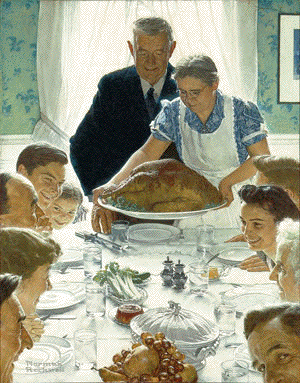
Norman Rockwell, 1943
Troubles was a tuxedo cat with one notched ear, a belly like a sack of flour, and the moral confidence of a Supreme Court justice who had never once been contradicted. Troubles watched Ralph and Alice from the top of the kitchen cabinet and seemed to regard the entire affair as evidence supporting his longstanding belief that human beings were incapable of governing themselves. According to Troubles, Ralph had committed an obvious offense, Alice had administered a proportionate response, and Troubles himself was entitled to compensation for the emotional distress caused by witnessing the whole spectacle. He had been given a small piece of chicken skin during the original transaction and therefore considered himself a silent business partner.
Troubles never worried about whether his behavior was good or evil. He believed in consequences. If he wanted food, he asked. If nobody responded, he asked louder. If that failed, he knocked something off the counter. If somebody objected, he looked at them as though they had just violated an international treaty. Troubles understood something human beings spend enormous amounts of time trying to avoid admitting: actions have consequences, and eventually somebody sends you the bill.
I suppose that is why I have always found the old pictures of Saints and Sinners so amusing. We like to imagine Heaven on one side and Hell on the other, with the Saints standing beneath their halos and the Sinners standing around with horns and pitchforks, as though Heaven and Hell were opposing political parties and you merely had to pick the correct registration card. But the older I get, the more I think the whole thing must look considerably more complicated. I can almost imagine Heaven after midnight: trumpets going, angels dancing, halos slightly crooked, somebody’s halo falling off in the punch bowl, and a Saint whispering to another Saint that he really shouldn’t be dancing with that particular sinner – but she looks so damned great – and the band is awfully good tonight. Meanwhile Hell has apparently hired a rhythm and blues, rock-a-billy band and is serving excellent drinks, which proves once again that temptation has always had better marketing than virtue.
Saints and Sinners have been dancing around one another since Cain first looked at Abel and thought, “Well, this isn’t going to end well.” We are fascinated by the dance because somewhere inside ourselves we recognize both of them.
 I have never believed that being a good man means you never have an evil thought, never become angry, never desire something you shouldn’t have, never be jealous or envy another man, never become selfish, and never make a fool of yourself. If that were the standard, Heaven would have an empty admissions office. Being good means something harder. It means knowing that the darkness is there and refusing to give it the keys to the house. It means having the capacity to do wrong and deciding not to do so. It means knowing you could hurt someone and choosing not to do so. It means being angry enough to strike and strong enough to lower your hand. It means finding yourself with an advantage over somebody weaker and remembering that power is supposed to come with responsibility. It means recognizing that the line between right and wrong is not merely a fence somebody else erected for your convenience. It is a boundary you must choose to respect, when nobody is standing there with a gun or a badge or a camera watching you.
No matter who I am or am not – no matter the highs and lows of my character, such as it may be – nothing prevents me from recognizing evil when I see it. In fact, I think it makes the distinction more important. I don’t need to pretend that I am an angel in order to know that murder is wrong. I don’t need to claim perfection to know that rape is an abomination. I don’t need to be without sin to know that robbing an innocent man is wrong. I don’t have to be a saint to stand beside the victim.
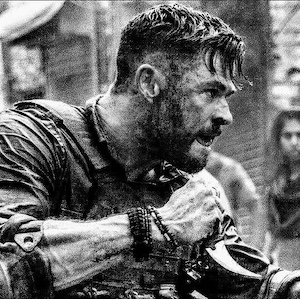 Maybe that is what Solzhenitsyn meant about that little bridgehead of good remaining even in a heart overwhelmed by darkness. Perhaps the real battle is not about pretending darkness isn’t there. It is about refusing to surrender that bridgehead. Every man has moments when he can turn one way or the other. The temptation may be as small as Ralph’s chicken wing, or it may be as enormous as the decision whether to protect someone from a genuine criminal. The scale changes, but the principle remains. We are creatures who make choices, and choices shape us.
And so it goes, every day, in every kitchen, every office, every heart.
We are fifty percent angel, fifty percent raccoon, wandering through the supermarket of moral choices, trying to decide if we can get away with the loose grapes. We hold doors for strangers whose names we will never learn. We sort the plastics. We nod politely. Then we stand in the soft blue light of temptation and negotiate with the tiny accountant in our left ear.
Sometimes we close the door and go back to bed, admirable and starving.
Sometimes we take the bite, sauce on the cheek, joy in the heart, and accept that tomorrow’s lunch will be a sleeve of saltines.
Either way, the cat is watching – or perhaps God [?] for those of us who believe.
Either way, the line is still inside us, oscillating, refusing to stay put.
That is what it means to be human: not the grand triumph of good over evil, nor the glamorous surrender to the dark side, but the daily, dusty, sauce-stained struggle to keep the bridgehead of goodness from being overrun while never quite managing to uproot the little corner of mischief that makes us interesting in the first place.
We will continue stumbling along between Heaven and Hell, doing our best, making mistakes, occasionally doing something wonderful, occasionally doing something stupid, and hoping that when the final accounting comes, the good we managed to do will outweigh the foolishness we couldn’t quite overcome.
The sun had dropped lower by then, and the orange light had begun disappearing behind the ridge. My coffee had gone cold, but I drank it anyway. Old men have a certain obligation to finish things they have started, particularly coffee. The bird down in the hollow had finally given up arguing and gone silent. The evening breeze had begun moving through the trees, and for a while I just sat there thinking about all the people I have known over the years, the good ones and the difficult ones, the brave ones and the foolish ones, the people who surprised me with kindness and the people who disappointed me with cruelty. I realized that I had spent most of my life looking for a simple answer to a question that probably doesn’t have one: What makes a man good?
The line between good and evil moves every day, and every day we get another chance to decide which direction it moves.
The sun was almost gone when I finally got up from that old chair. I looked toward the kitchen, thought about the refrigerator, and decided I wasn’t really hungry after all.
I had learned something from Ralph.
I went inside and found a chicken wing sitting on a plate.
There was a note beside it.
It said, “THIS ONE IS YOURS.”
I looked around suspiciously, to see if my girlfriend was lurking nearby filming my actions.
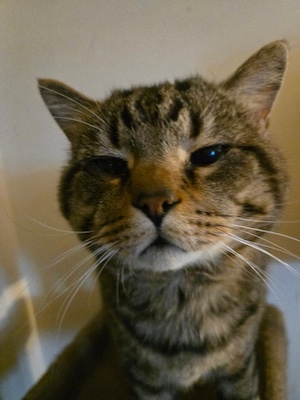 My own cat, Mudflapp, was sitting on the counter.
My girlfriend was nowhere in sight.
I picked up the chicken wing.
Mudflapp stared at me.
For one brief and glorious moment, I understood exactly what it meant to possess free will.
Then I ate the chicken.
And somewhere in the fading light, I swear I could hear Troubles laughing.
October 2, 2026
Justin O. Smith ~ Author
~ the Author ~
Justin O. Smith Has Lived in Tennessee Off and on Most of His Adult Life, and Graduated From Middle Tennessee State University in 1980, With a B.S. And a Double Major in International Relations and Cultural Geography – Minors in Military Science and English, for What Its Worth. His Real Education Started From That Point on. Smith Is a Frequent Contributor to the Family of Kettle Moraine Publications.