 The most serious threat to American liberty today is not a single cabal but a convergence of three powerful institutions — the national-security bureaucracy, the global technology industry, and the administrative regulatory state — that together create a system of soft despotism that is far more durable than any elected official.
This convergence is not a Trump invention, but it has not been dismantled by President Donald Trump either; in important ways, it was accelerated, normalized, and in some cases weaponized during his presidency, even as he rhetorically fought it. The result is a rapidly emerging single “new American order” imposed by a master plan and America’s technocrats, and something more insidious and more likely: a dystopian drift that could indeed end in civil upheaval if citizens lose faith that the system can be reformed from within. The danger is not that one man is a puppet; it is that the machine is stronger than any man, and that the American people have not yet decided whether they want to break it or merely curse it.
There comes a time in the life of a country when a man ought to stop listening to what the politicians say they are doing and start looking carefully at what they are actually doing.
Words are cheap. They have always been cheap. Politicians have been promising liberty, prosperity, security, peace, justice, reform and a chicken in every pot since the first fellow discovered that standing on a stump and shouting could get him elected. The difficulty is that a country cannot be governed by campaign promises. It is governed by institutions, laws, money, technology, contracts, bureaucracies and the people who control them. And if an ordinary American wants to know where his country is headed, he would do well to spend less time listening to speeches and more time watching where the machinery is going.
Because something very large is happening in America.
I do not mean that America is about to wake up tomorrow morning beneath a black flag with a fellow in a shiny uniform standing on the courthouse steps announcing that the Constitution has been cancelled. That would be much too simple, and frankly, it would be too easy. Americans would recognize that kind of tyranny. They would know what they were witnessing. They might not agree on what to do about it, but at least they would know that somebody had crossed the line. The transformation taking place now is considerably more sophisticated than that scenario. It comes dressed as modernization. It comes wrapped in national security. It comes advertised as convenience, innovation, efficiency, competitiveness and technological progress. It comes with venture capital, government contracts, congressional hearings, smiling executives, patriotic speeches and enough PowerPoint presentations to bury the entire Appalachian Mountains.
And while everybody is arguing about Republicans and Democrats, conservatives and liberals, MAGA and the establishment, immigration and abortion, Ukraine and Gaza, culture wars and the latest scandal on television, the machinery keeps getting built.
That is the part that bothers me.
The Republic was founded on a simple, unyielding premise: that free men, armed with reason and the right to dispose of their own lives, property, and labor, could govern themselves better than any cabal of experts, kings, or committees. Two and a half centuries later that premise is being quietly strangled, not by jackboots in the street, but by the soft, humming machinery of data centers, algorithmic governance, and programmable money. The strangulation is being performed by America’s elite technocrats in open alliance with the permanent military-industrial apparatus, and the man who once promised to drain the swamp now stands at the head of the procession, smiling for the cameras while the water rises around the ankles of the very people who elected him. What we are witnessing is not politics as usual. It is the consolidation of a new order in which individual choice is replaced by engineered compliance, national sovereignty is dissolved into global administrative networks, and the last remaining pockets of genuine liberty are systematically mapped, monitored, and, when necessary, extinguished. The stage is being set for a dystopia once confined to the pages of speculative fiction; the only question left is how long the American people will continue to applaud the performance.
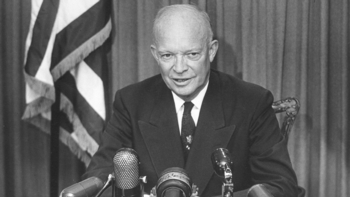 Eisenhower’s farewell address warned of the “unwarranted influence, whether sought or unsought, by the military-industrial complex.” He did not describe a conspiracy. He described an institutional gravity. A permanent defense establishment, a permanent arms industry, and a permanent congressional appetite for distributing defense contracts across districts create a self-sustaining system that needs threats to justify itself. After the Cold War, that system did not shrink; it adapted. It found new threats — terrorism, rogue states, cyberwar, pandemics, great-power competition — each of which justified new authorities, new surveillance, and new spending.
The result is a national-security state that operates largely beyond ordinary accountability. It classifies what it does. It leaks what it wants known. It uses the language of safety to expand its reach into communications, finance, travel, and now public health. The Patriot Act, expanded in 2001 and renewed in various forms since, normalized bulk data collection. The National Defense Authorization Act has been used to detain and to define the battlefield in ways that stretch constitutional boundaries. The Foreign Intelligence Surveillance Court operates in secret. Whistleblowers are prosecuted more aggressively than many violent criminals. None of this required a single dictator. It required only a frightened public and a permanent bureaucracy.
Into this system came Donald Trump, who ran against the Iraq War, against the intelligence community’s abuses, and against the “rigged system.” He promised to drain the swamp, to end endless wars, to audit the Pentagon, and to protect free speech. He did some of these things in part. He did not start new major wars, and he pushed allies to pay more for their own defense. He reduced some regulations and appointed judges who take the Constitution seriously. But the national-security state did not shrink. Surveillance authorities were renewed. Defense budgets rose. The war in Afghanistan continued until a chaotic withdrawal in 2021, negotiated under Trump but disastrously executed under Biden. The drone war continued. The Pentagon failed its fifth audit in a row, and the swamp was not drained; it was renamed, reorganized, and in some cases populated by the same people.
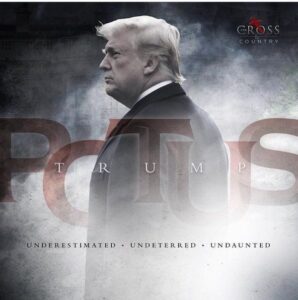 More troubling, Trump’s presidency demonstrated how easily the security state’s tools can be turned against domestic political opponents. The FBI’s Crossfire Hurricane investigation, the Carter Page FISA warrants, the prosecution of Michael Flynn, and the suppression of the Hunter Biden laptop story all suggested that the machinery of intelligence and law enforcement is not neutral. It can be aimed. Trump was both a target and, at times, a beneficiary of this machinery. His supporters saw a man fighting the deep state. His critics saw a man trying to weaponize it for himself. Both were partly right. That is the tragedy: the fight over the security state became a fight over who controls it, not whether it should exist.
From the early 1920s to the present, there have been people in our nation who have advocated for a Technocracy they envisioned forming the utopia so many men believe can be constructed her on Earth. And these dreamers persisted into the present, as a hard push came in July 1973 from the Trilateral Commission, a brain child of Zbigniew Brzezinski and David Rockefeller. This commission essentially set the stage for a new international economic order and the blueprint for the United Nations Agenda 2030 and many of the asinine globalist, Marxist-Maoist schemes we have flying about the country right now — the cornerstone of eliminating America’s national sovereignty and the sovereignty of all nations around the world, while the super-corporations soak up international monies as well as subsidies from the U.S. government, too, just as we currently witness in regard to all the new innovators in the world of Artificial Intelligence.
For years, ordinary Americans have been told that the great enemy is the politician on the other side of the aisle. Perhaps sometimes he is. But there is another power in modern America that does not require an election, does not wear a party label, and does not disappear when the White House changes hands. It lives in the great technology companies, defense contractors, intelligence networks, financial institutions, consulting firms, government bureaucracies, universities, data centers and national-security establishments that have become increasingly intertwined over the past several decades. It is a class of people who have accumulated something previous generations of American elites never possessed in quite this form: the ability to collect, integrate, analyze and act upon enormous quantities of information about nearly everybody.
Call them technocrats if you like. Call them the managerial class, the digital establishment, the national-security elite, the permanent bureaucracy or simply the people who run the machinery. The name is less important than the capability.
And that capability has changed the nature of power.
A government official in 1955 could issue an order, but he could not instantly know where millions of Americans were, whom they were communicating with, what they were purchasing, what they were reading, what they were watching, what their financial relationships looked like, or what patterns could be extracted from all of that information. A government official today can potentially obtain access to systems capable of doing precisely those things. Private companies possess enormous amounts of the information. Government possesses extraordinary legal authority and national-security resources. Put the two together and you have a relationship that deserves considerably more public scrutiny than it receives.
This is where the old distinction between government and private enterprise begins to become rather quaint. If the government needs technology, the technology companies are ready to provide it. If the technology companies need government contracts, the government is ready to buy it. If the intelligence community needs data analysis, there are companies built specifically to provide it. If the military needs artificial intelligence, autonomous systems, battlefield analytics or enormous computing capacity, Silicon Valley and the defense industry are increasingly eager to supply them. If the technology industry needs regulatory access, federal policy can open the door. Everybody gets something.
The only fellow who does not appear to have been invited to the meeting is the citizen.
Where does Donald Trump fit into this? He is not exactly a puppet in the sense of being secretly controlled by a shadowy council. That is a cartoon. But he is a facilitator in a more subtle and more troubling sense. He ran as an outsider, but he governed as an insider when it suited him. And one must wonder whether or not he is a willing co-conspirator in the rise of America’s new technocracy or simply really that dumb and just a stooge and a useful tool, too excited by way of his own self-interest and the riches he stands to gain from his own investments in this technology.
Consider what the Trump administration itself has openly announced. In June 2026, President Trump issued a national-security memorandum directing the United States to accelerate the development and use of artificial intelligence throughout the national-security enterprise, calling for deep and proactive partnerships with industry, access to frontier AI models, advanced computing facilities, private-sector security partnerships and an AI National Security Strategic Reserve of nongovernmental technical talent. That is not a conspiracy theory. It is a government document.
Another executive order issued days earlier directed the administration to promote advanced AI innovation and security through close cooperation between government and the private sector, including modernization of government and private-sector information systems and accelerated deployment of advanced technologies.
The same pattern now operates under the banner of America First. Millions of citizens, including those who had spent years documenting the growth of the surveillance state, voted for Donald Trump precisely because he promised to reverse that growth. He denounced central-bank digital currencies, ridiculed the World Economic Forum, and presented himself as the defender of national sovereignty against globalist technocracy. Yet once in office the second time, the very infrastructure of technocracy accelerated. Data centers multiplied. Flock Safety cameras spread across American cities and counties with minimal public debate. Real ID, resisted by the states for two decades, was implemented in the opening months of the new administration. Stablecoin legislation — the Genius Act and the still more expansive Clarity Act — converted privately issued digital tokens into instruments backed by Treasury securities and subject to the full suite of federal surveillance, freezing, and seizure powers. What had been marketed as “pro-crypto innovation” is in practice a back-door central-bank digital currency: programmable, trackable, and censorable by the same congressional apparatus that already requires biometric data and automatic reporting for ordinary financial transactions.
The claim that this somehow preserves the dollar or advances American leadership in digital assets is a rhetorical shell game. The dollar is being digitized and placed under administrative control; the citizen’s ability to transact outside that control is being systematically narrowed.
The personnel surrounding the administration make the continuity of purpose unmistakable. Figures once vocally hostile to Trump — Elon Musk, Peter Thiel, Larry Ellison, Sam Altman — now occupy positions of influence or public alignment. Musk’s own intellectual lineage is instructive. His grandfather led the Technocracy Party in Canada. Musk has repeatedly endorsed energy-based accounting systems and has spoken of Mars as a technocratic society. He has not repudiated those positions. His acquisition of a major social-media platform did not dismantle algorithmic control; it merely placed that control in different hands. Thiel’s long association with Palantir and with the intellectual current represented by Curtis Yarvin further underscores the ideological continuity. These men are not converts to constitutional republicanism. They are technocrats who have discovered that the MAGA coalition can be useful as a delivery vehicle.
The same administrative state that was once denounced as the deep state is now expanded under patriotic branding. The same globalist agenda once attacked under the name of Klaus Schwab is advanced under the name of American leadership. The packaging has changed; the product has not.
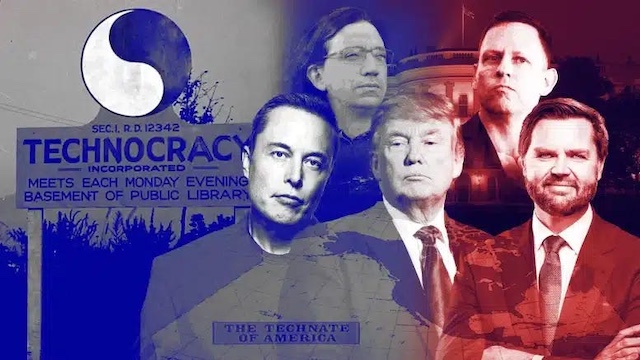 Nowhere is the logic more naked than in the reconstruction proposals circulating for Gaza. A business plan presented in elite forums envisions a series of AI-managed smart cities in which former residents receive digital tokens rather than restored property rights. Participation is conditioned on compliance with the digital system. The currency under consideration has been linked, in public discussion, to tokens associated with the Trump family’s commercial ventures. Palantir’s analytic capabilities are part of the architecture. Jared Kushner’s real-estate expertise is part of the deal structure. The Board of Peace — an entity chaired for life by Trump, requiring billion-dollar contributions for membership, and staffing itself with figures such as Tony Blair — functions as a parallel multinational governance body with its own force structure. It is the United Nations without the pretense of national representation, and its agenda is indistinguishable from the technocratic development model long promoted by the very institutions Trump once claimed to oppose. The project is not an aberration. It is a pilot program. What can be imposed on a defeated population under emergency conditions can, with sufficient normalization, be imposed on any population once the infrastructure is universal.
That infrastructure is already being universalized at home. Real ID is the foundation of a national digital identity. Flock cameras and similar systems create a persistent, searchable record of movement. Programmable money creates the capacity to freeze or redirect economic life without formal due process. Parallel systems of social scoring — already visible in banking deplatforming, insurance risk models, and employment screening — are being refined with artificial intelligence. The Chinese social-credit system is not a distant curiosity; it is a working prototype that American technocrats have studied and adapted. The difference is packaging. In China the system is explicit. In America it is introduced as convenience, security, and innovation. The effect on the individual is identical: the progressive narrowing of the domain in which one may act without permission.
The capture extends far beyond finance and surveillance. The educational system has for generations been shaped by foundations and administrative bureaucracies hostile to independent thought. The medical system demonstrated during the recent pandemic its capacity for coordinated, top-down enforcement of experimental interventions with minimal regard for informed consent or long-term risk. The military itself, once a largely neutral force that was purged and politicized under Obama, and now Trump, has become an instrument of domestic social engineering as well as foreign intervention. In each case the pattern is the same: expertise is invoked to override the judgment of ordinary citizens, dissent is pathologized, and the resulting compliance is celebrated as progress. The nation that once measured its freedom by the absence of prior restraint now measures its virtue by the thoroughness of its administrative controls.
Psychological operations complete the enclosure. Influence campaigns — domestic and foreign, commercial and governmental — saturate the information environment. Citizens who once questioned every expansion of state power now accept the same expansions when they arrive under the correct partisan label. The Q phenomenon, whatever its origins, functioned to absorb and neutralize precisely those segments of the population most likely to resist technocratic consolidation. Every policy that expands surveillance or programmable control is reframed as a brilliant 5-D chess move against the deep state. The result is a population that polices itself, defending the very mechanisms that render it powerless. This is not organic politics. It is the management of consent on an industrial scale.
The economic numbers confirm the inversion. America leads the world in military expenditure and in the rate of incarceration. It ranks far lower in measures of economic freedom, health outcomes relative to cost, and genuine innovation outside the narrow corridors of subsidized technology. The rhetoric of fiscal conservatism and anti-war principle has become theater. Deficits continue under unified Republican control. Permanent war continues. The surveillance state expands. The only consistent beneficiaries are the firms and individuals positioned at the intersection of government contracts, digital platforms, and monetary innovation. Trump’s personal financial trajectory during the second term — meme coins launched on the eve of inauguration, family ventures in stablecoins, real-estate opportunities in reconstruction zones — illustrates the point with brutal clarity. Opportunity, not principle, appears to be the governing calculus.
The ordinary American has been told for decades that freedom means the absence of visible chains. But the most effective chains are often the ones a man mistakes for conveniences. He accepts the application because it saves time. He accepts the camera because it makes him feel safer. He accepts the identity requirement because it prevents fraud. He accepts the automated decision because it is faster than waiting for a human being. He accepts the financial monitoring because criminals must be stopped. He accepts the integration because separate systems are inefficient. Then one day he discovers that he cannot opt out of any of it, cannot inspect the rules, cannot speak to a responsible person, and cannot function outside the network.
This is the soft despotism that Tocqueville warned about: a government that does not tyrannize but “hinders, compromises, enervates, extinguishes, dazes, and finally reduces each nation to being nothing more than a herd of timid and industrious animals of which the government is the shepherd.” It is not a new world order imposed by a single cabal. It is a new world disorder in which sovereignty is parceled out among bureaucracies, corporations, and international bodies, and in which the individual is left with the form of liberty but not the substance.
 The dystopian novels and films that Americans grew up with — *1984*, Brave New World, Fahrenheit 451, The Matrix, Minority Report — were not predictions of a single totalitarian party. They were warnings about the combination of technology, ideology, and power. We are not living in any one of them, but we are living in their shadow. The telescreen is in your pocket. The soma is on your feed. The firemen burn not books but accounts. The pre-crime unit is an algorithm that flags you for a loan denial, a job rejection, or a no-fly list.
At that point, the country may still have elections, flags, speeches, courts, churches, newspapers, and patriotic ceremonies. It may still call itself free. But freedom is not preserved by retaining the decorations of liberty after surrendering its working machinery. A man is not free merely because he can complain about the system if the system controls his livelihood, his movement, his money, his identity, and his access to public life.
The answer is not to smash every computer, reject every innovation, or pretend that the past was a golden age of privacy. The answer is to insist that technology remain subordinate to the Constitution rather than allowing the Constitution to become an inconvenience imposed upon technology. That means clear laws, meaningful warrants, strict limits on data retention, independent oversight, transparency in government contracts, genuine avenues of appeal, protection for anonymous political association, separation between commercial data and law-enforcement access, and consequences for officials or corporations that abuse the information entrusted to them. It means refusing to treat private companies as unelected sovereigns merely because government has become dependent upon their systems. It means preserving cash and other practical alternatives so that participation in society does not require permanent digital submission. It means remembering that a citizen is not a data point, a risk score, a behavioral profile, or a problem to be optimized.
Or citizens can simply refuse to comply with all illegitimate government demands that state they must use this technology, in order to be fully and properly represented by federal and state government. Not everyone wants to be a part of this new age of hyper-industrialized super-advanced technology — some of us just want to live and let live and be left alone, by the country’s busybodies and government.
Most of all, it means asking the oldest and most important American question: “Who gave you the authority?”
Who gave the agency the authority to collect the information? Who gave the contractor the authority to combine it? Who gave the algorithm the authority to decide? Who gave the financial institution the authority to deny access? Who gave the administrator the authority to classify a citizen as dangerous, unreliable, unprofitable, or unworthy? And what recourse does the individual possess when those judgments are wrong?
If the answer is always “the system,” then the system has become the sovereign.
That is the heart of the matter. The new order, if it emerges, may not arrive with a proclamation announcing the end of freedom. It may arrive through a thousand sensible adjustments, each defended separately and adopted for reasons that sound practical. The camera is for safety. The database is for efficiency. The identity card is for convenience. The algorithm is for fairness. The digital wallet is for innovation. The AI is for national security. The partnership is for competitiveness. The monitoring is for fraud prevention. The integration is for modernization.
And every individual measure may contain some truth. That is what makes the whole business so difficult to resist.
The danger lies in the accumulation. When all the systems are connected, when every institution can see more than it once could, when every transaction leaves a record, when every record can be analyzed, when every analysis can influence a decision, and when every decision can be made without a human face appearing before the citizen, the country will possess something more powerful than the old bureaucratic state. It will possess a state that can observe continuously, calculate instantly, and act quietly.
The people building that state may not think of themselves as tyrants. Some may sincerely believe they are saving lives, defeating criminals, protecting the nation, increasing prosperity, or winning the technological contest with China. Some may be patriots. Some may be opportunists. Some may be idealists. Some may simply enjoy the money. Their motives will vary. The machinery will not care.
Machines do not possess constitutional conscience. They do not understand the dignity of a free man. They do not know the difference between an unpopular opinion and a dangerous conspiracy unless somebody defines the difference for them. They do not recognize the moral importance of privacy unless the law requires them to respect it. They do not restrain themselves because restraint is noble. They execute the permissions built into them.
That is why the American people must stop allowing the men who build these systems to define the limits of their own authority. A contractor cannot be permitted to write the rules governing a machine from which it profits. An agency cannot be permitted to conceal its actions behind technical complexity. A president cannot be permitted to claim that a tool is harmless merely because it is being used against people his supporters dislike. A corporation cannot be permitted to become a private government simply because its software has been woven into public life.
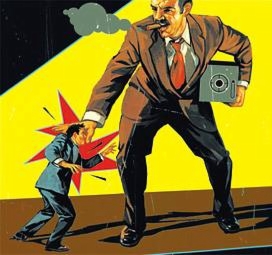 The working man understands this instinctively. If a company owns the only road to town, the fact that the road is privately owned does not make him free. If a bank controls the only means by which he can receive his wages, the fact that the bank is a private business does not make him independent. If an agency can observe everything he does but refuses to explain how it reaches its conclusions, the fact that the agency uses computers rather than armed men does not make its authority harmless.
Liberty requires room to stand apart. It requires the ability to say no, to keep some matters private, to transact without asking permission, to criticize the government without being categorized as a threat, and to make mistakes without having those mistakes preserved forever in a system that follows a man for the rest of his life. It requires human judgment, not because human beings are perfect, but because only human beings can be held morally and legally responsible for the exercise of power.
The machine is already here. It is not hidden in a bunker, and it does not need a dramatic unveiling. It is being built in laboratories, government offices, corporate boardrooms, defense contracts, financial regulations, data centers, identity systems, and software platforms. It is being built by people who often disagree with one another about politics but agree that more information, more integration, more automation, and more centralized capacity will solve the problems of the age.
Perhaps some of it will. Perhaps much of it will. But the question that must never be postponed until after the machinery is complete is whether the American citizen will still possess the practical power to refuse it.
There is no political solution internal to this system. The two parties have become complementary instruments of the same administrative expansion. One provides the rhetoric of equity and climate emergency; the other provides the rhetoric of national greatness and technological dominance. Both deliver the infrastructure of control. Elections change the personnel and the branding; they do not reverse the trajectory. The window for exit and construction of parallel institutions is narrowing as the physical and digital architecture locks into place. Cabins in the mountains will not suffice when every transaction, every movement, and every association is logged and scored, unless like-minded folks produce what they need within their own communities and deal within a black market. Otherwise, Americans’ only remaining options are obstruction at every legal and practical chokepoint, relentless public exposure of the mechanisms, and the deliberate cultivation of communities that refuse the digital leash. In the last resort, the tree of liberty may again require the watering that Jefferson described. That is not a call to violence; it is a recognition that free societies have never been preserved by those who waited for permission.
The technocrats and their military-industrial partners are not invincible. Their systems are complex, therefore fragile. They depend on continuous compliance, continuous data flows, and continuous belief in the competence of experts. Withdraw any of those, and the machinery begins to seize. The American people still possess, for a little longer, the residual habits of self-reliance, the residual institutions of local association, and the residual memory of what a free society actually looks like. Those resources will not last if they are not used. The choice is no longer between left and right. It is between the managed future being constructed in the data centers and the unmanageable freedom that the Founders risked everything to secure. History will not forgive those who, having been warned, preferred the comfort of the slogan to the hard work of resistance. The wildfire is already lit. Whether it consumes the Republic or clears the ground for something worth keeping depends on whether enough free men and women decide, while there is still time, to act as if their liberty were still their own.
A free people should not wait until the machine is finished to ask who owns the switch. By then, the switch may be the least important part of the problem. The real question will be whether anyone remembers that the machine was supposed to serve the man — and not the man serve the machine.

September 27, 2026

Justin O. Smith ~ Author
~ the Author ~
Justin O. Smith Has Lived in Tennessee Off and on Most of His Adult Life, and Graduated From Middle Tennessee State University in 1980, With a B.S. And a Double Major in International Relations and Cultural Geography – Minors in Military Science and English, for What Its Worth. His Real Education Started From That Point on. Smith Is a Frequent Contributor to the Family of Kettle Moraine Publications.