America Isn’t Just ANGRY Anymore…
It’s suspicious of itself!
That’s how 53% of American adults describe the morality and ethics of their fellow citizens: bad, according to a global Pew Research Center survey reported by the Detroit News. Let that sit for a second. More than half of us don’t just think the country is off track. We think the people around us are.
That should bother us. Political disagreement is one thing. Moral suspicion is another. When Americans stop believing their neighbors can be wrong in good faith, every argument starts to look like proof of corruption, ignorance, hatred, or treason.
You can see it everywhere now: yard signs, bumper stickers, school board meetings, court rulings, elections, and dinner tables. Politics doesn’t just shape what people think anymore. It shapes who they trust, who they avoid, and who they assume is dangerous.
That’s where the Constitution comes in…
 When a country loses trust in its institutions, leaders, media, and even its neighbors, it looks for something solid to stand on. For America, that common foundation isn’t a king, a church, or a bloodline. It’s the Constitution. In that sense, the U.S. Constitution functions as America’s Bible. I don’t mean everyone worships it or that it fell from heaven. I mean it plays the role sacred texts play for other communities: it gives the people a common story, a shared authority, and a standard to argue from when everything else starts falling apart.
You can see it every time Americans fight over rights. Whether it’s a protester holding a sign, a journalist refusing to back down, a church challenging a government restriction, a defendant demanding due process, or citizens arguing over gun rights, they’re all doing the same basic thing: reaching back to the Constitution and saying, “This is the line you can’t cross.” We may disagree about where the line is, but we still argue as if it exists. That’s the point.
Think about the civil rights movement, too. The demand wasn’t just “be nicer” or “change your attitude.” It was a constitutional claim grounded in equal protection, due process, and voting rights. The movement appealed to America’s founding promises and forced the country to account for the gap between what it said on paper and what it allowed in practice. That’s what sacred civic texts do: they give reformers a language powerful enough to challenge the nation by its own standards.
That’s why the Constitution still matters. Not because it resolves every fight, but because it gives us a common place to begin the debate.
That kind of loyalty can be dangerous when it’s directed at the wrong things, but it also helps explain why founding documents matter so much. They can become what people look to when the country feels like it’s coming apart. And right now, it feels like we’ve lost some reverence for the idea of becoming one people, not because everyone has to erase where they came from, but because a republic needs a shared identity to survive.
Instead of that shared identity, we keep retreating into smaller labels and competing tribes. Heritage matters. Family history matters. Culture matters. But when every label becomes a wall, the country starts to feel less like a people and more like a collection of rival camps. That’s the danger I’m pointing to.
Regardless of how you explain the Constitution’s origins, the outcome still matters: representatives from the thirteen original states gathered, argued, compromised, and accepted this document as the foundation of a new republic. Not perfect. Not finished. But foundational. It became America’s compass and blueprint.
That matters because our First Amendment rights aren’t permission slips to do whatever we want. They’re protections against government overreach, safeguarding speech, belief, worship, assembly, and the press. But they don’t erase responsibility. Freedom without restraint isn’t liberty. It’s chaos.
The founders knew the document would need room to breathe. That’s why the amendment process exists. Change is allowed, but it isn’t supposed to happen because one faction screams the loudest on a given afternoon. It requires a process, an agreement, and a high threshold of collective consent.
That’s the theory, anyway. The Constitution gives us a process for disagreement, but modern media often turns it into entertainment, identity, and outrage. Instead of helping us argue from a shared foundation, the media-industrial complex keeps pulling us back into our corners. It leads people around like sheep because outrage is easier than thought and noise is easier than truth. “Sheeple” may be an ugly word, but sometimes ugly words wake people up. The behavior is real: people latch onto one authority, one outlet, one tribe, and let it do their thinking for them. It feels safe. It feels simple. And that’s exactly the problem.

Sheeple May Safely Graze
The point isn’t to look down on people. It’s to ask why so many of us keep handing our judgment to someone else. If someone repeats a headline, slogan, or talking point without first asking whether it’s true, who benefits from that obedience?
Media shapes belief by deciding what gets attention and how the story is framed. One outlet can present a protest as a fight for civil liberties, while another can frame the same event as violent lawlessness. Same event, different story, different audience reaction. That’s the power of framing.
Consider a school board meeting. One headline can make concerned parents sound like citizens defending their kids. Another can make the same room sound like a mob attacking public servants. Or look at immigration, policing, crime, war, or elections. The facts may be complicated, but the presentation usually isn’t. The audience gets the version that keeps them loyal, angry, and convinced that the other side is either stupid or dangerous.
Even the images matter. Show burning buildings, and the story becomes chaos. Show families marching with handmade signs, and the story becomes one of courage. Show a politician’s worst ten seconds, and the person looks incompetent or cruel. Show applause, flags, and smiling supporters, and the same person looks like the leader of a movement. The media doesn’t just tell us what happened. It teaches us how to feel about it.
Then comes repetition. The same themes are pushed again and again until people accept them as obvious. Fear, outrage, and resentment spread faster than patience or nuance, so that’s what the business model rewards. Keep people angry, and you keep them watching.
That’s why the same story can feel like five distinct Americas, depending on where you get your news. One America is always under attack. Another is always being liberated. Another is always being betrayed. Another is always on the brink of collapse. After a while, people aren’t just consuming different opinions. They’re living in different realities.
The digital age supercharges it. Algorithms feed us more of what already grabs us, usually more that flatters our side and humiliates the other. Before long, the echo chamber starts to feel like common sense. Hear something enough times, and it starts to sound true, even when it isn’t. And when every issue gets shoved into a two-team cage match, people learn to conform just to avoid isolation.
That’s the architecture of modern discontent. It’s not simply that Americans disagree; disagreement is supposed to be part of the constitutional design. The deeper wound is that too many Americans now see disagreement as proof of corruption, ignorance, hatred, or treason. Once we stop believing our neighbors can be wrong in good faith, citizenship becomes a permanent courtroom, and every argument becomes an indictment.
All of this helps explain why the Pew number matters. When 53% of American adults say the morality and ethics of their fellow citizens are bad, that statistic isn’t just an opinion poll; it’s a warning light on the dashboard of the republic. Pew’s 25-country survey found that the United States was the only country in which more adults described their fellow citizens’ morals and ethics as bad than as good. That makes the American result feel less like ordinary frustration and more like national alienation.

CON-gress
This alienation shows up in how Americans talk about institutions. We don’t merely criticize CON-gress; we assume it’s bought. We don’t merely distrust media outlets; we assume they’re programming us. We don’t merely disagree with court decisions; we assume the courts are illegitimate when they rule against what we want. Some of that skepticism is earned. Institutions have failed, lied, overreached, and protected themselves. But a nation can’t survive on suspicion alone. Suspicion may expose rot, but it can’t build roads, schools, families, neighborhoods, or trust.
That’s what makes the First Amendment more than a slogan. It isn’t a toy for provoking strangers online. It’s a discipline. It requires us to protect speech we dislike, faith we don’t share, assemblies we wouldn’t attend, and press coverage we may deem unfair. That isn’t weakness. That’s the hard labor of liberty.
But liberty without responsibility curdles into license. If the First Amendment protects the right to speak, it doesn’t relieve us of the obligation to think. If it protects the press, it doesn’t require us to outsource our judgment to any commentator who confirms our resentment. If it protects religion, it doesn’t authorize turning faith into a weapon against neighbors. Rights aren’t just shields against government abuse; they’re also reminders that free people must govern themselves before demanding that the government govern everyone else.
The media-industrial complex understands our weakness better than we do. Outrage is cheap to manufacture and profitable to distribute. Fear keeps people watching. Contempt keeps people sharing. A calm citizen is a terrible customer for an outrage economy, but an anxious citizen will click, repost, donate, argue, and come back for another dose. That doesn’t mean every journalist is corrupt or every media company is malicious. It means the incentive structure rewards escalation, and America has been living in that escalation for years.
Why do they create that tension? Because tension pays. Calm doesn’t trend. Balance doesn’t sell as well as panic. A story that says “this is complicated” asks people to slow down, while one that says “your way of life is under attack” grabs attention immediately. It boosts ratings, drives clicks, sells subscriptions, fills ad space, pulls in donations, and keeps people emotionally tied to the outlet that made them feel understood. Once fear becomes profitable, somebody will always package it.
You see media-driven tension most clearly during election season, when every poll is treated like a medical emergency, and every campaign speech is taken as proof that democracy is either being saved or destroyed. Instead of explaining what happened and why it matters, the coverage often turns politics into a countdown clock: panic now, donate now, watch now, hate now.
A protest is another easy example. If a network wants fear, it shows the smashed window, the fire, the sirens, and the most extreme person in the crowd. If it wants sympathy, it shows peaceful families, handmade signs, police in riot gear, and someone crying into a microphone. Same event, but the emotional instructions are completely different.

Heah dey iz!
Court rulings receive the same treatment. A decision can be framed as justice finally arriving or as the end of the country as we know it. The legal reasoning often gets buried beneath reaction clips, angry panels, and dramatic music. By the time people hear what the ruling actually says, they’ve already been told how to feel about it.
Even a crisis gets sorted into teams, and that sorting deepens political tension. A hurricane, a shooting, a border surge, a police encounter, or a recession becomes less about solving the problem and more about proving which side is evil, stupid, or responsible. That pressure keeps the audience emotionally engaged, but it also makes ordinary compromise feel like betrayal.
Social media intensifies this pattern by turning public life into performance. We no longer just hold opinions; we display them. We no longer just disagree; we brand ourselves through disagreement. Every issue becomes a costume, a slogan, a team color, a signal to allies, and a threat to enemies. In that environment, moderation looks like cowardice, patience like surrender, and humility like weakness. The algorithms didn’t invent these flaws; they discovered, measured, and learned to monetize them.
You see it when a fifteen-second clip is ripped out of context and treated as the whole story. Someone says something clumsy at a meeting, on a campus, or in a store, and by dinner they’re a symbol of everything wrong with America. Nobody waits for context because outrage travels faster than context. The clip gets shared, the sides line up, and the person becomes a prop for somebody else’s argument.
You see it in the way people post, too. A tragedy happens, and within minutes, everyone is expected to have the right statement, the right hashtag, the right outrage, and the right enemy. Silence is treated as guilt. Nuance is treated as betrayal. And if someone asks a careful question, the crowd hears it as siding with the other side.
Then the feed learns you. If you linger on an angry post, it serves you ten more. If you argue with one stranger, it finds you a hundred others. Pretty soon, the phone in your hand stops feeling like a window and starts acting like a funhouse mirror, stretching every fear and shrinking every bit of common ground.
Underneath all of this lies loneliness. A lonely country is an angry one because isolation amplifies every grievance. When people lose churches, clubs, unions, neighborhood rituals, extended family networks, and ordinary face-to-face obligations, politics rushes in to fill the spiritual vacuum. It offers a sense of belonging, villains, rituals, prophets, slogans, and the promise that salvation will arrive after the next election. That’s too much weight for politics to carry, and it bends public life toward idolatry.
You can see it in the person who doesn’t know the people on their street but knows every scandal in Washington. You can see it in someone who hasn’t sat across from a neighbor in months yet spends every night arguing with strangers online. Politics becomes the place where people feel noticed, useful, and part of something bigger. The problem is that belonging comes with a price: constant anger is the membership fee.
That’s also why conspiracy thinking can be so tempting. It offers lonely people a map, a mission, and a cast of villains. Suddenly, the messiness of life has a script. The person isn’t isolated anymore; they’re “awake.” They’re not just frustrated; they’re part of a hidden battle. That kind of story can feel powerful when the ordinary community has disappeared.
And it shows up after real loss, too. A person loses a job, a church closes, a parent dies, a marriage falls apart, or a town changes faster than people can process. If there’s no healthy community around them, political anger can become the container for all that pain. It gives grief a place to go, even if the target isn’t always the real source of the wound.
Benjamin Franklin, “Fart proudly!”
Yes, there’s discontent in America. It’s directed at government, media, schools, corporations, religion, policing, borders, courts, speech, money, culture, and one another. But the bigger question is whether discontent remains a warning sign or becomes who we are. A country can use dissatisfaction to reform itself. It can’t renew itself through permanent contempt.
The way out isn’t agreement on everything. That’ll never happen, and it shouldn’t. The way out is rebuilding enough civic trust to believe that the person across the aisle, across the street, or across the Thanksgiving table is still part of the same national project. That means choosing conversation over conflict, compromise over condemnation, and enough connection to remember we’re still in this together.
The question isn’t whether America will face conflict. It always will. The question is whether we still have enough trust, discipline, and grace to preserve the constitutional system we inherited — what Benjamin Franklin called “a republic, if you can keep it.”
For the Amalgamated Heavy
‘The devil you say…‘

August 27, 2026
~ the Author ~
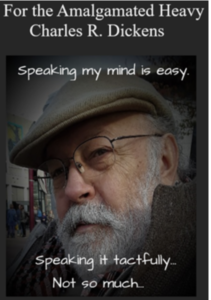 Charles R. Dickens Was Born in 1951, Is a Veteran of the Vietnam War, for Which He Volunteered, and the Great-Great Grandson of the Noted Author, Whose Name He Shares.
He Is a Fiercely Proud American, Who Still Believes This Is the Greatest Country on the Planet, With Which We’ve Lost Control and Certainly Our Direction. He Grew Up in Moderate Financial Surrounding; We’re Not Rich by Any Stretch, but Didn’t Go Hungry – His Incredibly Hard Working Father Saw to That. As Most From That Era, He Learned About Life From His Father, Whose Story Would Take Too Long to Tell, Other Than to Say That, He Is Also a Fiercely Proud American; A WWII and Korean War, Veteran Marine.
Charlie Was Educated in the Parochial System Which, Demanded That You Actually Learn Something, and Have Capability to Retain It Before You Advance. He Attended Several Universities in Pursuit of a Bachelor’s Degree, and Chased the Goose Further to a Master’s, and Has Retained Some Very Definite Ideas About Education in This Country.
in Addition, Charlie Is a Retired Blues Guitar and Vocalist – a Musician. This Was His Therapy Career. Nothing Brings Him as Much Joy as Playing Music, and He Wishes That He Could Make a Living at It… but Alas… Life Goes on!