
Or… more than you ever wanted to know about computer networks, though you were smart enough not to ask.
Sometimes life plants the seed of an idea that takes time to germinate. This one took a few years to take root. What began as a personal frustration with government paperwork led me to a broader question: why, in an age of nearly instantaneous information retrieval, must citizens still repeat the same information across multiple agencies and systems?
The short answer is that the system is inefficient, in part by design. In a democratic republic, efficiency is often traded off for checks and balances, privacy protections, and limits on centralized power. Yet that trade-off now carries a growing cost. Government silos reduce visibility, duplicate effort, slow decision-making, and make fraud harder to detect. The challenge, then, is not choosing between privacy and efficiency, but how to modernize responsibly enough to preserve both.
That tension – between liberty and administrative efficiency – lies at the heart of the American silo. Citizens rightly expect the government to protect their personal data and limit unnecessary sharing. At the same time, we expect agencies to respond quickly, detect fraud, and avoid waste. Those expectations increasingly collide within a technological architecture that is fragmented, aging, and costly to maintain.
My own experience with personal data illustrates this contradiction. We routinely expose fragments of ourselves online, voluntarily or otherwise, while also demanding that government systems protect us from misuse, overreach, and breaches.
Why Silos Exist
I subscribe to a service that scans the dark web for exposures of my personal and medical information. Even with that level of vigilance, breaches still happen. A few years ago, thieves accessed our accounts and stole several thousand dollars. That experience made me take data security seriously, but it also clarified the larger point: modern systems are vulnerable whether information is over-shared, under-protected, or fragmented across too many places.
Personal data security is not the central focus of this essay, but it offers a useful parallel. The same forces that expose individuals online – fragmentation, inconsistent controls, and legacy infrastructure – also shape the architecture of government systems.
The Trade-off: Security vs. Efficiency
The debate between stand-alone and interconnected systems boils down to a hard trade-off: security versus efficiency. The technology landscape beneath much of the U.S. government is paradoxical. In many places, the front door – identity, access, and user-facing security – looks modern, while the foundation supporting processing and storage still reflects the computing world of the 1960s and 1970s.
 That creates the strange condition sometimes described as security by obsolescence. These vintage systems can be resistant to modern cyberattacks precisely because they predate today’s attack surface. A typical attacker is trained in current operating systems, tools, and languages – not the older stacks that still run parts of government. But while these systems may be difficult to hack in conventional ways, they are also dangerously brittle.
Their greatest enemy is often not a foreign intruder but simple entropy: aging components, scarce replacement parts, and technical expertise that is disappearing over time. When a mission-critical part fails, there may be no manufacturer left to contact. In practical terms, that means the government is preserving continuity by relying on systems that are simultaneously durable, fragile, and increasingly expensive.
– Entropy: The easiest way to understand it is to think of it as nature’s natural tendency for things to get messy and disorganized if left alone.
The personal information sold on the dark web falls into several distinct categories of Personally Identifiable Information (PII) and digital footprint data. Cybercriminals target everything from basic contact details to permanent government identifiers. Financial PII is the most sought-after because it can be exploited for immediate financial gain. This includes credit card details, banking credentials, crypto wallet keys, and other identity information, such as government-issued cards: driver’s licenses, passport numbers, Social Security numbers, and tax information. Your detailed medical records are also widely available and considered among the most valuable commodities. If you have been treated at a hospital, clinic, or pharmacy that suffered a cyberattack, your Protected Health Information (PHI) is likely compiled in a dark web database.

Out of the Dark Web.
The dark web is an intentionally hidden, encrypted portion of the internet that is not indexed by traditional search engines. It requires specialized, privacy-focused software, such as the Tor Browser, to access. While notorious for illicit marketplaces, it is also a vital tool for privacy advocates.
From the citizen’s perspective, this is why the same personal information must often be submitted repeatedly. The structure is not arbitrary; it reflects legal, technical, and institutional boundaries intended to slow the concentration of power, even at the cost of convenience.
– Different agencies build identical, costly IT systems from the ground up.
– Processing times drag on as agencies verify data by mail.
– Intelligence gaps can arise when agencies fail to connect the dots.
– Fragmented data makes large-scale, unauthorized government surveillance significantly harder.
– Requiring agencies to obtain permission before sharing data creates a clear paper trail.
– A hacker who breaches one agency cannot steal all government data.
Here’s a fallacy in this approach. Multiple systems expose significant security weaknesses, especially when they are not integrated and operate in stand-alone environments. Although every system has security vulnerabilities, data silos directly exacerbate them by degrading visibility, fragmenting access controls, and delaying incident response. In fact, security research underscores a harsh reality: roughly 70% of organizations with data silos experienced a data breach within a two-year span. When a company’s risk and IT management operations exist as isolated islands, they fundamentally compromise the enterprise security posture.
“Information silos” are the primary inefficiency caused by stand-alone systems. While isolating a system improves security, it also limits the ability to leverage that data across the rest of an organization. When systems are unconnected, employees often recreate work that already exists elsewhere because they have no way of knowing it is there. Teams unknowingly perform the same tasks or research because they cannot see the output of other isolated systems. Budgets are drained by paying for multiple tools or software licenses that essentially do the same job but are “siloed” in different departments.
Stand-alone vs. Interconnected Systems
A stand-alone system is an independent ICT (Information and Communications Technology) system that operates entirely on its own without relying on external networks, central servers, or other devices.
– Network isolation: It does not connect to the internet or to local area networks (LANs).
– Self-contained processing: The device includes its own operating system, software, and data storage.
– Local input/output: Users must interact with the system either physically or via directly attached peripherals.
– Independent power: It often runs on its own power source or standard electrical outlets, without relying on network-dependent power management.
In the context of data management and operational efficiency, an interconnected (or integrated) system is a network of hardware, software, and databases that automatically share data and communicate with one another in real time.
– Automated data flow: Information moves between departments and applications without human intervention.
– Single source of truth: All connected platforms draw from and update a unified database to ensure consistency.
– Unified interface: Users can access data from various company functions through a single central dashboard or application.
– API dependency: It relies on Application Programming Interfaces (APIs) and network protocols to translate data across different software programs.
How This Shows Up in Government

CON-gress in Session
The U.S. government may be the largest real-world case study of this trade-off. Historically, agencies operated as secure, stand-alone silos that prioritized secrecy, jurisdiction, and narrow mission boundaries. Following major intelligence failures and repeated modernization efforts, the pressure shifted toward interconnected systems capable of sharing data faster and more broadly.
As of mid-2026, this tension is playing out in three major arenas:
– Intelligence: The Shift from Silos to Integration and Data Democratization
– Operational Agility vs. Rigorous Governance
– Comprehensive Data Sharing vs. Compliance Boundaries
Before the 9/11/2001 incident, the CIA, FBI, and NSA largely operated as stand-alone information silos. They were highly secure yet inefficient; they couldn’t “connect the dots” because the dots were on separate, disconnected computers.
– The Change: To address this, the government launched initiatives such as IC ITE (Intelligence Community Information Technology Enterprise), which moved 17 distinct intelligence agencies into a shared, interconnected cloud architecture.
– The Trade-off:
* Efficiency Gain: An NSA analyst can now securely correlate data with CIA findings in real time.
* Security Risk: The “Insider Threat.” With systems interconnected, a single leak (such as the Edward Snowden or Jack Teixeira leaks) can expose data from multiple agencies at once, rather than from just one agency.

More recently, the executive branch has publicly targeted information silos as a source of waste and delayed oversight. The policy logic is straightforward: if agencies can compare records more quickly, they can identify duplicate payments, conflicting claims, and obvious fraud with far less delay. The counterargument is equally important. Some of these boundaries were intentionally created to prevent broad, casual access to highly sensitive information.
– The Action: The March 2025 Executive Order (“Stopping Waste, Fraud, and Abuse by Eliminating Information Silos”) directed agencies to break down the walls between their databases.
– The Goal (Efficiency): By integrating data from the IRS, the Department of Labor, and Medicaid, the government aims to instantly flag fraudulent claims, such as someone claiming unemployment while reporting income on their tax return.
– The Risk (Privacy/Security): Critics argue that these silos were intentional. For example, IRS tax data (Title 26) was legally “siloed” to ensure that other government officials couldn’t arbitrarily access citizens’ financial lives. Connecting these systems removes that structural privacy protection.
Infrastructure: The Vulnerability of “Smart” Interconnection.
The government also manages the defense of critical infrastructure (power, water, transportation), which has shifted from stand-alone to interconnected systems.
– Stand-alone (Past): A dam or power plant was manually operated. To hack it, you had to physically break into the building.
– Interconnected (Present): These systems are now online for remote monitoring. This enables “lateral movement” attacks – state-sponsored hackers can breach a minor interconnected vendor and then move across the network into the control systems of major US utilities.
The Cost of Silos
What This Means to You and Me…
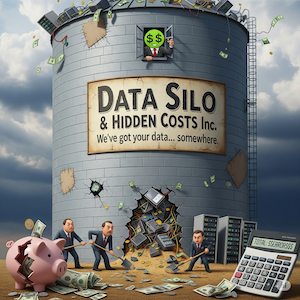
The Cost of Silos
For citizens and taxpayers, the effects of information silos are not abstract. They manifest as slower service, duplicate spending, delayed verification, and improper payments that are harder to detect. In fiscal terms, the cost is enormous because fragmented systems make it harder for government to see clearly across programs, agencies, and eligibility rules.
* Unless otherwise noted, the figures below are based on estimates and public reporting available as of 2026, with cumulative references often using 2003 as a baseline. Many of the broad estimates are drawn from Government Accountability Office (GAO) reports and related federal budget materials.
Annual Improper Payments = $186 billion
The largest financial losses stem from Improper Payments – money sent to the wrong person, in the wrong amount, or for the wrong reason. This happens because siloed agencies cannot “cross-check” their data.
In Fiscal Year 2025 alone, the government made an estimated $186 billion in improper payments.
– Example: A person might claim unemployment benefits (Department of Labor silo) while also earning a salary (IRS silo). Because the two systems don’t communicate in real time, the government pays the fraudulent claim.
– Impact: Since 2003, this “blindness” has cost the U.S. government approximately $3 trillion.
The ‘Redundancy Tax‘ (Duplication) = $80 billion
When agencies can’t see what others are doing, they inevitably duplicate work. The GAO issues annual reports documenting this waste.
– Fragmented Programs: One GAO report identified 82 distinct programs across 10 agencies, all aimed at improving “teacher quality” and costing $4 billion. Many of these programs had separate administrative overhead.
– The Savings Potential: By addressing these duplications (e.g., by merging the silos), the government has saved more than $600 billion over the past decade, yet tens of billions in potential annual savings remain untapped.
– Direct Maintenance ($80B/yr): The cost of paying staff and vendors to keep obsolete, isolated mainframes operational.
– Fraud & Error ($186B/yr): Losses from the inability to verify eligibility across agency databases.
Opportunity Cost (Incalculable):
The GAO estimates that since 2003, cumulative improper payments have now reached $3 trillion. To visualize this “Opportunity Cost” in 2026 terms:
– Infrastructure: The lost funds could have funded the Infrastructure Investment and Jobs Act (approximately $1.2 trillion) twice over, rebuilding every major bridge and road in America.
– National Debt: It represents roughly 8% of the total National Debt (approximately $36 trillion to $40 trillion in 2026), which could have been erased instantly.
– Defense: It is equivalent to fully funding the U.S. Military for nearly 3.5 years.
The Legacy Tax – $80 billion
Maintenance versus Modernization: The most direct financial cost is the expense of keeping the silos operational. The federal government spends over $100 billion annually on IT, but 80% of that budget is consumed by Operations and Maintenance (O&M) for aging legacy systems.
Agencies spend billions to patch 50-year-old silos rather than buy modern replacements. For example, maintaining just 10 critical legacy systems costs taxpayers about $337 million annually.
Because maintenance consumes the budget, only about 20% remains for modernization. This creates a “death spiral” in which agencies can never afford to escape the silos that drain their budgets.
Cumulative Waste = $3 trillion
The economic value lost because data cannot be shared to enable faster decisions or drive innovation. What could we have done with these funds?
Key Takeaway:
The central point is simple: silo inefficiency is not merely an administrative nuisance. It is a recurring fiscal burden. The government spends tens of billions to maintain aging systems while losing far more to improper payments and fragmented oversight.
A Practical Modernization Path
Recommendation:
If there is a viable path forward, it is likely not a dramatic one-time replacement. Large, sudden overhauls often fail because they try to replace mission-critical systems all at once. A more realistic approach is incremental modernization: reduce risk, preserve continuity, and connect data more intelligently over time.
 One useful model is the Strangler Fig pattern, a software modernization approach popularized by Martin Fowler. Rather than rewriting an entire legacy system in a single high-risk effort, organizations wrap the old environment, build modern replacements feature by feature, and retire legacy components gradually. The result is a transition that keeps operations running while lowering the risk of a catastrophic failure.
The pattern mirrors the life cycle of the strangler fig, which wraps its roots around a host tree and gradually takes over. The software implementation proceeds in three phases:
– Transform (Wrap/Proxy): You place an intermediary layer (a façade or API router) between your clients and the legacy system. Initially, the router forwards all traffic to the legacy system.
– Coexist (Build & Route): You incrementally rewrite specific features as new, modern services. The router is then updated to intercept requests for these features and redirect them to the new services, while older requests continue to be handled by the monolith.
– Eliminate (Strangle): As more features are migrated, the legacy system handles less traffic. Once the new system covers all functionality, the old host is decommissioned.
Core Benefits are that it:
– Reduces Risk: You mitigate the risk of catastrophic failure by deploying changes in iterations.
– Enables Continuous Delivery: You can ship new features to users immediately instead of waiting months for a massive rewrite.
– Has Built-in Rollback: If a new microservice fails, you can redirect the router to the legacy system while you fix the issue.
* This is a simplified description, but the broader point stands: viable alternatives exist. Incremental modernization avoids the recurring failure mode of attempting to replace massive legacy platforms overnight. Instead, it provides a safer bridge from monoliths to services, from isolated records to usable data, and from stagnation to gradual improvement.
The technical details can be dense, but the broader conclusion is straightforward: reform is possible if it is designed to keep the patient alive during treatment. When the fiscal stakes are this high, the cure cannot be more destructive than the disease.
Long-Term Fiscal Implications
The long-term implications extend beyond information architecture, but the themes connect. The national debt and the annual deficit are often conflated, though they are not the same. The debt is the accumulated total; the deficit is the amount added in a given year. What matters here is that rising interest costs now consume a growing share of the federal budget, narrowing the room for everything else.
– The government now spends more on interest payments than on National Defense.
– This shift fundamentally changes the U.S. economy from one that invests in the future (security, infrastructure, and R&D) to one that pays for the past.
The “Interest vs. Defense” Flip in 2026: The cost of servicing the debt has become the third-largest item in the federal budget, consuming nearly $1.1 trillion annually.
– Net Interest Costs (2026) $1.1 trillion, Exceeds Defense Budget
– Defense Budget (2026) $885 billion ~ 12.5% of Total Spending
– Annual Deficit: $1.9 trillion added to Debt Each Year
The Three Major Implications
The Budget Squeeze (“Dead Money”) – Every dollar spent on interest is “dead money” – it buys no jets, fixes no bridges, and funds no healthcare.
The Squeeze: As interest rates remain elevated (around 4-5%), the share of the budget allocated to debt service increases.
– The Consequence: To balance the books without borrowing more, the government must either cut services (such as Social Security and Medicare) or raise taxes. Currently, it is doing neither, which accelerates the debt cycle.
The “Crowding Out” Effect – When the government borrows $2 trillion a year, it soaks up a massive share of available lending capital in the global market.
– Competition: The government competes with you for investors’ capital. To attract investors, it offers higher yields on Treasury bonds.
– Impact on YOU: Banks raise rates on mortgages and car loans to match bond yields. Effectively, the government’s hunger for cash makes your debt more expensive.
Reduced “Fiscal Space” (National Security Risk)
– Historically, the U.S. has used debt as a “superpower” to weather crises (WWII, the 2008 Crash, and COVID-19)
– With the credit card already maxed out at $40 trillion, the U.S. has less capacity to borrow for the next emergency, which is a problem.
– The Geopolitical Risk: If a major war or pandemic broke out tomorrow, borrowing another $5 trillion would spike inflation and interest rates to potentially catastrophic levels, thereby limiting the President’s options.
 The $186 billion lost to fraud each year is roughly 20% of the entire Defense Budget. While fixing silos won’t solve the $40 trillion debt, it is one of the few “painless” ways to reclaim nearly $200 billion annually without raising taxes or cutting benefits.
The “best” way to reduce the deficit is to recognize that efficiency alone cannot solve it. While fixing information silos saves money, the math is clear: you cannot balance a $1.9 trillion deficit by cutting only $186 billion in waste.
Recommendation:
Here are several approaches worth considering:
The conservative approach to the deficit, as defined in the Republican Study Committee (RSC) Blueprint, rejects tax increases and instead relies on two main levers: aggressive spending cuts and supply-side growth.
In the current climate, following the mixed results of DOGE – the “Department of Government Efficiency,” or, as I put it, “Discovering Outrageous Government Excess” – the conservative consensus holds that efficiency alone is insufficient. The new strategy moves beyond trimming waste and instead emphasizes shrinking the administrative state and more tightly limiting the federal scope.
The conservative plan sharply diverges from the “Status Quo” baseline by imposing a cap on spending growth.
Growth First (Supply-Side)
– Logic: You cannot tax your way out of debt; you must grow the GDP denominator to reduce the Debt-to-GDP ratio.
– Action: Permanently extend the Tax Cuts and Jobs Act (TCJA) provisions.
– Energy: Unleash domestic oil and natural gas production (“Drill, Baby, Drill“) to lower energy costs, which serves as a de facto tax cut for consumers and businesses.
Hard Spending Cuts
– Logic: The federal government is doing too much. Agencies outside the constitutional core (Defense, Justice) should be eliminated or devolved to the states.
– Target: A 23% across-the-board cut in Non-Defense Discretionary spending.
– Specifics: Eliminating the Department of Education (which allocates block grants to states) and repealing “Green New Deal” subsidies from the Inflation Reduction Act.
Entitlement Reform
– Logic: Social Security and Medicare are the primary drivers of debt. They must remain solvent without general tax hikes.
– Action: Means testing (reducing benefits for wealthy retirees) and gradually raising the retirement age to match increases in life expectancy (e.g., to age 69 or 70 for younger workers).
– Medicaid: Convert to “Block Grants” (fixed payments to states), which would force states to manage costs and likely reduce federal outlays by $4.5 trillion over 10 years.
The Liberal Approach

CONgress
The liberal approach to the deficit rests on a different premise: the gap should be narrowed through a mix of higher revenue from upper-income households and large corporations, targeted savings in healthcare and procurement, and selective public investment to raise long-run productivity, rather than through deep cuts to the social safety net alone. In practice, that means asking more from those with the greatest capacity to pay while also reducing avoidable costs in areas such as prescription drugs, Medicare overpayments, fossil-fuel subsidies, and inefficient contracting. As a benchmark, the Congressional Budget Office projects a roughly $1.9 trillion federal deficit in fiscal year 2026. Liberals generally argue that no single reform will solve the problem and that meaningful deficit reduction must combine multiple revenue and savings measures.
Revenue First:
– Raise more revenue from the top of the income and wealth distribution by increasing taxes on high earners, capital gains, inheritances, and very large fortunes, while also raising the corporate tax burden and tightening international profit-shifting rules. Public estimates for this general approach are substantial: raising the corporate income tax rate to 28 percent has been estimated to yield about $1.3 trillion over 10 years, while broader high-income tax changes in the Biden FY2025 budget were estimated to raise about $2.0 trillion over a decade.
Targeted Cost Control:
– Preserve core benefits but cut waste where liberals argue it is concentrated – allow broader Medicare drug-price negotiation, reduce Medicare Advantage overpayments, and strengthen enforcement against tax evasion and contractor fraud. On the healthcare side, recent estimates suggest Medicare Advantage overpayments will be about $76 billion in 2026 and could total roughly $1.3 trillion from 2027 to 2036 if left unreformed. The first round of Medicare drug-price negotiation was estimated to lower Medicare spending by about $6 billion, based on 2023 prescription volumes.
Investment with Payoff:
– Maintain or expand spending on infrastructure, childcare, housing, education, and clean energy on the theory that some near-term spending can improve labor-force participation, lower household costs, and produce stronger long-term growth and revenues. Liberals generally frame these investments as part of a larger package that is fully or largely paid for elsewhere, arguing that growth-supporting public investments should be paired with offsetting tax increases and savings rather than treated as stand-alone deficit reduction.
Entitlement Preservation over Retrenchment:
– Rather than sharply raising the retirement age or shifting major costs to states and households, the liberal model tends to protect Social Security, Medicare, and Medicaid benefits and to seek solvency through additional revenue, negotiated savings, and incremental reforms.
A Blended Approach
A practical middle ground would blend elements of both approaches rather than treating them as mutually exclusive. In that model, deficit reduction would come from a three-part strategy: moderate spending restraint, targeted revenue increases, and efficiency reforms that improve administration without pretending that waste alone can close a $1.9 trillion annual gap. Such an approach would reject both the pure conservative view that tax increases are unnecessary and the pure liberal view that social spending should be largely insulated from broader structural reform.
– Moderate Revenue Increases: Focus on politically narrower measures, such as higher taxes on very high incomes, stricter corporate enforcement, and the closure of selected loopholes, rather than broad across-the-board tax hikes.
– Selective Spending Restraint: Slow federal spending growth through caps, procurement reform, marginal means-testing, and incremental eligibility adjustments for future beneficiaries, rather than large across-the-board cuts.
– Efficiency plus Structural Reform: Preserve the emphasis on reducing fraud, duplication, and legacy-system waste, but treat those savings as one component of a broader package rather than a stand-alone cure.
– Political Reality: Because the deficit is now too large for any single faction’s preferred remedy to solve alone, a blended framework is arguably the most realistic path if policymakers ever move from messaging to arithmetic.
Note: The recommendations above synthesize public budget proposals, policy analyses, and AI-assisted research available at the time of writing.
Conclusion: What Must Change!
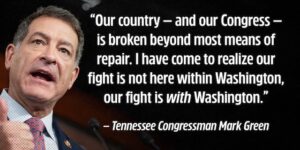 If this is where the current debate stands, my concern is not simply partisan. It is civic. A republic cannot remain healthy if it keeps answering structural problems with temporary workarounds, deferred choices, and fragmented accountability. The longer those habits persist, the harder meaningful reform becomes.
We are in serious trouble because we have normalized delay. “Kicking the can down the road” is not a strategy; it is a way of financing today at the expense of tomorrow. Public frustration with leadership, institutions, and incentives grows when citizens conclude that the system rewards postponement over repair.
– In Case You Didn’t Know (ICDYK): “Kick the ‘can’ down the road” means opting for a quick, temporary fix instead of resolving the issue permanently right now, knowing you will still have to deal with the bigger problem later. Maybe a better analogy is performing heart surgery with a Boy Scout knife and a box of Band-Aids.

Pistachio Pelosi
Roughly 65% of American adults believe that most or all people who run for office do so to serve their own interests. This includes 68% of Republicans and 56% of Democrats. Majorities in both parties believe politicians run primarily to make money, seek fame, or pave the way for a higher-level office. Only 13% of Republicans and 16% of Democrats believe that a desire to serve the public or address community issues motivates most or all elected officials.
The point bears repeating because it is central to this essay: a nation cannot keep making the same structural choices and expect a different outcome. If those choices repeatedly produce waste, delay, mistrust, and fragility, the design itself deserves reconsideration.
“And if thy right hand offend thee, cut it off and cast it from thee: for it is better for thee that one of thy members should perish, rather than that thy whole body should be cast into hell.” ~ Matthew 5:30
The phrase does not call for physical harm. In the ancient world, the “hand” symbolized your actions and livelihood. Therefore, “cutting it off” means severing a specific action, habit, or tool that is destroying you. Actions begin in the mind. The phrase teaches that the true problem is internal and that you must address the root cause of your temptations. Just as a surgeon amputates a diseased limb to save a patient’s life, you must sometimes cut out a part of your life you love if it is poisoning the rest. The pain of letting it go is less than the pain of ruin.
Extreme imagery is meant to convey that some problems cannot be solved with half-measures. In public policy, however, drastic need not mean reckless. It can mean honest diagnosis, disciplined priorities, and the willingness to remove what no longer works. I believe there is still time to right the ship of state, but only if we treat fragmentation as a design problem rather than a permanent condition. A free society cannot tolerate limitless centralization, yet it also cannot afford a government so siloed that it becomes blind, slow, and fiscally self-defeating.
That is the dilemma within the American silo. We do not need a system without boundaries; we need one with better boundaries – clearer rules, better data stewardship, stronger accountability, and modernization that respects constitutional limits. If we fail to strike that balance, we will keep paying for the same fragmentation in money, time, and public trust.
“Jesus knew their thoughts and said to them, ‘Every kingdom divided against itself will be ruined, and every city or household divided against itself will not stand.’” ~ Matthew 12:25
Our partisan political system is paralyzed by extreme polarization and gridlock, and it cannot function, pass laws, or sustain a stable democracy.
Who in the Hell Can Afford this Crap Anymore?
 These are the consequences – and, in some cases, the perverse rewards – of a siloed system and the habits of governance that sustain it. But the lesson is not limited to government. It reaches into every part of modern life. Read the passage from Matthew again: in thirty-nine words, it offers a warning about division, drift, and decay. What we do with that warning is our choice, not only as individuals but also as citizens of this republic and participants in this experiment.
Ask yourself: Is this the path we want to follow? We have been on it since the beginning; the rocks are getting bigger and the potholes deeper. Is now the time to consider a change, or will we wait until the solution is out of reach?
But – we still have cell service! Oy Vey!
The devil you say?
“Politics is the art of looking for trouble, finding it everywhere, diagnosing it incorrectly, and applying the wrong remedies.” ~ Groucho Marx
Unabashedly!
Charles R. Dickens
For the Amalgamated Heavy…
June 9, 2026
~ the Author ~
 Charles R. Dickens Was Born in 1951, Is a Veteran of the Vietnam War, for Which He Volunteered, and the Great-Great Grandson of the Noted Author, Whose Name He Shares.
He Is a Fiercely Proud American, Who Still Believes This Is the Greatest Country on the Planet, With Which We’ve Lost Control and Certainly Our Direction. He Grew Up in Moderate Financial Surrounding; We’re Not Rich by Any Stretch, but Didn’t Go Hungry – His Incredibly Hard Working Father Saw to That. As Most From That Era, He Learned About Life From His Father, Whose Story Would Take Too Long to Tell, Other Than to Say That, He Is Also a Fiercely Proud American; A WWII and Korean War, Veteran Marine.
Charlie Was Educated in the Parochial System Which, Demanded That You Actually Learn Something, and Have Capability to Retain It Before You Advance. He Attended Several Universities in Pursuit of a Bachelor’s Degree, and Chased the Goose Further to a Master’s, and Has Retained Some Very Definite Ideas About Education in This Country.
in Addition, Charlie Is a Retired Blues Guitar and Vocalist – a Musician. This Was His Therapy Career. Nothing Brings Him as Much Joy as Playing Music, and He Wishes That He Could Make a Living at It… but Alas… Life Goes on!