“There must be a beginning of every matter, but the continuing unto the end yields the true glory. If we can thoroughly believe that this which we do is in defense of our religion and country, no doubt our merciful God for his Christ our Savior’s sake is able and will give us victory, though our sins be red.” ~ Sir Francis Drake writing to Sir Francis Walsingham, on May 17th 1587
Welcome America to a new day and another war we find ourselves fighting in Iran, as we prepare to honor the memories of those who have given their lives, making the ultimate sacrifice fighting and dying in foreign wars far away from everything and those they love most. No matter the reasons they chose to defend America, they swore their oath to protects and defend America from all enemies both domestic and foreign, and I daresay that regardless of how many may view this new war – as righteous, unjust, or unconstitutional – everyone who lost their lives understood the mission and task at hand, in this war and every previous war we’ve fought, and they full-well understood there was always a chance that they might die in battle for America. And I also daresay that most of them are currently trying to leap from their graves in anger, as they see what America has become and the massive numbers of amerikkans who accept and advocate and fight for those tyrannical ideas of the very same tyrants and foreign ideologies our country has long fought to destroy, whether we speak of Marx, Mao or Marx.
Many millions of men and women have served in the U.S. Armed Forces, from World War I to the present. They all may have had numerous assorted reasons for joining, from benefits and education opportunities to travel and real world experiences, but for the most part, they understood that U.S. military might was necessary for peace. They have stood ready and leaped to action against our enemies, making them pay a terrible price for any aggression or attack, and they have made many personal sacrifices in the process, in order to keep this Great America of Ours safe and free forever.
And today our Service Members follow in the tradition of such American patriots, such as Tennessee Representative Felix Grundy who addressed the U.S. Congress in 1811 with the following: [The question is] “whether we will resist by force the attempt, made by the [British] government, to subject our maritime rights to the arbitrary and capricious rule of her will … Sir, I prefer war to submission.”
There is not any real good way to properly acknowledge the service of so many wonderful and deserving people in a list. Many of us have family members or someone in our community who left the military service and carried on through exemplary lives, pursuing their dreams. But we can and should remember who they were this day, as fathers and mothers and a part of their communities, the contributions they made on a daily basis to make the world and life better for their loved ones outside of their military service; tell the stories and reminisce over the good times past and remember those things that made us love them best.
Over the past seventy days since the start of Operation Epic Fury against Iran, on February 28th, America has lost thirteen of Her fine Armed Service Members killed in action and at least 381 have been wounded according to data from the U.S. Central Command. Killed in Iran:
* Major John Klinner, a 33 year old resident of Auburn, Alabama, with a degree from Auburn University in 2016 in mechanical engineering – survived by his wife Libby and three children.
Speaking of the devastation she feels for her children, Libby wrote in a post:
“They won’t get to see firsthand the way he would jump up to help in any way he could. They won’t see how goofy and funny he was. They won’t witness his selflessness, the way he thought about everyone else before himself. They won’t get to feel the deep love he had for them.”
* Captain Ariana Savino, 31, was a resident of Covington, Washington, according to the Pentagon. She was a member of the 99th Air Refueling Squadron, serving as the chief of current operations pilot.
* Tech Sgt. Ashley Pruitt, 34, resided in Bardstown, Kentucky, according to the Pentagon. She was also a member of the 99th Air Refueling Squadron, serving as an assistant flight chief of operations and KC-135 instructor boom operator.
* Captain Seth Koval, 38, lived in Stoutsville, Ohio, and was an aircraft commander assigned to the 121st Air Refueling Wing at Rickenbacker Air National Guard Base in Columbus, Ohio.
His wife Heather writes in a Facebook post:
“He was truly the most amazing husband, father, son, brother, friend, and Airman. He loved what he did, and he was proud to put his uniform on and serve others. He always put others before himself — until the very end. I will see him in the smile of our son and carry him with me in every moment.”
* Captain Curtis Angst, 30, was a resident of Columbus, Ohio, and was also part of the 121st Air Refueling Wing, serving as a KC-135 pilot, and he had ten years of service.
Mary Angst, his wife, told the New York Times that her family was “beyond grateful for the outpouring of love and support surrounding us during this unimaginable time” – adding – “Curtis was incredibly proud to serve our country, and we are committed to honoring his life and legacy.”
* Tech Sgt. Tyler Simmons, 28, lived in Columbus, Ohio and was a boom operator assigned to the 121st Air Refueling Wing.
* Sgt. Benjamin Pennington, 26, was a resident of Glendale, Kentucky. He joined the Army in 2017, at first working as a unit supply specialist, according to U.S. Army Space and Missile Defense Command (USASMDC). Last summer, he was assigned to the Space Battalion as a part of the 1st Space Brigade in Fort Carson, Colorado. He received several accolades for his service, including the Army Achievement Medal.
* Major Jeffrey O’Brien was 45 and a resident of Waukee, Iowa, according to the Army Reserve. He commissioned in the Army Reserve in 2012, serving first as a signal corps officer. In 2019, he was deployed to Kuwait.
In a statement released by Des Moines television station KCCI, his parents said:
“It was instilled in him to recognize that when people need help or a job needs done, you do it because it is the right thing to do. Growing up, whether it was waking up early to help his Grandfather to tend livestock, baling straw on the family farm, or raising flags for his local parish on Memorial Day and July 4th, Jeff would always put others ahead of himself.”
* Chief Warrant Officer 3 Robert Marzan, 54, lived in Sacramento, California. In a Facebook post, Marzan’s niece said he was “just two months away from coming back home” from his last deployment after more than three decades in the Army at the time of his death.
* Sgt. 1st Class Nicole Armor was 39 and resided in White Bear Lake, Minnesota. She enlisted in the National Guard in 2005, working as an automated logistics specialist. Amor had two children: a son in his senior year of high school and a daughter in fourth grade, the AP reported. She liked gardening, rollerblading, and bicycling.
* Sgt. Declan Cody was 20 and lived in Des Moines, Iowa, according to the Army Reserve. Coady, who was a student at Drake University, joined the Army Reserve in 2023, working as an Army information technology specialist. He received several accolades for his service, including the Army Service Ribbon, National Defense Service Ribbon, and the Overseas Service Ribbon.
* Cody Khork, 35, lived in Winter Haven, Florida, according to the Army Reserve. He enlisted in the National Guard in 2009, serving as a multiple launch rocket system/fire direction specialist. Five years later, he began working as a military police officer in the Army Reserve.
* Sgt. 1st Class Noah Tietjens, 42, resided in Bellevue, Nebraska, according to the Pentagon. He came from a military family, the New York Times reported. He enlisted in the Army Reserve in 2006, serving as a wheeled vehicle mechanic. He had previously been deployed to Kuwait in 2009 and in 2019.
And these men and women will be sorely missed by their friends and family for all the days of their lives, just as the hundreds of thousands who have died in the wars before them were missed, leaving a hole and a void in the hearts of those who loved them so dearly. If I could, I would name and honor them all individually.
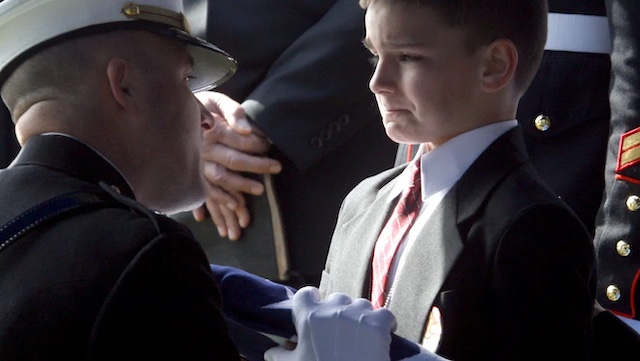
Choking back tears, biting his upper lip, 8-year-old Christian Golczynski looks into the eyes of the Marine Lt. Colonel Ric Thompson, who hands the boy the folded American flag that was draped over his father’s coffin; Marine Staff Sgt. Marcus Golczynski was killed by enemy fire in Iraq in 2007.
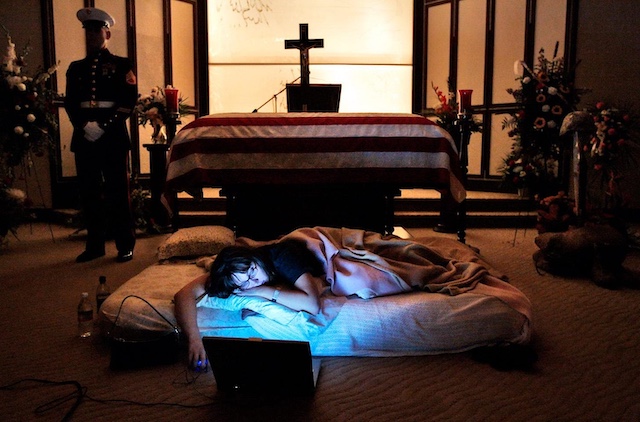
A Marine’s widow refused to leave his side in 2007. The moment was captured by Todd Heisler in this Pulitzer Prize winning photo referred to as ‘The Final Salute’. Two Marines made a bed for her, and one remained to watch over her through the night.
Aside from my father, a much-decorated U.S. Army Staff Sergeant who served during WWII, Korea and Vietnam, receiving two Bronze Stars with “V” for Valor and recommended for a Silver Star, some of those Veterans who have most influenced my life include:
* Captain Roger Donlon, a personal friend of my father and the first recipient of the Medal of Honor during the Vietnam War, who I had the privilege and honor to meet, as a young boy, at Columbia Military Academy in Columbia, Tennessee in 1968. His heroic actions in the early morning hours of July 6th 1964 read like something out of a Hollywood script, as he moved his men to action, ran ammo, killed Vietnamese sappers and stuffed a rag in his own stomach wound as he helped his wounded soldiers get to safety.
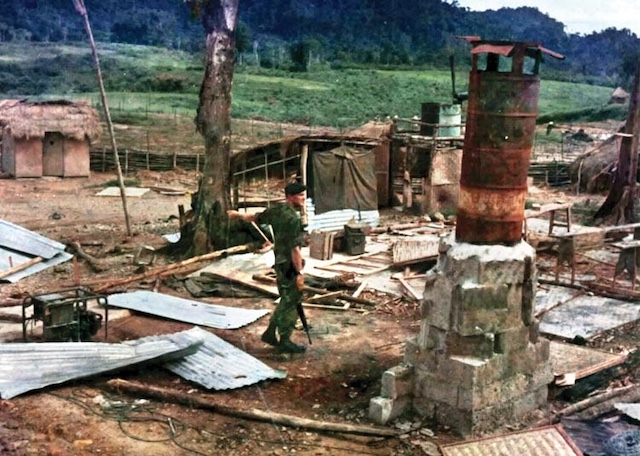
Captain Donlon surveys the Nam Dong camp two months after the Viet Cong attack. The light fortifications and minimal obstacles of early-war Special Forces camps made them vulnerable to being overrun by Viet Cong possessing heavy weapons that arrived by the Ho Chi Minh Trail.
* A.C. “Ace” Wintermeyer, a WWII U.S. Army Veteran and Chief of LaVergne Fire Department, who gave me my first real job.
* Sam Ridley, a much decorated WWII Air Force Veteran, who did many fine things for Smyrna, TN as its mayor and always had a moment for some great conversation with Smyrna’s youth. He served as a tank commander, attaining the rank of Major, under General George S. Patton, and went on to receive a Silver Star, two Bronze Stars and a Purple Heart, during WWII.
* Professor (Lt. Colonel) Ralph Fullerton, my mentor at MTSU and a former aide to the Ambassador to Nicaragua, who was one of the most adventurous, interesting and intelligent men I ever had the pleasure of knowing.
* SSGT Barry Sadler, a Vietnam Veteran and author of the ‘Ballad of the Green Beret’ and ‘Nashville With a Bullet’, who often regaled me with fascinating stories, good advice and a bit of philosophy over many a cup of coffee at Shoney’s Big Boy in Hendersonville, TN.
* Pete Doughtie, a U.S. Army Veteran of the Korean War, who owns and operates The Rutherford Reader, along with his wife Kaye, and who has been gracious enough to give me the opportunity to keep the community informed through one of the few conservative and ethical newspapers left in America.
* SSG Macon Blue, my old Drill Sergeant who had a steel plate in his head from “Friendly Fire” in Vietnam, a funny, no-nonsense motivator, often shouting out “Let your conscience be your guide young soldier” when anyone appeared to be faltering during training – then shouting out “How far” to which we all responded “All the way!” He opened a soul food restaurant in Berlin, Germany, after he retired.
Most able bodied men and a small number of women, nearly 10% of the entire U.S. population, served in the military during WWII and were on active duty by war’s end. As a result, most Baby Boomers have at least one family member who served in uniform, and approximately one-third of all Americans born since 1980 are related to someone with military experience.
Today, our Armed Forces are comprised of an undrafted, all-volunteer cadre, most of whom enlisted after the September 11th 2001 attacks on the U.S. and has included nearly 300,000 women, cut from the same cloth as Lt. Col. Courtney Rogers, a Tennessee State Legislator, Lt Col Joni Earnst, Iowa’s Republican Representative and SRA Shevontae “Smitty” Smith who served with Reaper 5 in Bagram, Afghanistan.
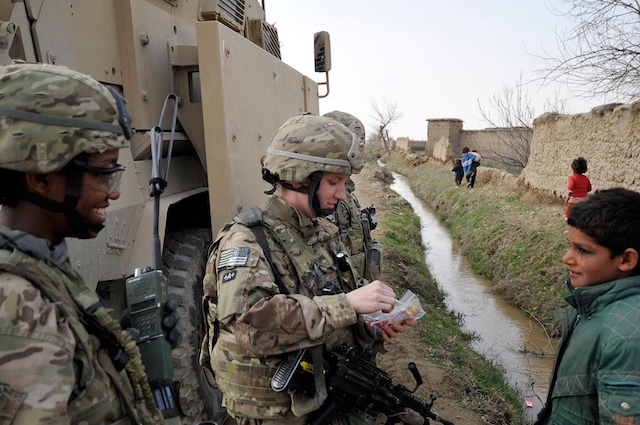
Senior Airman Shavontae Smith, 755th Expeditionary Security Forces Squadron Reaper Team 5 radio transmission operator smiles at a local boy as Airman 1st Class Kameryon Futral, 755th ESFS Reaper Team 5 fire team member, looks for a piece of candy for him during a presence patrol near Bagram Airfield, Afghanistan, March 9th 2013. Reaper Team 5 in the 755th ESFS was one of several units responsible for patrolling the nearly 180 mile security zone that surrounded Bagram Airfield. [credit, U.S. Air Force photo/Capt. Erika Yepsen]
Soldiers who fully comprehend and believe in the mission usually come home and are able to adjust well. These are the hard men in battle, living, breathing and eating combat operations around the clock. But it’s their love of family, country, and often God, and love returned that saves them from the ravages of mental anguish and Post Traumatic Stress, “battle-fatigue”, upon their return home.
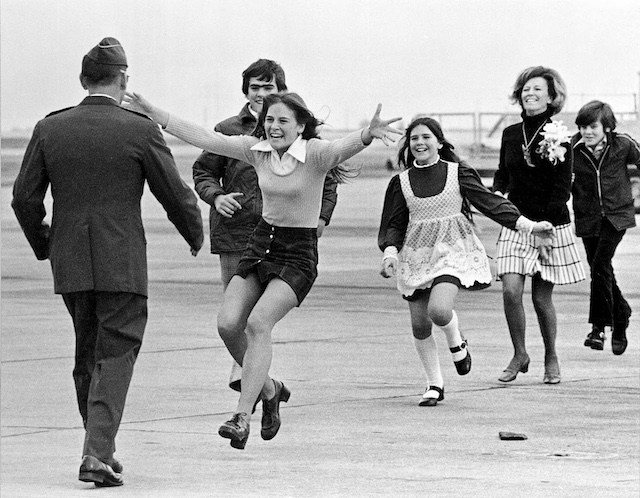
After spending more than five years in a North Vietnamese camp, Lt. Col. Robert L. Stirm is reunited with his family at Travis AFB, on March 13th 1973. [credit, Salva “Sal” Veder/ AP]
The vast majority of recent Veterans, roughly 90% according to numerous studies, are not bitter or angry. They say they still would have enlisted, even in consideration of all they now know about war and military service.
U.S. Army Sgt. David Moeller, who served two years in Iraq, told Kaiser Family Foundation in 2014: [We] “had a positive impact there. I don’t regret it. It’s something I’d do over and over again.”
America lost roughly 117 thousand soldiers fighting WWI, 417,000 in WWII and thousands of more afterwards, in Korea and Vietnam. Approximately fourteen thousand and seventy-one U.S. military and contractors have died in the Middle East and the “War on Terror” since 2001.
Since 2001, more than 3,002,635 men and women of the United States Armed Forces have deployed in support of the Global War on Terrorism, with more than 1,400,000 of them deploying multiple times, and many times before Biden’s infamous retreat from Afghanistan, America witnessed U.S. soldiers being deployed to Afghanistan to fight in a war that began before they were born.
As a society, America has traveled a long way from the early days of the draft and Vietnam, when 3000 people in Fayetteville, North Carolina were led by fifty soldiers from Ft Bragg — part of G.I.s United Against the War in Vietnam — in a protest at Rowan Park, and to many U.S. military personnel patriotism isn’t as complex a matter as so many anti-war advocates want to make it, and neither is the reason we fight. To most, in today’s all volunteer military, the mission and the need is clear as a bell; what isn’t so clear too many times is the road back into civilian life after their military career has ended, either voluntarily or due to service related medical disabilities.
Combat changes everyone. The experience of killing another human sometimes results in significant psychological changes, whether it is the justifiable killing on an insurgent or enemy combatant, or the accidental killing of and innocent bystander who happens to get caught in the crossfire — too often dehumanized as “collateral damage”. Whether it is another member of one’s unit who is blown to pieces by an IED or your closest friend who dies in your arms after a sniper round penetrates just at the edge of his protective body armor, watching people die changes you. Even if one never experiences this bloodier side of war, constantly being on the alert and acutely aware of the ever present dangers of war will change one. Everyone who is deployed to a war zone is changed by his or her experiences, and it would be abnormal if they weren’t.
After hearing by radio that his friend was shot and down during an ambush, one corpsman rushed to render aid. The event is described by former platoon leader and 1st Lieutenant Dan Gannon: “Instead of staying on the trail, he just … took off and cut across. He made about fifteen steps and tripped a mine and was killed immediately. So here I’ve lost both corpsmen and we had injuries … we had to improvise. That was a very bad day for me, because both corpsmen I was quite close to.”
Gregory Gomez, part of an elite four man team in a Marine Corps Force Recon unit and a pure blooded Apache from West Texas, recalls the numerous times they were dropped by helicopter into North Vietnamese territory, without a medic and little support. They would eat Vietnamese food, not the C-rations, so they’d smell like the enemy who often would pass just yards from their position in the dense jungle. He observed: “Everyone who has lived through something like that has lived through trauma, and you can never go back. You are 17 or 18 or 19 and you just hit that wall. You become very old men.”
Old soldiers hate war but love combat.
When an old accomplished, battle-hardened soldier first arrives home, all he can think about is being back In Country and in the thick of things. Home-life initially leaves them feeling unfulfilled, empty and without purpose, despite having their family and friends near them, and having a job. An Old War Dog has a long seemingly unshakable feeling that there is “unfinished business that needs to be taken care of” and he wants to return to fray and to “complete the mission“.
Although demanding and dangerous, the intensity of combat is rewarding in and of itself to many soldiers, and constantly living on the edge for many soldiers was the highlight of their life: Their time In Country was an experience they wouldn’t change for the world and it’s something they would happily and freely do once more — as they recall a powerful brotherhood, the bonds and friendships forged in combat that last a lifetime.
Combat Veterans are happy to have escaped injury and still be above ground, yet many feel guilty that some of their unit weren’t so lucky. Shame and guilt make them second guess decisions they made, or didn’t make, that resulted in the injury or death of a team member or civilian, and these Veterans feel guilty over enjoying life, with their feelings wavering between happiness and guilt; and sometimes depression sets upon them and interferes with their ability to function or enjoy life.
I would never minimize the pain and suffering of any Veteran, however, according to a 2015 analysis in the Annals of Epidemiology, Veteran suicides only topped civilian numbers in 2008, and they are most often seen in soldiers who had mental issues prior to their service and in Veterans over fifty years old. The analysis noted that the more time that passes between the trauma the less likely one is to commit suicide, while identifying suicide attempts before deployment as the most accurate predictor of post-deployment suicide.
The Annals suggested better screening for pre-existing mental disorders would reduce Veteran suicide, while also noting U.S. Airborne and other highly trained units in WWII had some of the lowest rates of psychiatric casualties of the entire military, relative to their number of wounded. And, in a 1968 study from the Archive of General Psychiatry, Special Forces soldiers in Vietnam had levels of the stress hormone cortisol go down before any anticipated attack, while less experienced soldiers had their cortisol levels increase.
However, even the strongest among us might succumb to the pressure cooker of multiple tours of duty and an untold number of bloody and horrific combat actions. One in two soldiers have reported to government inquiries, that they know a member of the military who has attempted or committed suicide, and over one million soldiers say they cannot control their anger.
No one person can presume to actually understand the mental and physical toll military service takes on a soldier, unless they have been where it’s real, where an IED can end your life in a second or where an old Muslim with a mild smile on his face and gentle empathetic eyes says “Allah Akbar” and detonates himself and all within a hundred-foot circumference. Unless one has hunted for the enemy along goat paths and in little mud and wood constructed towns, where an RPG can scorch a man’s flesh from his body in a second, raided a cave by moonlight taking fire all the way to extract, and lain in their own urine and defecation for three days for a high-value shot, one cannot fully comprehend the soldier’s sacrifice.
How many old soldiers live with the memories of young soldiers following their orders being blown to pieces? How many remember their own fears, panic and pleas to God as they clinched in the wake of incoming blasts and repelled human wave attacks with every last ounce of strength they could humanly muster?
In a conversation I had ten years ago as Memorial Day arrived, it was heartbreaking and shocking to hear a 90-year old WWII Veteran reminisce and say, with a voice weakened by time, “I wish I’d died over there.” I told him his life and his experiences were valuable to his family and this generation, and that he was loved by me and millions of other Americans, who understood he had laid it all on the line in the name of freedom. His only answer was a nod of his head, a half-smile and tears welling in his eyes.
How many old soldiers returned home only to send their sons off to war to fight and survive or return in a flag-draped coffin?
The most severe and debilitating injury afflicting our returning soldiers is Traumatic Brain Injury (TBI) generally received by being too close to an Improvised Explosive Device when it was detonated. The lingering effects of such an injury, in tandem with Post Traumatic Stress Disorder and haunting memories, places a soldier in an unimaginable struggle and makes any attempt to start his post-war civilian life a daunting challenge; and, he most usually has a hard time holding down a job and has a drinking habit that is accompanied by hallucinations of his best friend who died in the war. And he drinks like it is his job to try and block out his troubling memories.
Although it is impossible to gauge accurately and equally hard to imagine someone who served America in the military living on the streets, many experts and studies estimate approximately 50,000 Veterans are still homeless on any given night in the United States of America. In conjunction, a recent Department of Defense report states that 383,947 Veterans have been diagnosed with war related Traumatic Brain Injuries (TBI), since the year 2000. And in 2015, a Veteran Administration Inspector General’s report revealed that 307,000 Veterans died awaiting approval on healthcare claims.
Veterans tend to dig their own graves, going too far before they realize their mistake and the result of their own self-destructive behavior. So, while many dig their own hole without even knowing it, many of us in the military community and the community in general can implement the old OODA Loop concept of Observe, Orient, Decide and Act in order to offer assistance to those Brothers and Sisters in need.
Get rid of the parades and replace them with a community ceremony on Veterans Day attended by citizens, who are willing to give meaning to the words “I support the troops”, showing up at town halls across the land to hear our Veterans speak about the war, their own particular wars. Some Veterans will be proud of their service, some will be angry, and some will be unable to speak as tears flow down their face. A community ceremony like that would finally return the experience of war to our entire nation, rather than just leaving it to the people who fought.
This Memorial Day and every day forward, take a few moments, whenever the opportunity presents itself, to offer the most sincere, well-thought thanks to the men and women of our U.S. Armed Forces, with more than just a smile and a handshake. Offer a friendly ear on occasion and really listen. Offer a helping hand to those Veterans struggling to re-enter civilian life, and offer friendship to all of these brave men and women. And, as we acknowledge that so many have sacrificed their lives defending America, the U.S. Constitution and freedom and liberty worldwide, we offer our prayers for all the U.S. Armed Forces, who protect this nation’s existence each and every day, and we pray for America.
Since our nation’s founding, the strong independent nature of the American people carried over into the military, which enabled America to pursue her best interests and to become the most benevolent, strongest and wealthiest nation in the world. The wheel of destiny has turned so that any hope for peace and freedom will hinge on America’s moral courage and a U.S. military that ensures “peace through strength.”
All of Our U.S. Veterans past and present have been great friends to someone, recognized as great soldiers, American through and through. Valiant soldiers, their service, bravery and strength of character represents the principles and virtues that built America, and I salute them, each and every single one for defending and protecting our country, the Land of the Free and the Home of the Brave — their service to which I will never forget and much time spent in harm’s way — together Brother, together Sister.
They lived, they fought. And for their country’s sake they died, from Argonne to Berlin and from Kabul to Ramadi and Fallujah – in Kuwait, Saudi Arabia and Iran now.
Looking out across our fathers’ graves, and taking liberties with Kipling’s words, the astonished years reveal the remnant of our country’s patriots whose blood, guts and steel defended America, and we think on those fine Americans we have lost with tears in our eyes that none will scorn, and one more service we dare to ask. Pray for us, heroes, pray, that when Fate lays on Us our task, We do not shame the day.
Memorial Day 2026
Justin O. Smith ~ Author
~ the Author ~
Justin O. Smith Has Lived in Tennessee Off and on Most of His Adult Life, and Graduated From Middle Tennessee State University in 1980, With a B.S. And a Double Major in International Relations and Cultural Geography – Minors in Military Science and English, for What Its Worth. His Real Education Started From That Point on. Smith Is a Frequent Contributor to the Family of Kettle Moraine Publications.